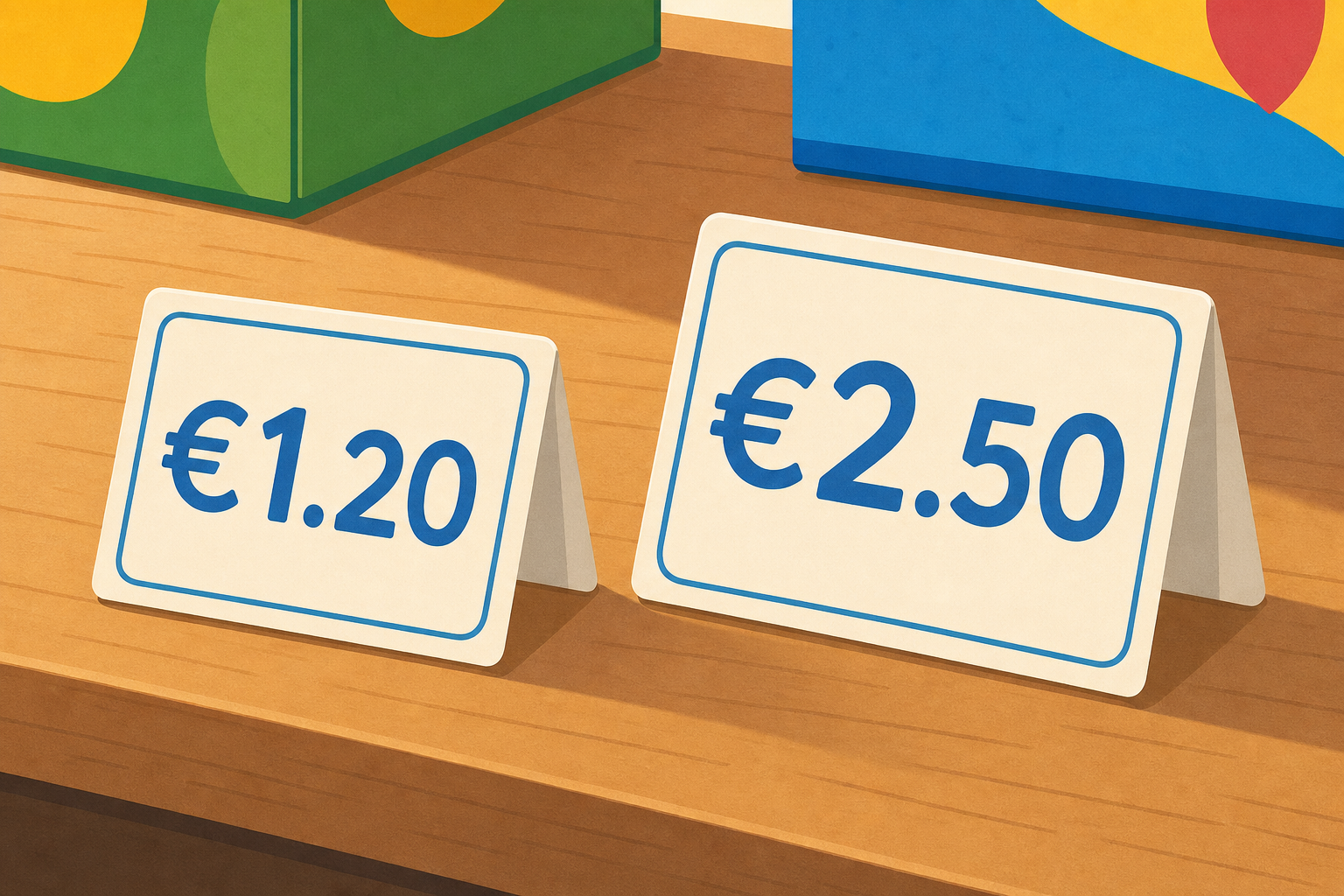
Here are two shop prices: €1.20 and €2.50. Look at the part after the point on each one. What do you think those two little digits are counting — and what does the €2.50 really mean when you say it out loud?
Display the two prices side by side as pupils settle. Take three hands-up answers, not open call-outs. You are only fishing for the idea that the digits after the point are the cent — the naming as hundredths comes in the next step, so don't correct or extend yet.
Three trays of coins are on screen, each with an amount to read. The two digits after the point count the cent, and there are one hundred cent in every euro. Look at the cent part of each amount as we name it as a fraction of a euro.
€1.50: €1 coin and 50c. One whole euro plus 50c, which is half a euro, so one and a half euro.
€0.25: coins (20c + 5c) add to 25c but don't look like a quarter — use a fraction wall beside the tray, point to the one-quarter piece as you say 25 out of 100 cent is one quarter.
Take the hands-up prediction before moving on: if a quarter is 25 cent, how much is half a euro? Wrong guesses are fine.
All three trays show at once — create the reveal by moving your finger, not by the screen changing.
€2.75: two whole euro plus 75c left over. 75 out of 100 cent is three quarters, so two and three-quarter euro. The cent part is always a fraction of just one euro.
Metre parallel: hold up a real one-metre length. State one metre is 100 centimetres, just as a euro is 100 cent. Fold it in half in front of the class — each part is 50cm, half a metre, the same as €0.50 is half a euro. Cent and centimetres are both hundredths of one whole. Do this physically before pupils convert on paper.
Let's build four amounts together on the coin tray and read each one two ways — as a decimal, then as a fraction of a euro: €0.50, then €1.30, then €0.75, then €3.05. The €0.50 lands exactly on half a euro, and the €3.05 has a tricky zero we will say aloud before we check it.
This round is for talking it through together — pupils take turns at the board and the class agrees or corrects out loud.
Call each amount, send an individual pupil to drag the coins, and have the class read the total two ways: the decimal (zero point five zero) and the fraction (half a euro). To keep the watching rows thinking, before each pupil drags ask the class which coins will we need, and how many? and take two hands-up answers. Watch for the zero in €3.05 — pupils often drop it and read three-fifty; say three euro and five cent aloud first. Rotate four pupils.
In your maths copy, write €0.50 as one half of a euro and €0.25 as one quarter of a euro. Then write 0.5 m as fifty centimetres. Say each one to yourself as you write it: half a euro, a quarter of a euro, half a metre.
Walk the room and glance that pupils have paired each amount with its fraction and that 0.5 m is matched to fifty centimetres — this is whole-class copybook practice, not marking.
Let's work through four money and measure problems together, each a step harder than the last: add up two 60c snacks; find the change from a €5 note for a €3.50 book; work out how much less 75 cent is than a full euro of 100 cent; and change 0.3 m into centimetres. The last one reminds us that centimetres are hundredths of a metre, just like cent are hundredths of a euro.
These are the practice questions — pupils take turns at the board, check each answer, and the class confirms before moving on. Keep the board work brisk rather than over-explaining.
For the change question, count on from €3.50 up to €5 aloud with the class. For the 75-cent question, revoice: a whole euro is 100 cent, so 100 take away 75 leaves 25 — that is what is missing to make a full euro. For the metre question, revoice: each tenth of a metre is 10 centimetres, so 0.3 m is 3 tens, which is 30 centimetres. Individual pupils solve each while the rest predict and call out.
You're previewing this lesson. Get full access to this lesson and hundreds more — each one ready to teach, with interactive activities, printable resources and pupil progress tracking built in.