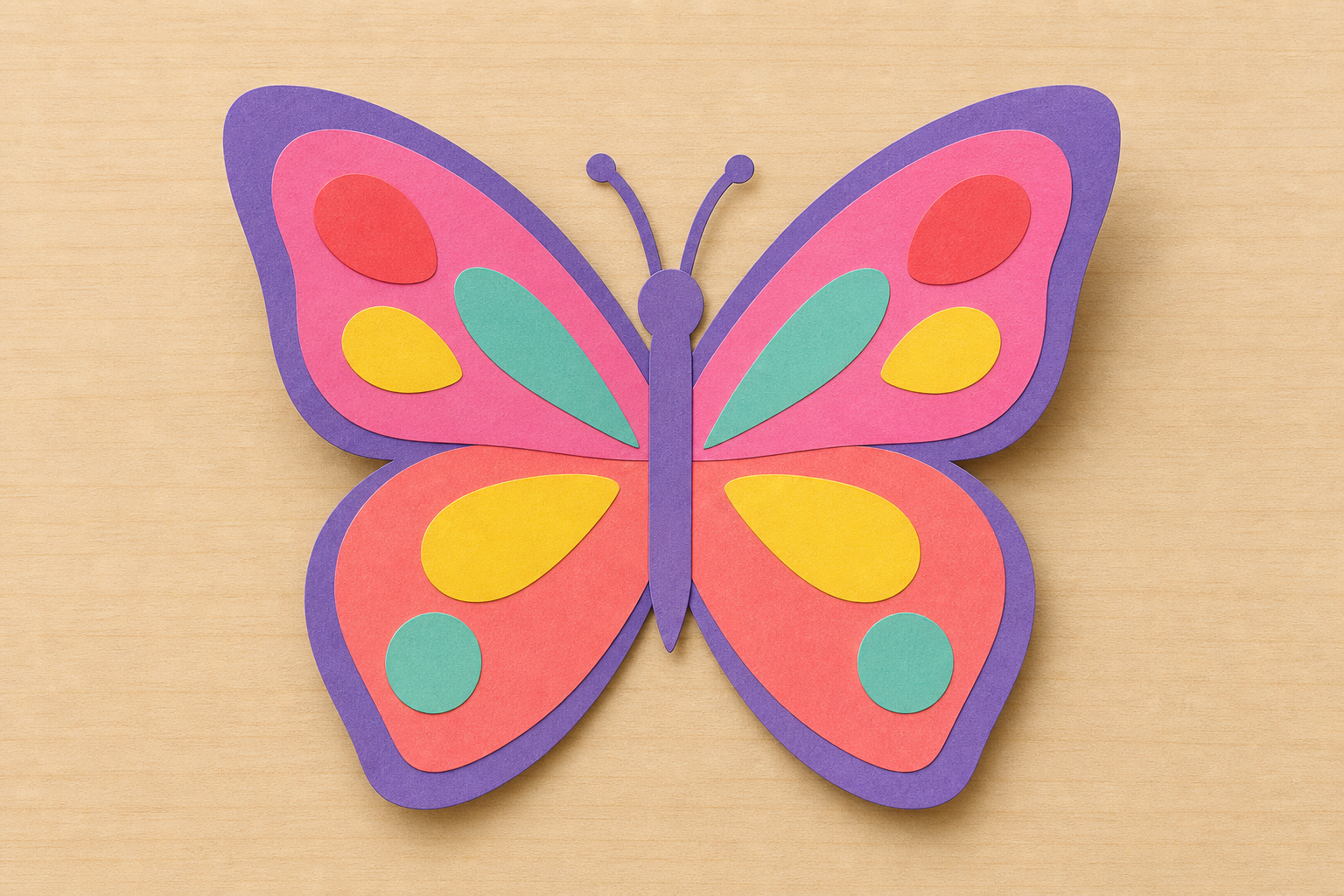
Look at this paper butterfly. If we folded it right down the middle, both wings would land exactly on top of each other.
Where else could you fold a shape so the two halves match perfectly? Have a think before any hands go up.
Give five seconds of quiet think-time before any hands go up. Take two or three hands-up answers, not open call-outs.
If you have a real paper butterfly or a folded heart to hand, hold it up and fold it slowly so the class sees the wings meet. Otherwise the photo carries the idea.
Watch the shapes fold on the board. When a shape folds so both halves land exactly on top of each other, that fold is a line of symmetry, also called a mirror line. Watch how many ways each shape folds to match.
So some shapes fold to match in lots of ways, and some only fold to match once.
Square: board shows the up-and-down fold, both halves land exactly on top. Hold up a paper square, fold it side to side and corner to corner, ask each time whether both halves land exactly on top. They do, so a square has four lines of symmetry.
Triangle with three equal sides: hold up a paper triangle, fold from each corner to the middle of the opposite side, all three match. Your demonstration that a shape can have more than one line of symmetry before pupils try it.
Letter A: board shows the one true fold down the middle, halves match. Deliberately try a slanted fold, ask whether the halves match. They miss. Key point: a fold is only a line of symmetry when the halves cover each other.
Each shape is drawn for you on the grid. For each one, decide where it folds so that one half lands exactly on the other, choose those folds, and check. We work through a letter T, a rectangle, a square and an L-shape — and one of them has no fold at all.
Not every fold goes straight up and down. The square has folds corner to corner as well.
This round is for talking it through together — pupils take turns at the board and the class agrees or corrects out loud.
Call one pupil up at a time to drag the mirror line on the tool. Before checking, ask the rest of the class: do you think the halves will match on that line? Then reveal and let the class confirm or correct.
Then take a paper rectangle and a paper triangle with three equal sides. Fold the rectangle side to side (a true line) and corner to corner (the halves do NOT match — a useful contrast). Fold the triangle from each corner to show its three lines. These folds are not straight up and down, so we do them on paper rather than on the up-and-down tool.
Keep revoicing the test: a real line of symmetry, or mirror line, makes the halves cover each other.
In your maths copy, draw a square and a rectangle. Then use your ruler to draw every line of symmetry you can find on each one.
Underneath each shape, write how many lines of symmetry it has.
Walk the room glancing at whether pupils are using a ruler and whether their lines pass through the middle — no individual marking, this is whole-class copybook practice. Watch for pupils who give the rectangle four lines; the corner-to-corner folds do not match for a rectangle, so it has just two.
Today we work through these shapes together: a heart, then a rectangle. For each one, find the lines of symmetry, the folds where both halves match exactly.
At the end we will think together about a circle. How many ways could you fold a circle so the halves match?
These are the practice questions — pupils take turns at the board, check each answer, and the class confirms before moving on. Keep the board work brisk rather than over-explaining.
After the tool work, finish with a quick spoken discussion: hold up or sketch a circle and ask how many folds would match. The class agrees a circle has far too many to count — any fold through the centre works. Callout to use: is the slanted fold a real line of symmetry, or do the halves miss each other?
How can you test whether a fold is a true line of symmetry? What must the two halves do?
Listen for pupils naming the test in their own words: the two halves must land exactly on top of each other. Revoice a strong answer: so a fold is only a line of symmetry when one half covers the other perfectly. Head off the idea that any straight line down a shape counts — the slanted fold on the rectangle showed it does not.
Next we will use the mirror line to complete symmetrical pictures, building the matching half square by square.
Keep this brief. Recap the matching-halves test once more before moving on, and remind the class that the line of symmetry is the same thing we will call the mirror line next lesson.
You're previewing this lesson. Get full access to this lesson and hundreds more — each one ready to teach, with interactive activities, printable resources and pupil progress tracking built in.