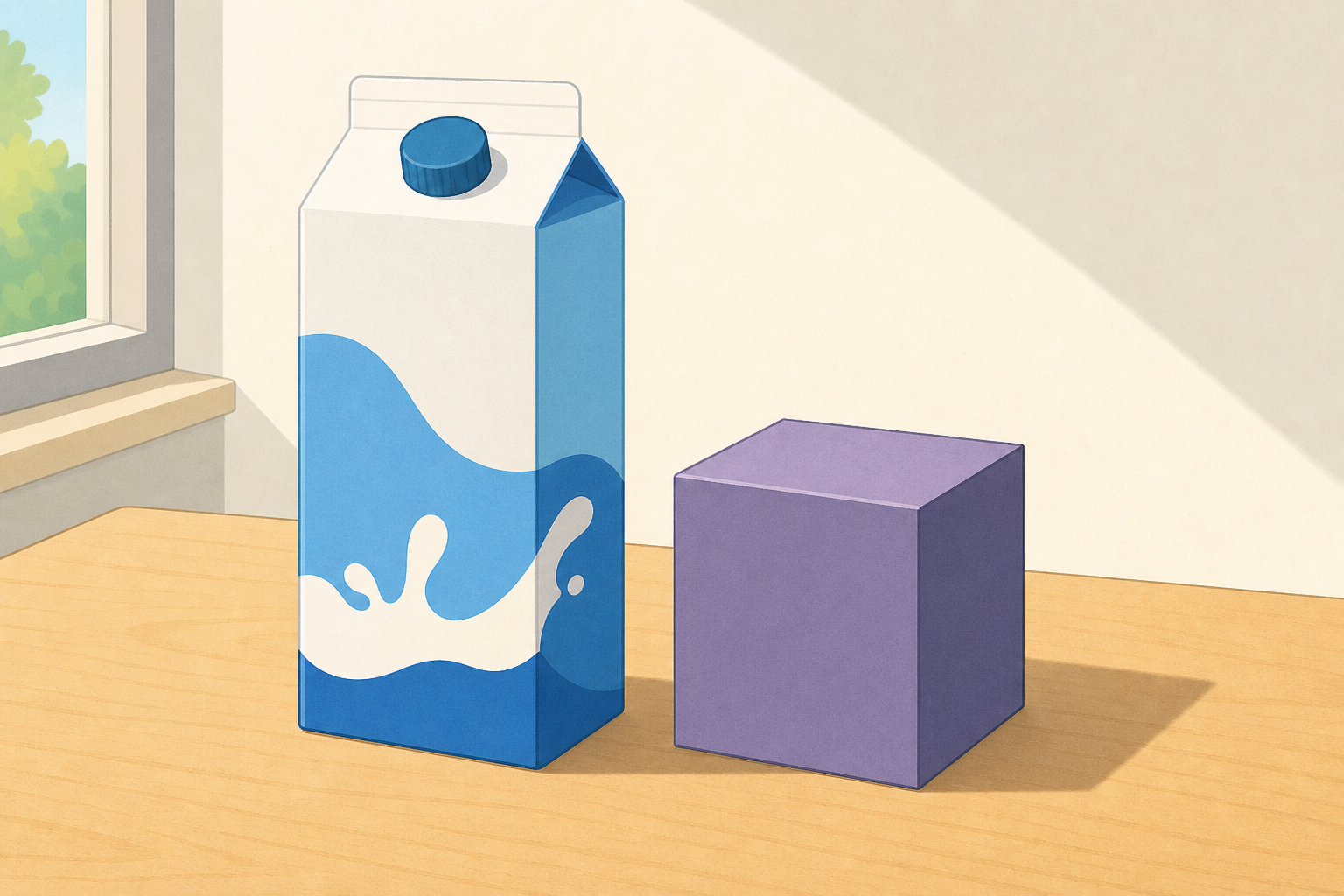
Here is a 1 litre carton of milk, and beside it a solid cube that measures 10 cm along every edge.
Hands up: do you think these two hold the same amount of space inside, or is one bigger than the other?
Show the carton and the 10 cm cube side by side (or the images) as pupils settle. Take three hands-up answers, not open call-outs. Hold the reveal for Watch and Notice.
Listen for pupils who say the carton "looks bigger" because it is taller. That hunch is exactly what this lesson unpicks.
Watch the two boxes and the converter on screen. The two boxes look completely different but hold the same amount — see if you can spot what stays the same. Then watch how one litre turns into millilitres, and think about what the very last step to cm³ should be.
First box, 10 cm cube: point to each 10 cm edge, ask the class what 10 × 10 × 10 comes to before naming 1,000 cm³ = 1 litre.
Second box, 20 × 10 × 5: different shape, same 1,000 cm³, same litre. Pause and let a pupil say why before confirming.
Converter: litre to ml is three × 10 steps = × 1,000, so 1 litre = 1,000 ml. It stops at ml.
Last rung is in their heads: 1 ml = 1 cm³, so this step is × 1 and the number doesn't change. That makes 1,000 ml = 1,000 cm³, so 1 litre = 1,000 cm³.
Remember our rule: 1 ml fills exactly 1 cm³, so those numbers are always the same. When a job is written in cm³, we swap it for the same number of ml in our heads, then use the converter. Before we check each one, we say out loud whether we multiply or divide, and by what.
Talk this one through together — pupils take turns at the board and the class agrees or corrects out loud.
Set the converter to volume. The converter works in l/ml only, so before the cm³ job the class swaps 2,500 cm³ for 2,500 ml (they are the same size), then divides by 1,000 to reach 2.5 litres. For each value, ask "multiply or divide, and by what?" before a pupil drives the chain.
In your maths copy, write each value below twice, side by side: once as a volume in cm³ and once as a capacity in litres or ml. Between the two, draw an arrow and write "÷ 1,000" or "× 1,000" to show the step.
Now write one extra line on its own: 250 ml = 250 cm³. Draw the arrow between them and write "× 1", because ml and cm³ are the same size, so the number stays the same.
Walk the room and glance for the arrow labels — is the pupil showing × 1,000 or ÷ 1,000 correctly on the litre lines? Check the extra line separately: the 250 ml = 250 cm³ arrow should read × 1 with the same number on both sides. This is whole-class copybook practice, not marking.
Today we work through these on the board. Say whether you multiply or divide before each one.
This is the practice round — pupils take turns at the board, check each answer, and the class confirms before moving on. Keep the board work brisk rather than over-explaining. The converter works in l/ml only, so swap the cm³ value for the same number of ml before feeding it in (they are the same size): 3,000 cm³ becomes 3,000 ml, which divides by 1,000 to give 3 litres.
The converter cannot do the multiplication for the fish tank, so work out its volume on the board first: 30 × 20 × 25 = 15,000 cm³. The challenge card is pre-loaded with 15,000 ml so pupils see where the number came from. Then divide by 1,000 to reach 15 litres. Let a pupil predict the litres before the divide.
You're previewing this lesson. Get full access to this lesson and hundreds more — each one ready to teach, with interactive activities, printable resources and pupil progress tracking built in.