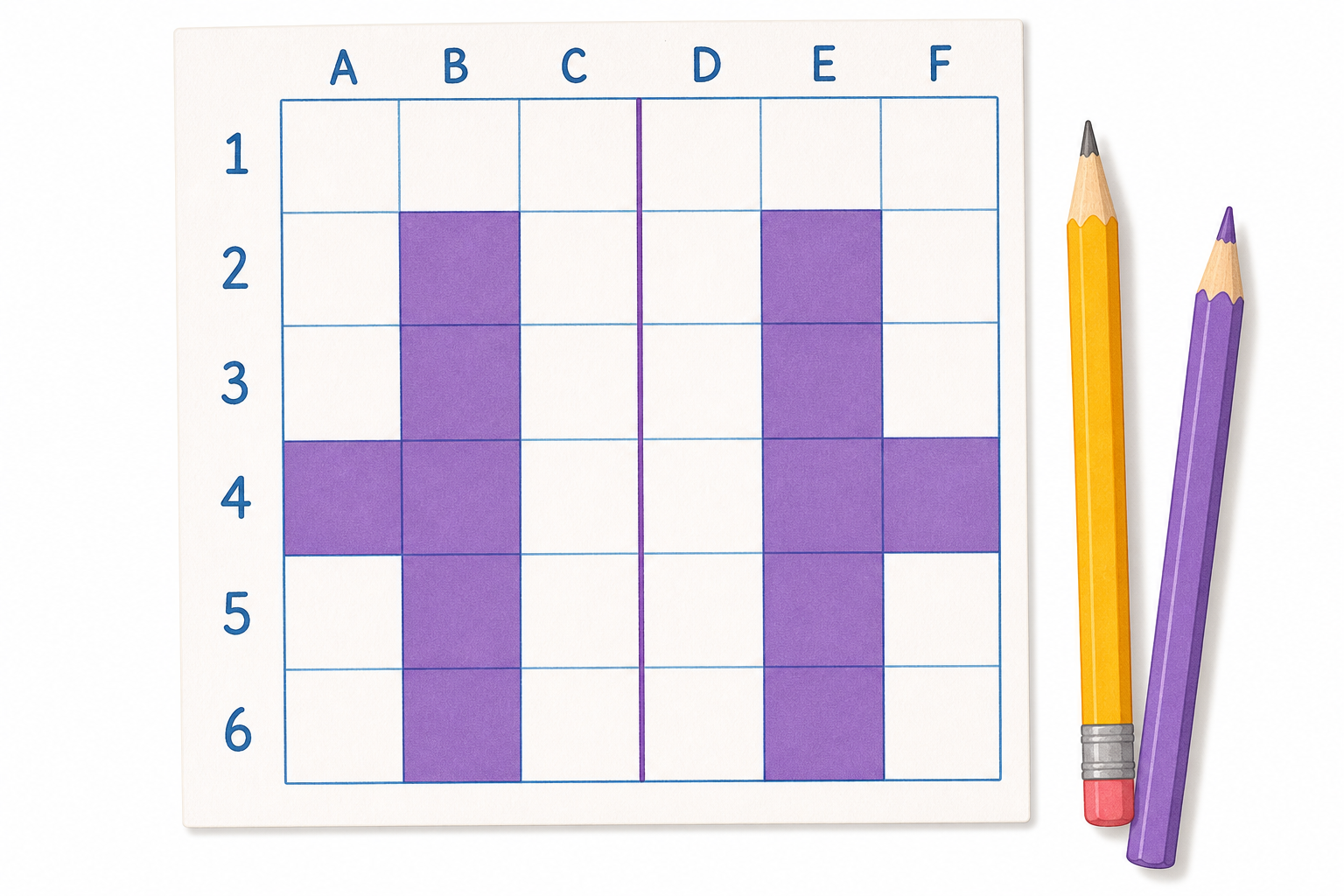
Look at this design on the board. It was built on a squared grid. Can you spot a reflection, a slide, or a matching half?
Today you become the designer. You will make a secret picture on a grid, then write directions so exact that a classmate could copy it without ever seeing it.
Show the pinned design for ten seconds, then take two or three hands-up answers on what pupils notice. Don't name the transformations for them yet.
We will look at one shape shown two different ways. First it is reflected, flipped like a mirror. Then it is slid, moved along without turning or flipping. Notice what stays the same each time, and notice how the grid reference changes.
First snapshot, reflection: ask what changed before naming it. Flip keeps size and corners the same; only the facing changes.
Second snapshot, slide: hold out for the difference — a slide keeps the shape facing the same way, only position moves. Revoice a strong answer: reflection flips it, a slide does not.
Use B3-style language throughout so pupils hear the change in the words they must use: corner started at B2, after the flip it is at E2.
Worked reference, reflection: B2 across the line between column C and D. B is two squares left of the line, so it lands two right, at E2. Letter jumps B to E, row stays 2. Method: count squares from the mirror line.
Worked reference, slide: same B2 slid three right. Add three to the letter — B, C, D, E — lands at E2. Method: add to the letter for a slide right.
Both land at E2, so stress HOW they get there, not a different destination.
Today we complete a symmetrical house together on the interactive. The mirror line runs straight down the middle, between columns C and D. We only build the left half. When you tap a square, its matching partner appears the same distance away on the right.
Work through the house in this order. Say the grid reference out loud before each tap, letter first.
After each tap, check the partner landed the same number of squares from the mirror line. Then read the new grid references together.
Talk this one through together. Pupils take turns tapping; the class predicts the partner square before it appears.
Worked house, vertical mirror between C and D (B pairs with E, C pairs with D; row stays the same):
Method each time: count squares from the mirror line, then the same count the other way. Example: B is two squares left of the line, so it lands two right at E on the same row.
Watch for the common slip: a square on the mirror line stays put, it is not doubled. Revoice: every shaded square is the same number of squares from the line as its partner.
This is your design challenge. On your labelled grid you will make a secret picture, then describe it so exactly that a classmate could redraw it.
First watch how a clear set of directions looks. Here is one finished example on the board:
Notice the order: starting place, what transformation, then the new references. That is the pattern you will use.
Get as far as you can. Even finishing step one is great.
Can you make a secret grid picture and describe it exactly enough for a classmate to copy?
['Shade a small shape on your labelled grid and list the grid reference of every square (letter across, then number).', 'Reflect the shape across a chosen mirror line and write the grid references of the reflected squares.', 'Slide the shape three squares along and write the grid references where it lands.', 'Extra: design a symmetrical secret picture, then write directions and grid references precise enough for a classmate to redraw it without seeing it.']
Ways to start:
Stretch:
Record: labelled squared paper plus a written list of grid references and directions
Share back: swap grids and try to redraw a classmate's picture from their written description alone
This is individual paper work at the pupils' seats, not an on-screen interactive. Every pupil works on their own labelled grid. The four prompts rise in difficulty, so everyone starts at the first and the strongest reach the fourth as an extension.
Before they begin, put the worked directions on the board and talk them through once: Start at B2. Reflect across the line between C and D (count squares from the line: B is two left, so lands two right at E2). Then slide three right (add three letters: B to E, E to H). End references E2 and H2. Stress the order: starting grid reference, transformation type, new grid references.
The four coreProblems below carry worked answers, use them as your exemplars when you circulate so you can check pupils' references quickly. Prompt for the grid-reference order: letter across first, then the number. Watch for pupils who slide and turn at once; a slide keeps the picture facing the same way. Also watch for directions that name only the end squares and skip the starting place or the transformation type.
Keep the board free of pupil work during this step. The redraw-from-directions test happens in the wrap-up, not here.
In your maths copy, draw a small 4-by-4 grid on squared paper. Label the columns A, B, C, D across the top and the rows 1, 2, 3, 4 down the side. Shade any shape you like, then write the grid reference of each shaded square underneath, letter first.
Walk the room glancing at the column letters and row numbers and the letter-first order — this is whole-class copybook practice, not marking.
You're previewing this lesson. Get full access to this lesson and hundreds more — each one ready to teach, with interactive activities, printable resources and pupil progress tracking built in.