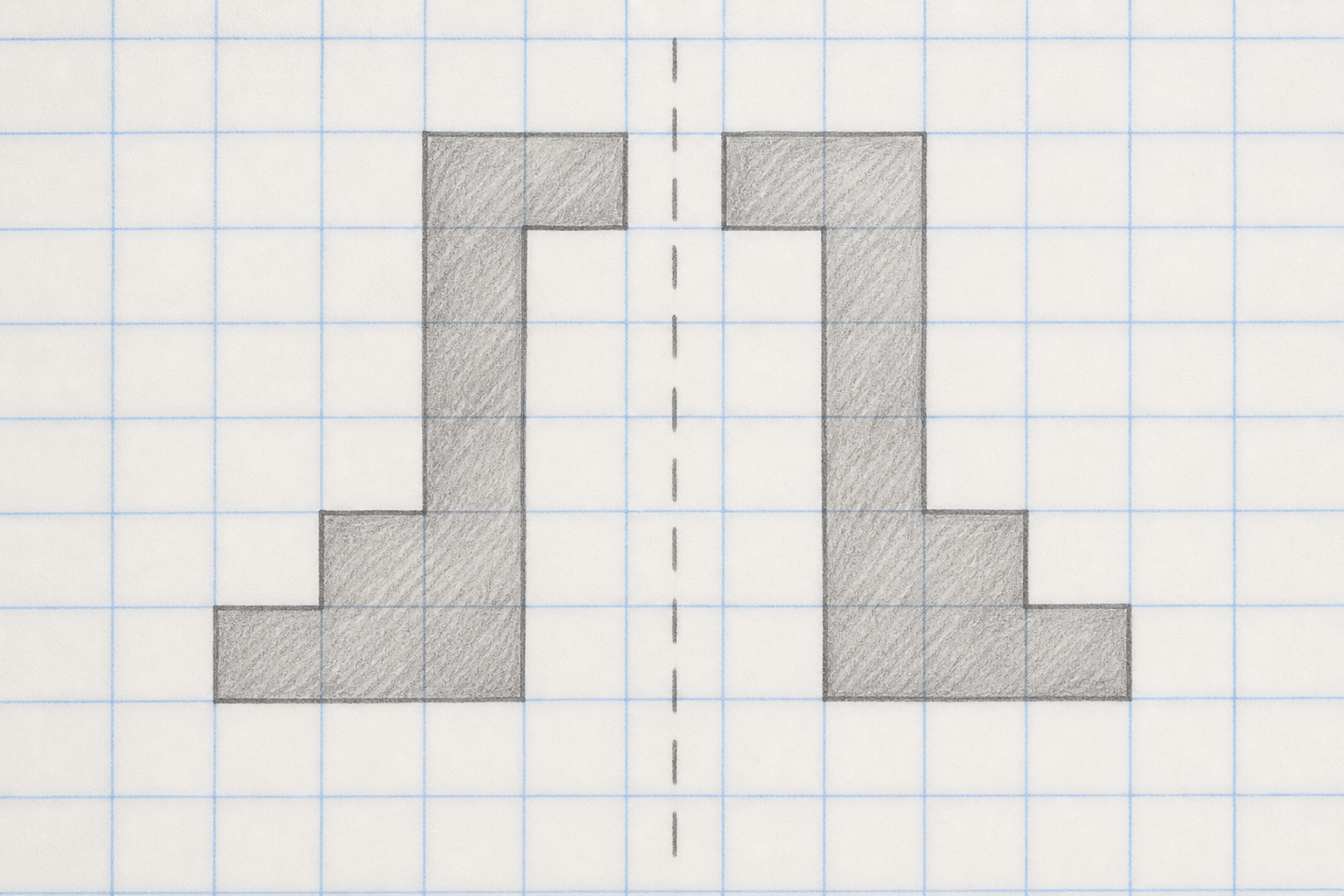
I have a tile design on the grid. It was built by flipping and sliding one small shape, and it has a mirror line down the middle.
Which moves do you think made it: flips, slides, or turns? And where on the grid do you think each piece sits?
Bring the finished symmetric design up on the IWB grid and take three hands-up answers. Don't confirm anything yet, just gather the vocabulary the class already has (flip, slide, mirror line, across, up).
Listen for whether pupils reach for grid-reference language on their own; you will build on it in the next step.
First, watch a symmetrical design on the grid. Notice how each shaded square on the left has a matching square the same distance on the right of the mirror line.
Now watch three points on the co-ordinate grid. We read each one across first, then up, and we write it as (across, up).
On the symmetry snapshot, run a finger from a left square across to its mirror partner and say same distance, opposite side. Read the grid reference of two shaded squares out loud as across first, then up so the class hears the order even though the tool stores squares as row and column.
Pause between the two snapshots: ask who can tell me a square on the left and its mirror partner on the right? before moving on, so the class settles the symmetry idea before the points appear.
On the co-ordinate snapshot, pose a quick question before you read each dot: who can tell me its reference, across first? Take one answer, then read it back three across, two up. Hold out for the across-first habit — this is the slip that ends the year's location work in the wrong square.
Here is point A on the grid. First, look at where a vertical mirror line could sit so the point would flip neatly onto its match.
Then look at point A. What is its grid reference, across first? And if you flipped the point across the mirror line, how many squares would it land on the other side?
If you are not at the board, call out the point's reference aloud, across first, before we check it together.
This round is for talking it through together — no marking yet. Take hands-up answers and revoice.
On the co-ordinate grid, point A is already plotted. Ask pupils to suggest where a vertical mirror line could sit so the point would flip onto a match, then agree the reference of point A across first, then up.
Then take two predictions for how far the point lands after a flip, and check by reflecting it on the grid. Revoice: the point has to be the same number of squares from the line on each side.
Today we work through these together on the co-ordinate grid. Our mirror line is the vertical line at 5 across. Each time, say the reference aloud, across first, before you plot it:
If you are not at the board, call out the new reference, across first, before the pupil at the board taps it in.
This round is for talking it through together — no marking yet. Pupils take turns at the board and the class agrees or corrects out loud.
Say the mirror line is at 5 across and trace the vertical line each time so pupils count squares from a line they can picture, even though it is not a plotted point.
Individual pupils come up to plot each point; the rest of the class calls the new grid reference before the pupil taps. Reconcile any disagreement about across-versus-up on the spot.
Watch for the reflection slip where pupils count from the shape rather than from the mirror line. Revoice a good answer: so the corner has to be the same number of squares from the line on each side.
In your maths copy on squared paper, design your own small symmetrical pattern on a grid. Draw a mirror line first, then shade one half and mirror it across the line.
When your pattern is finished, label the grid reference of three of its squares, writing each one across first, then up.
Walk the room glancing for the mirror halves matching and for across-first references. No marking — this is whole-class copybook practice, not assessment. Nudge any pupil whose reflected half is a slide, not a flip.
You're previewing this lesson. Get full access to this lesson and hundreds more — each one ready to teach, with interactive activities, printable resources and pupil progress tracking built in.