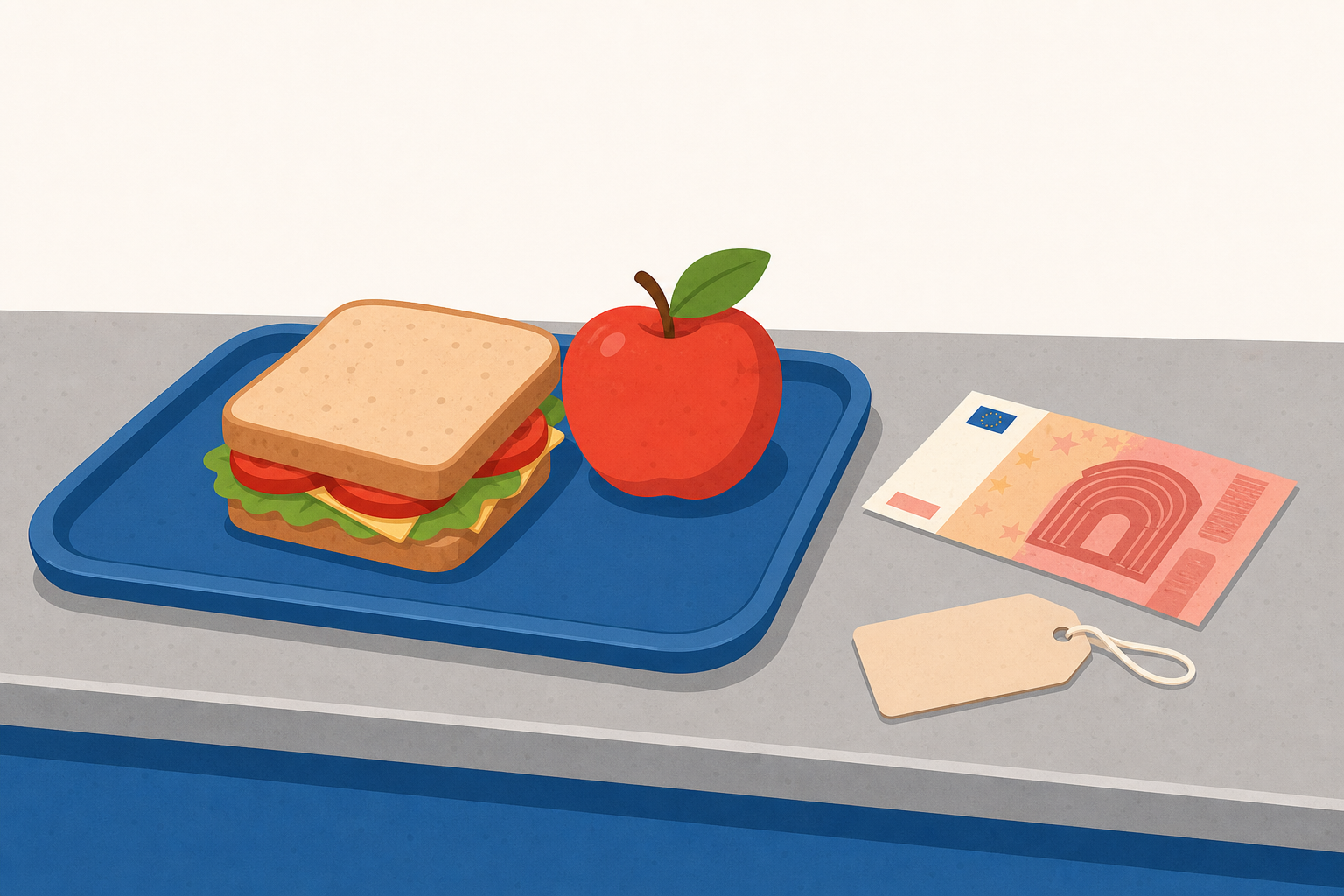
You buy your lunch and it comes to €6.55. You hand over a €10 note. Hands up: what change should the shopkeeper give you back, and how did you work it out in your head?
Take three hands-up answers, not open call-outs. Listen for whoever counts UP from €6.55 versus whoever subtracts €6.55 from €10 — you'll come back to both. Don't confirm the answer yet; the interactive will.
Watch four change amounts already built on the coin-counter tray. Each one shows the change owed for a different bill and cash paid. Notice how each change is made with the fewest coins and notes — always the biggest coin that fits first.
For the first one, watch how we count on from €6.55: 45c gets us to €7, then €3 to €10 — that's €3.45.
The next one is change from a €20 note. We count on from €13.85: 15c gets us to €14, then €6 to €20 — that's €6.15.
The next one is small change from a €5 note. This change ends in 73c — an amount that doesn't land neatly on a round euro. Hands up: looking at the tray, which small coins make it, and why can't we use fewer? (A few little coins are still needed here, that's expected.)
The last one is change from a €50 note, so we build it with notes first and then the coins.
For each tray, point at the coins from biggest to smallest and count aloud with the class to confirm the total matches the change. On €3.45, ask the class to count ON from €6.55 first (45c gets you to €7, then €3 to €10) before checking the tray — this is the strategy the lesson turns on.
The €1.73 tray is where fewest-coins gets fiddly (the 2c and 1c). Ask why can't we do this one with fewer? and let a pupil explain the awkward 3c.
In your maths copy, work out each change by counting on from the bill. Write down every hop you make, like this:
Do the same for these three bills and the cash paid: €5.70 paid with €10, €2.35 paid with €5, and €12.15 paid with €20. Write the total change at the end of each one.
Walk the room glancing for the count-on steps written down, not just a final answer — this is whole-class copybook practice, not marking. Watch for pupils who jump straight to the round number and lose the middle step; nudge them to write the hop to the next whole euro first.
If you printed the 'Making Change: count-on worksheet', pupils can record their hops directly on it instead of the copybook; otherwise the copybook layout above works on universal kit.
Today we work these out together on the tray. We reuse the same tray for each amount in turn. For each one, count on from the bill, build the change coin by coin, then check the total:
Talk this one through together — pupils take turns at the board and the class agrees or corrects out loud.
For each amount, get the class to count ON to the change first (€5.70 → €6 → €10 gives €4.30), then send one pupil to build it. The rest of the class predicts the biggest coin needed before the pupil taps it. Revoice a strong answer: so the 30c gets us to a round euro, then the euros are easy.
Today we build the change for each of these. Count on to find it, then build it and check:
This is the practice round — pupils take turns at the board, check each answer, and the class confirms before moving on. Keep the board work brisk rather than over-explaining.
The €1.73 build is the tricky one (the awkward 3c needs a 2c and a 1c) — expect a pause there. The €17.60 stretch mixes notes and coins; ask the class which note goes down first. Use the Check tick as part of your narration: yes — that's it.
You're previewing this lesson. Get full access to this lesson and hundreds more — each one ready to teach, with interactive activities, printable resources and pupil progress tracking built in.