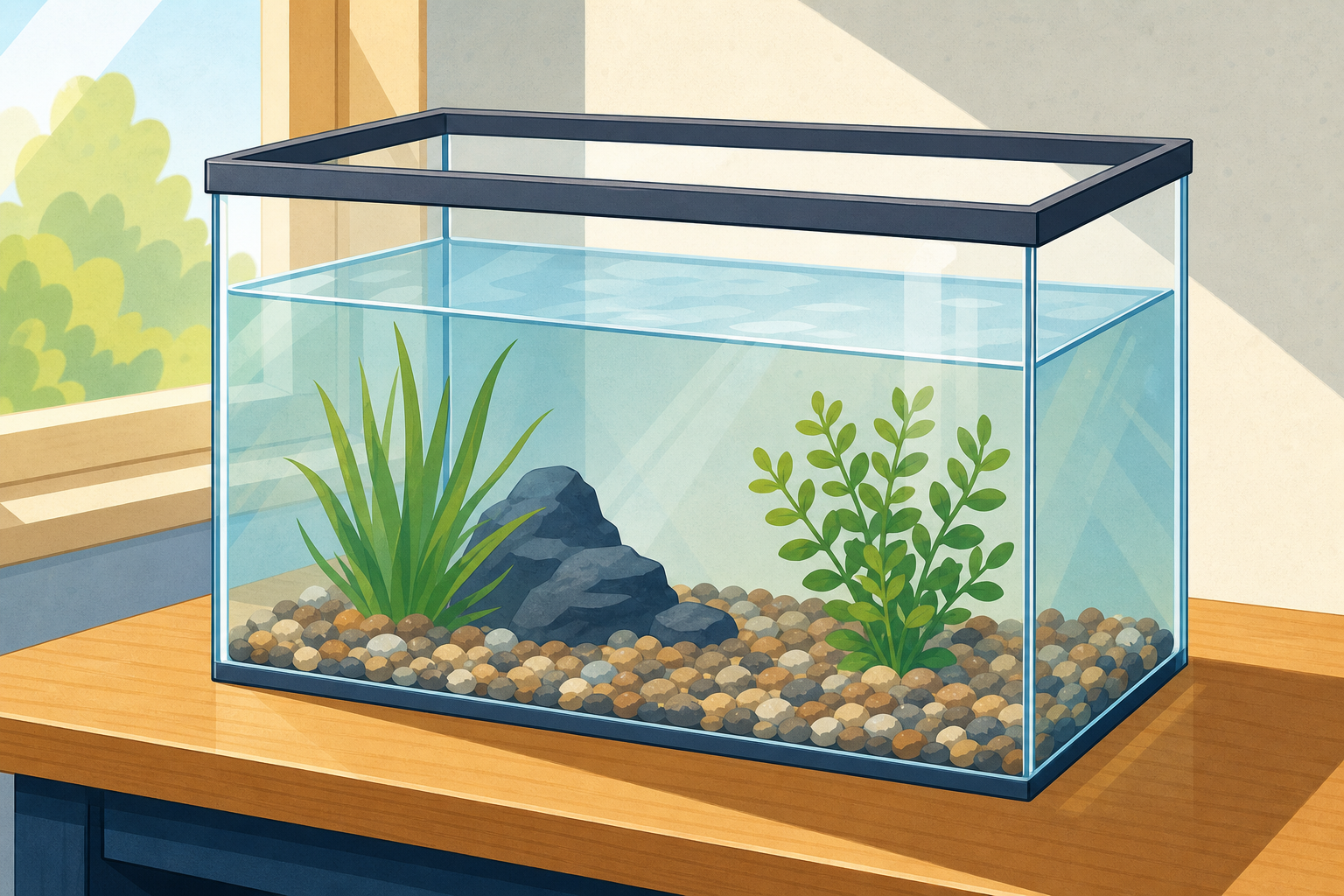
Imagine we're designing a fish tank for the classroom. Before we buy anything, we need to know a few different things about it.
Which of these do you think we'd have to measure: how much metal to make the frame around the top, how much glass to cover the sides, or how many litres of water it will hold?
Watch one design problem worked right through. We use several kinds of measure, and we choose the unit to match what we measured, watching for squared units on a surface and cubed units on a solid.
Together we design a small storage box and work out three things about it, in this order: the length of tape to seal every edge of the base, the area of card for the four sides, and the volume it holds. Our box is 20 cm long, 10 cm wide and 15 cm tall.
For the four sides, split them the way we did with the tank: two big faces are each 20 cm × 15 cm, and two small faces are each 10 cm × 15 cm. Double each area, then add.
I'll put the box in the measuring tool on screen, read the volume it shows, then check each measure by hand. Your job is to work out each measure by hand at your desk, ready to say the answer aloud, so the class can agree or correct before it goes on the board.
Before you open your copy, we will fix one conversion on the board together. Our last box held 3,000 cm³. Because 1 litre is the same as 1,000 cm³, we divide the volume by 1,000 to get litres: 3,000 ÷ 1,000 = 3 litres.
Now in your maths copy, complete one full multi-measure problem. Do all four of these:
Use this container: a box 25 cm long, 20 cm wide and 10 cm tall. Find the tape around the base, the area of the base, and the volume it holds in litres. For the litres step, use the same divide-by-1,000 move we just practised.
Today we crack a five-clue measures mystery. Each clue uses a different measure, and solving it unlocks the next: first a length, then an area, then a volume, then a capacity, and finally a mass.
To crack the mystery code, take just the number from each answer, set its unit aside, and add the five numbers together. That total is the game code — it is not a real measurement, because you can't really add a length to an area to a mass. In this puzzle the units are dropped on purpose, just for the code.
You're previewing this lesson. Get full access to this lesson and hundreds more — each one ready to teach, with interactive activities, printable resources and pupil progress tracking built in.