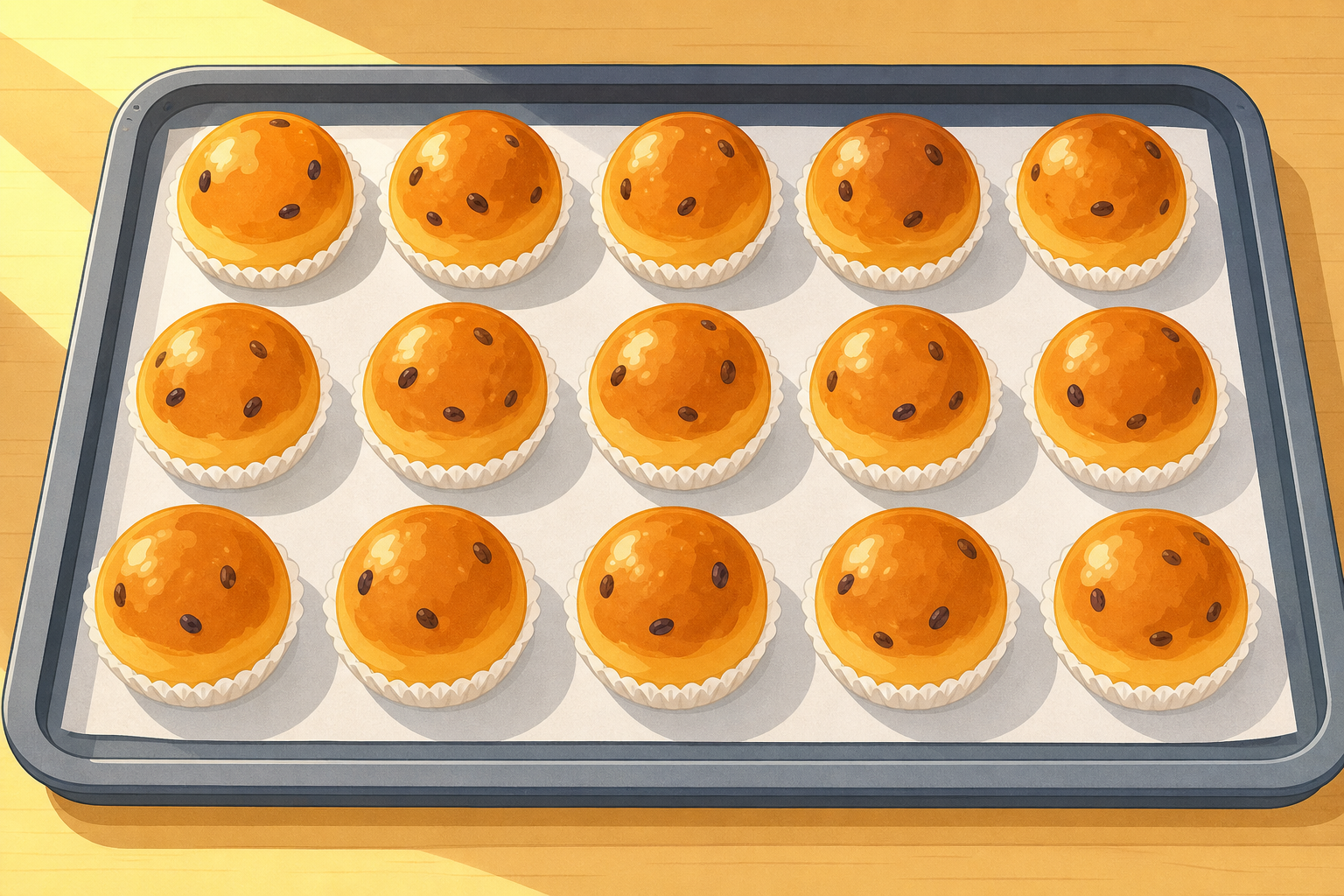
Picture a bakery tray of fresh buns. There are 3 rows, and each row holds 5 buns. How many buns are on the whole tray? And here is the real question: is there a quicker way to find out than pointing at each bun one at a time?
Give five seconds of quiet think-time, then take three hands-up answers. Listen for anyone who says five plus five plus five or three fives rather than counting all fifteen — that is the seed of the whole lesson. Don't confirm the answer yet; hold it for the model step.
Look at each array of coloured tiles on the interactive. Read every array two ways with me, as repeated addition, then as a multiplication. Keep your eye on the last pair: the same tiles, but turned.
Example 1, 3 rows of 4: point along one row, four, then four and four and four is three fours. Write 4 + 4 + 4 = 3 × 4 = 12 beside it.
Example 2, 5 rows of 2: ask more or fewer tiles than the last one, pause for a prediction before revealing. Read as five twos, 5 × 2 = 10.
Example 3, the same ten tiles turned: this is the key one, slow right down. Tall array on left reads 5 × 2, wide array on right reads 2 × 5, count both to get ten and ten. Pick up your ten real tiles laid as 5 by 2, give a quarter turn so they sit as 2 by 5, set beside the on-screen wide array. Say plainly you only turned them, none added, none taken away. Land that 5 × 2 and 2 × 5 both give ten.
Today we build arrays together on the board and read each one two ways. We will do 4 rows of 3, then turn it to 3 rows of 4; then 2 rows of 6, then turn it to 6 rows of 2. Each time, build it, read the repeated addition aloud, then say the multiplication and check the total.
This round is for talking it through together — pupils take turns at the board and the class agrees or corrects out loud.
Keep the watching class working. Before each array is built, ask the whole class to predict the total on their thinking (a quiet count of a few seconds), then take two hands-up answers before the pupil at the board reveals it. After each turn, do a quick turn-and-name: name the multiplication for what is on the board now, two more hands up. That way every array reveal has the whole room predicting and answering, not just the pupil at the board.
Insist every pupil says the array two ways — the repeated addition first (3 and 3 and 3 and 3), then the multiplication (4 × 3). Revoice a strong turn-and-check: so when Aoife turned it, the tiles were the same, so the answer had to be the same. Watch for pupils who recount every tile after turning — prompt do you need to count again, or do you already know?
In your maths copy, draw a 4-by-6 array of dots — four rows, six dots in each row. Then write it two ways underneath:
Count your dots to check both give the same total.
Walk the room glancing that each array has four equal rows of six and that both a repeated addition and a multiplication are written underneath — this is whole-class copybook practice, not marking. A common slip is dots that are uneven, so the rows no longer match; nudge those pupils to line them up.
Now we outline rectangles on squared paper and count the squares to find each product. Work these in order, each one a little bigger: a 2-by-6 rectangle, then a 3-by-6, then a 3-by-8, then a 4-by-6. For each rectangle, count the squares inside, then write the matching multiplication. Watch for the pair that share the same total.
These are the practice questions — pupils outline each rectangle on their own squared paper and check the count against the multiplication; the class confirms each answer aloud before moving on. Keep the board work brisk rather than over-explaining.
The escalation is deliberate: the last two rectangles are too big to count comfortably one square at a time, so pupils feel why the multiplication shortcut is worth having. The equal-product pair is genuine here — 3-by-8 and 4-by-6 both give 24 — so a callout of which two of your rectangles share the same total? pays off and lands the commutative idea again. For the stretch, pupils can also make a new rectangle that gives 24, such as 2-by-12.
You're previewing this lesson. Get full access to this lesson and hundreds more — each one ready to teach, with interactive activities, printable resources and pupil progress tracking built in.