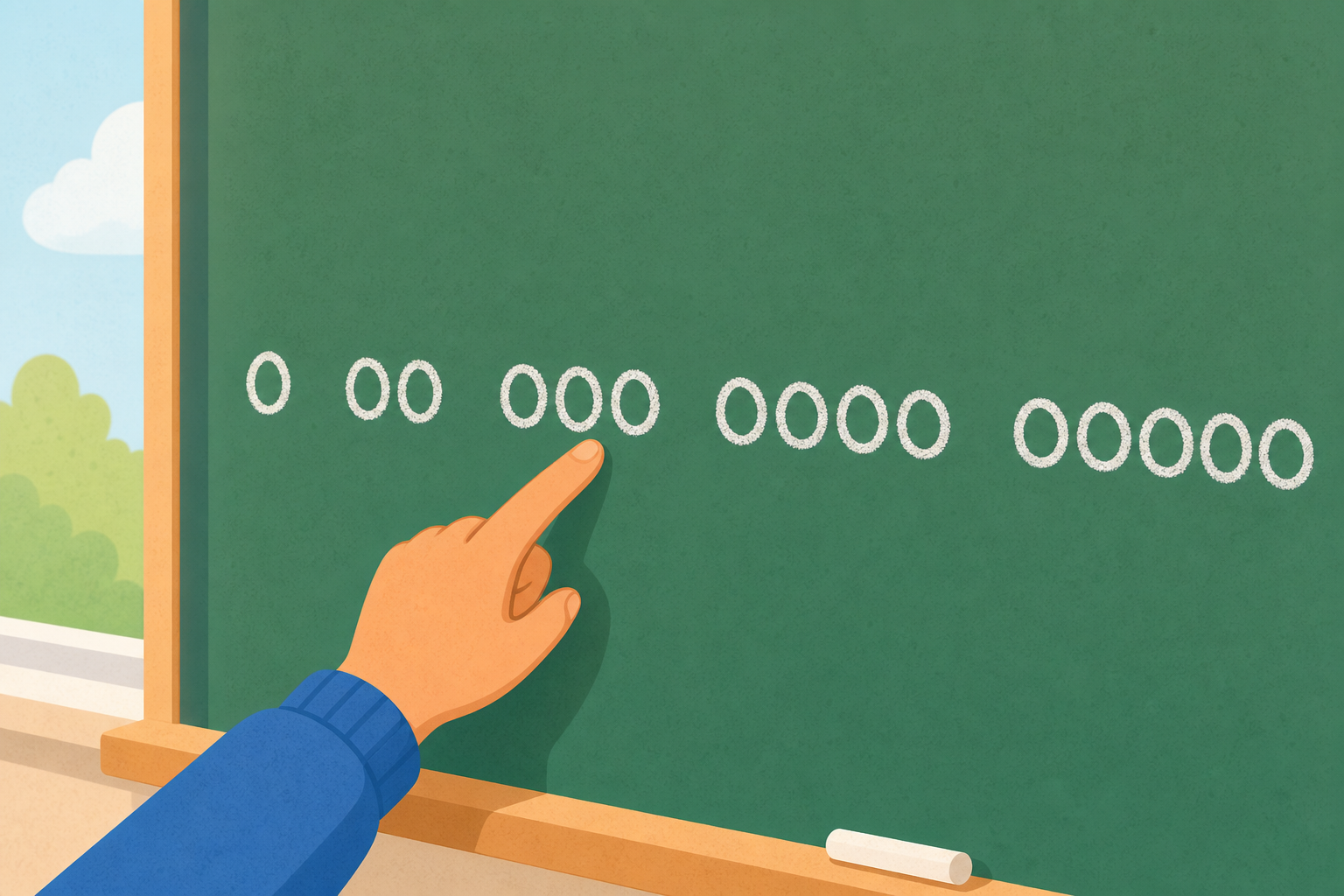
Let's count the whole class in fives together: 5, 10, 15, 20... Keep going until we pass thirty. Watch the numbers appear on the board as we call them out. Now look at every number we landed on. What do you notice about the last digit of each one? Do they all end in the same few numbers?
Count aloud in fives around the room, one number per pupil, and write each number on the board as it is called so the counted list stays visible. Stop once the count passes thirty, so the closing question has plenty to work from without depending on class size.
Take three hands-up answers to the closing question, not open call-outs. Steer toward the noticing you want: every fives answer ends in 0 or 5. Don't confirm it yet — that pattern is the key one of Watch and Notice.
Look at the three hundred squares showing the multiples of 5, of 3, and of 6. Watch the shape each pattern makes. Keep an eye out for numbers that are shaded on more than one square.
Fives: shade 5, 10, 15, 20. Point down the two columns, read the 0/5 endings, ask why they line up so neatly. Then have them predict the threes before revealing.
Threes: shade 3, 6, 9, 12, 15. Trace the slanting stripe, not columns. Pause on 15 and ask have we seen this shaded already in the fives.
Sixes: shade 6, 12, 18, 24. The key moment. Count the jumps on the threes picture: 3, then 6 is two threes, then 9, then 12 is two more. Show each six landing on every second three. Draw out that six is two threes counted together.
One person comes up to shade each fact on the board. Everyone else skip-counts aloud together as they shade, 5, 10, 15 and so on, so we read the answer as a class.
Now we work through some facts together on the class hundred square: first 5 × 4, then 3 × 6, then 6 × 3, and finally 6 × 5.
For each six-fact, check together that the sixes land on multiples of three.
This round is for talking it through together — one pupil shades on the class board at a time, and the whole class skip-counts aloud with them and agrees or corrects.
Call a fact, an individual pupil shades the multiples, and the class skip-counts to read the answer. For each six-fact, ask the class to check it lands on a shaded three. Rotate four pupils across the four facts, and between facts turn-and-name a pupil to predict the answer before the next pupil shades, so the watching class stays with it.
Watch for pupils who count every shaded cell one by one instead of skip-counting in the table's step — nudge them to count in the jumps.
In your maths copy, write out the 3-times table. Then, beside each three-fact, write its double to make the matching six-fact. For example, next to 3 × 4 = 12 write 6 × 4 = 24, because 24 is 12 doubled.
Model the layout first: the three-fact on the left, its doubled six-fact beside it. Walk the room and glance for pupils lining up each six-fact beside its three-fact and doubling correctly. This is whole-class copybook practice, not marking.
Now we build up the pattern picture together. Shade the multiples of 5, then clear and shade the multiples of 3, then the multiples of 6, and finally shade the numbers that are multiples of both 3 and 6. Predict before each reveal what the shading will look like.
These are the practice questions — pupils take turns at the board, check each answer, and the class confirms before moving on. Keep the board work brisk rather than over-explaining.
The final round is the key one, and it is a confirmation, not a new hunt: the numbers that are multiples of both 3 and 6 are exactly the multiples of 6, because every six is already a three. Warn the class the shading will look the same as the sixes round — that sameness IS the point. Draw them to notice it with a use a three-fact you know to get the six-fact callout.
You're previewing this lesson. Get full access to this lesson and hundreds more — each one ready to teach, with interactive activities, printable resources and pupil progress tracking built in.