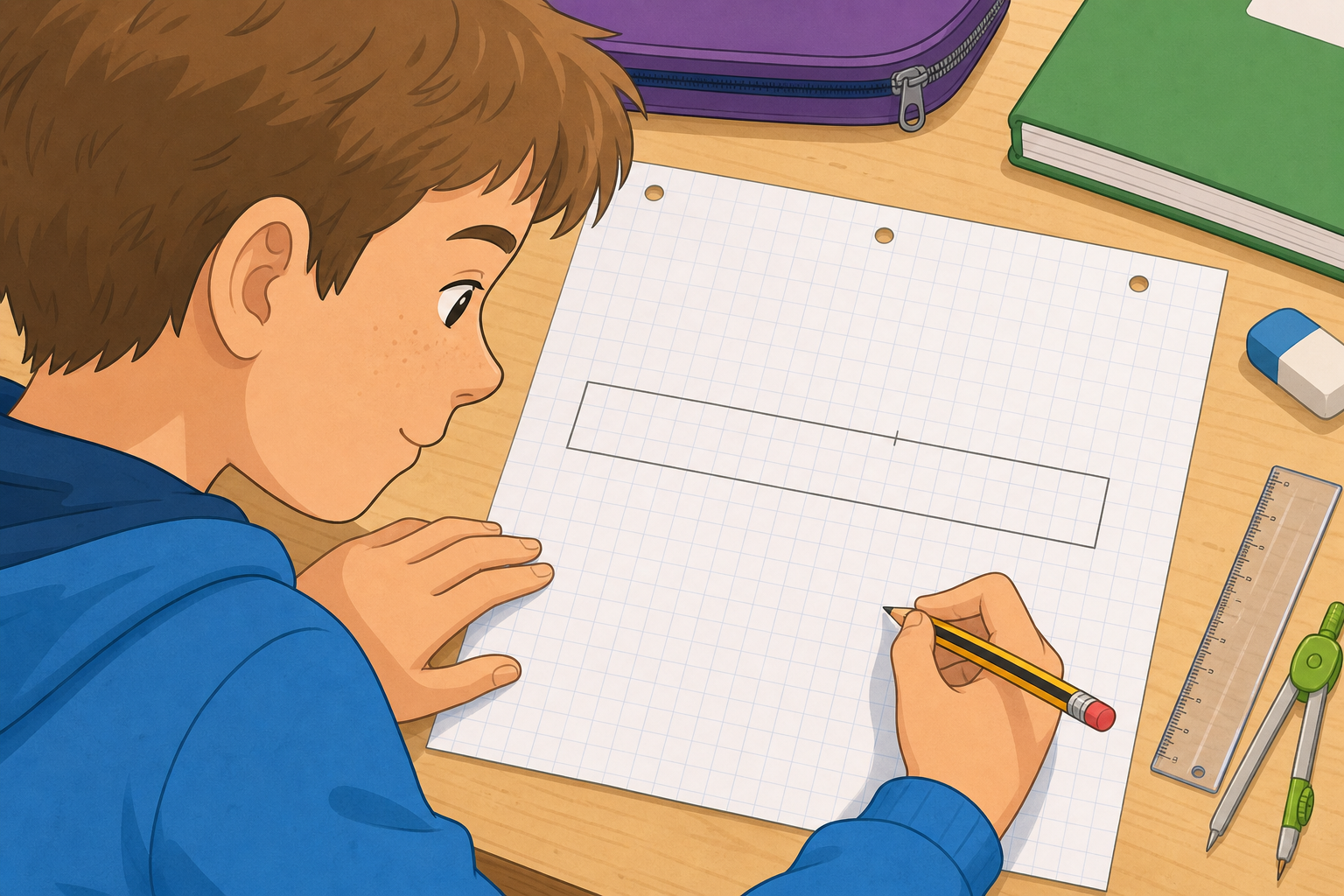
Here is a rectangle that is 23 squares long and 4 squares tall. Hands up: roughly how many little squares do you think fill it? Have a guess before we work it out. If we split the long side into 20 and 3, does that give us a friendlier way to count than one square at a time?
The interactive splits each rectangle into boxes and shows the column method beside it. Watch where the number breaks apart, and see if the boxes and the column land on the same answer.
Today we work through two products together on the board. First 138 × 6: we split 138 into 100, 30 and 8, so we get three boxes. Find each box: 100 × 6, then 30 × 6, then 8 × 6. Add the three partial products to reach the whole answer. Then we do a second one, 216 × 4, the same way. Call out each box answer before we drop it in.
In your maths copy, sketch the area-model rectangle for each example. Write the partial products inside each box, then total them at the bottom. Check your total against the column shorthand.
Big numbers make a lot of boxes, so once we trust them we switch to the column shorthand (shown on the right) to keep things tidy. Working right to left: 4 × 9 = 36, write 6 and carry 3; 8 tens × 9 = 72, plus the carried 3 makes 75, write 5 and carry 7; 0 hundreds × 9 = 0, plus the carried 7 makes 7; 1 thousand × 9 = 9. The answer is 9,756.
The zero in the hundreds column still needs working: nothing times nine is nothing, then add the carried seven. On screen the hundreds box has a side of 0, so its area is 0 — a zero box holds the place but adds nothing. You will meet a zero box again in the next challenge.
You're previewing this lesson. Get full access to this lesson and hundreds more — each one ready to teach, with interactive activities, printable resources and pupil progress tracking built in.