Mathematics
Intermediate
40 mins
Teacher/Student led
+80 XP
What you need:
IWB/Projector/Large Screen
3D solids

Nets: Flat to 3D and Back

Explore how flat nets fold into 3D solids. Test which arrangements of six squares make a cube, discover why some leave gaps or overlap, and sketch a cuboid net with matching pairs.
Teacher Class Feed

Load previous activity

    1 - Getting Started ~4 mins

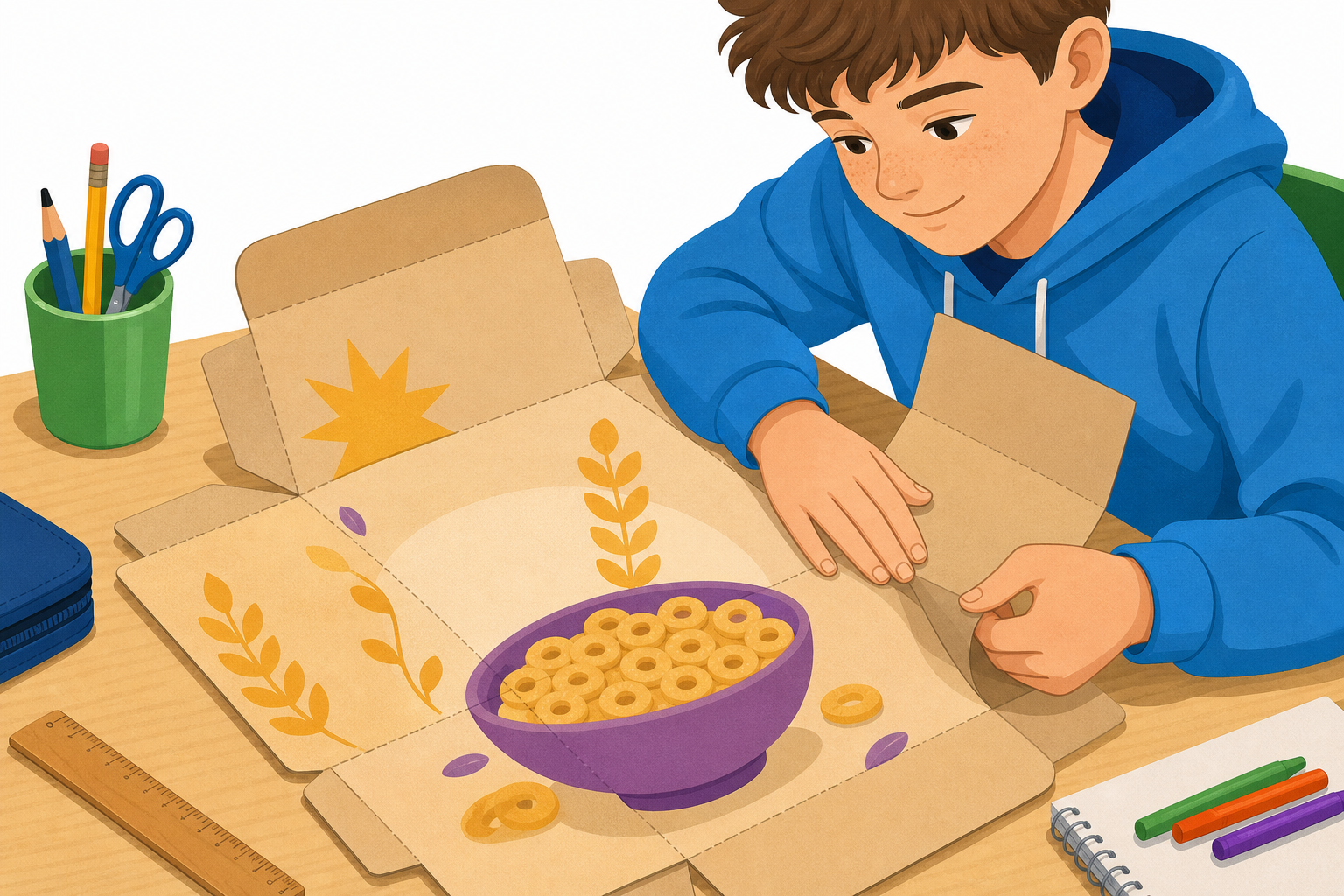
    Illustration for Getting StartedHere is a cereal box. Watch as it unfolds flat at the front. What shape did the box become once it lay flat? And do you think we could fold it back to look exactly like a box again?
    2 - Watch and Notice ~9 mins

    Watch the solids unfold flat into their nets and fold back up again. A flat side of a solid is called a face. As each one folds, keep your eye on where each face ends up.

    3 - Try It Together ~11 mins

    First, all eyes on the board. Here are six squares in a cross. Predict together: will they fold up into a cube? We will fold to check and watch each square close into place with no gap. Once we have folded it together on the board, turn to the real net on your desk: fold your own cube net and cuboid net, and lay a finger on a square to name the face it becomes — top, front and side.

    Will these six squares make a cube?

    4 - Sketch the Cuboid Net in Your Copy ~2 mins

    COPYBOOK MOMENT

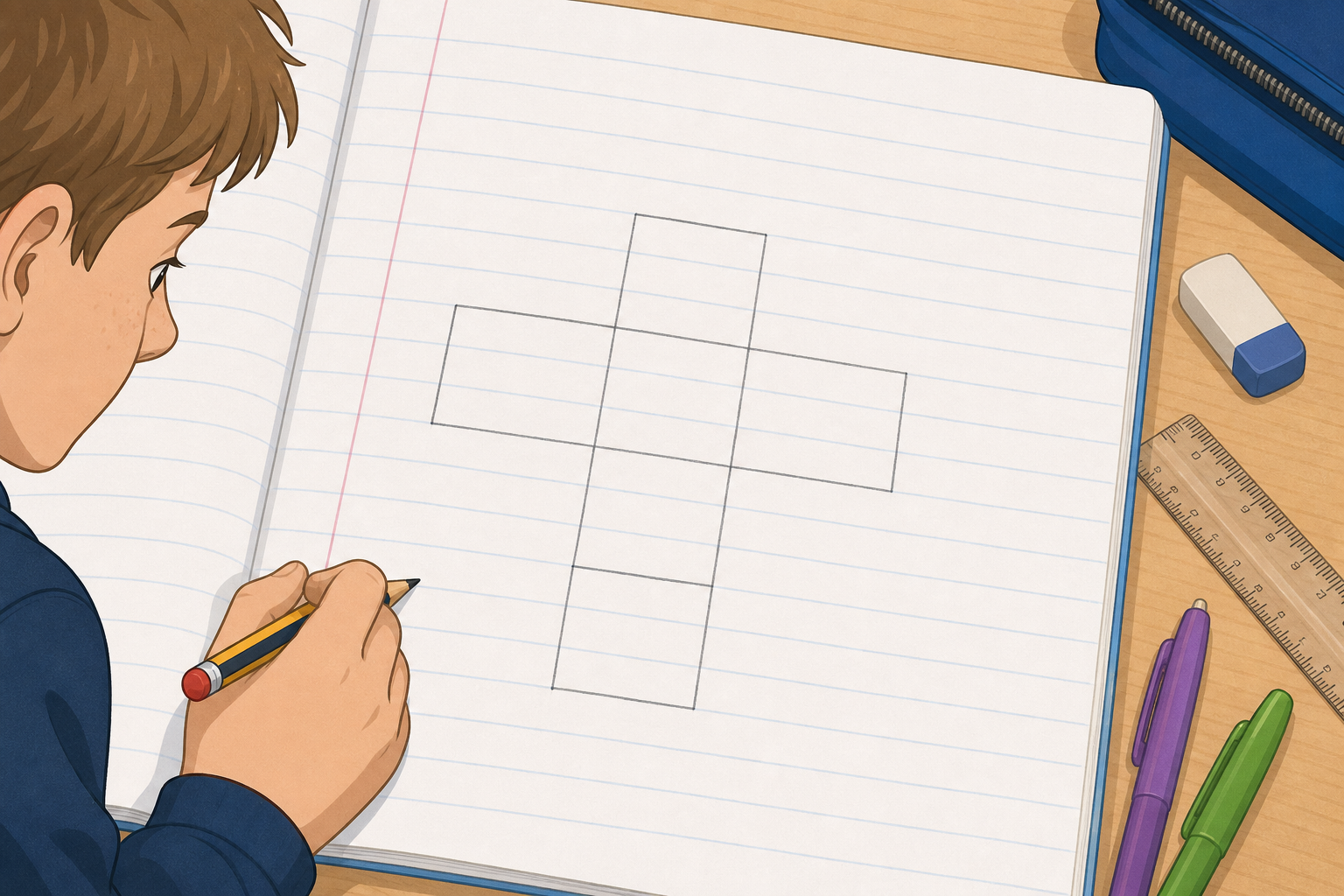
    Illustration for Sketch the Cuboid Net in Your CopyIn your maths copy, sketch the net of a cuboid: three matching pairs of rectangles. Label which face folds to the top, which to the front and which to the side. Then mark the pairs that are the same size, so you can see at a glance that top matches bottom, front matches back, and the two ends match.

    5 - Class Challenge ~8 mins

    Today we work through these arrangements together. For each one, predict folds into a cube or does not fold before we fold to check. Some leave a gap where a face is missing; some have two squares that would land on the same face and overlap. The screen reveals the gap or the overlap when an arrangement fails. We finish with a thinking question, not a counting one: there are many ways to lay out six squares, and only some make a cube net — can you explain what has to be true for a layout to fold up?

    Cube net or not?

    6 - What Did We Notice? ~3 mins

    MATHS TALK

    Why do some six-square arrangements fold into a cube while others leave a gap or two squares overlapping? What has to be true about where the squares sit for the net to close?

    7 - What's Next ~3 mins

    Today's big ideas

    • A net is the flat shape that folds up into a solid, with every face laid out side by side.
    • A cube net is six squares that fold with no gaps and no overlaps; not every arrangement of six squares works.
    • A cuboid net is three matching pairs of rectangles: top and bottom, front and back, the two ends.
    Coming up

    Next we move on to angles: what an angle is, and how we measure the amount of turn between two lines.

    Pupil practice
    Module 6 · 2D and 3D Shape, Angles, Symmetry Shape & Space
    Lesson 72 · Nets: Flat to 3D and Back
    Download Activity Book page (PDF)
    End of lesson
    123learn · Online learning platform

    Unlock the full learning experience

    You're previewing this lesson. Get full access to this lesson and hundreds more — each one ready to teach, with interactive activities, printable resources and pupil progress tracking built in.

    Hundreds of curriculum-aligned lessons
    Interactive activities in every lesson
    Printable resources & progress tracking
    Copyright Notice
    This lesson is copyright of Coding Ireland 2017 - 2025. Unauthorised use, copying or distribution is not allowed.
    🍪 Our website uses cookies to make your browsing experience better. By using our website you agree to our use of cookies. Learn more
