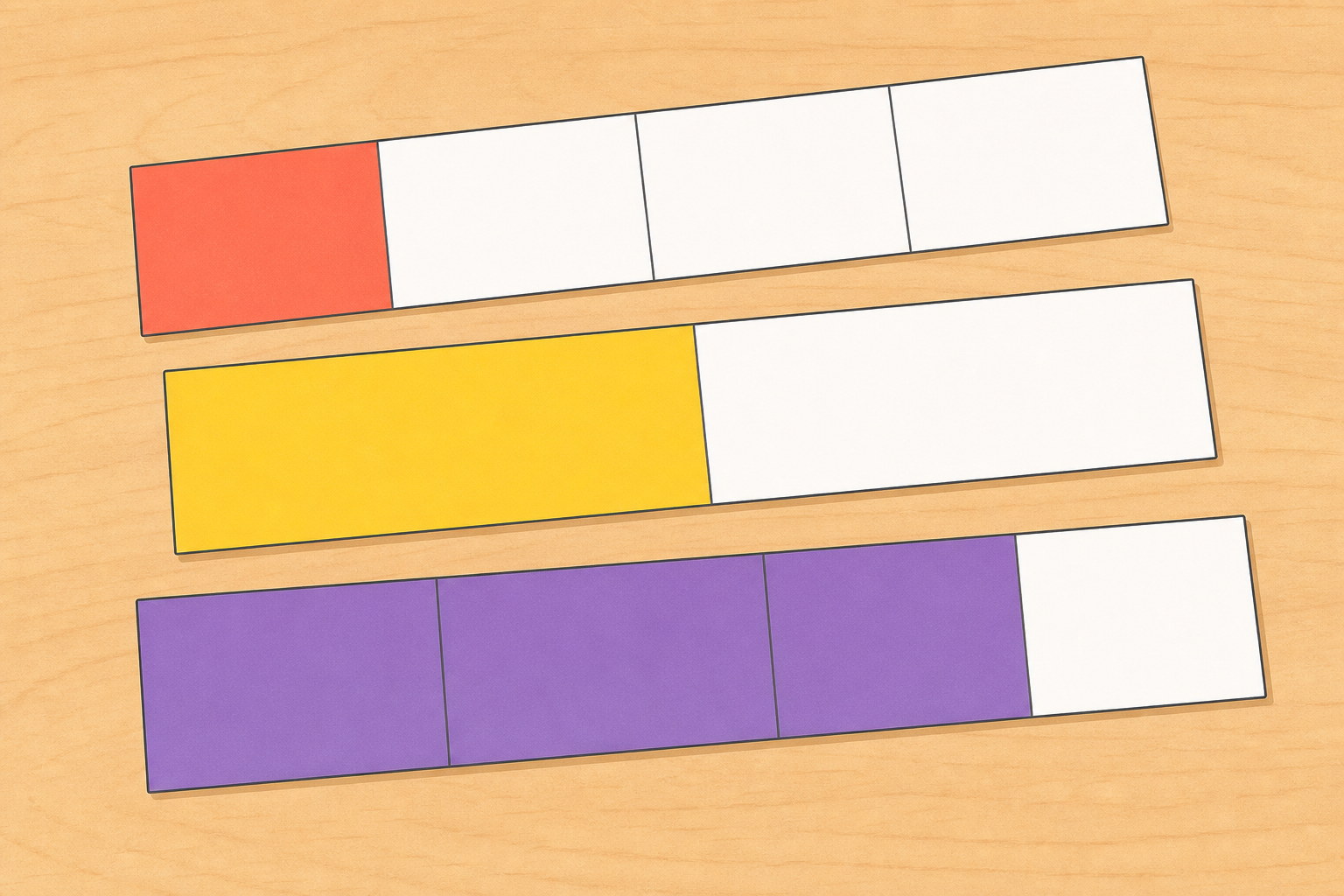
Here are three fraction cards jumbled up on the board: one quarter, three quarters and one half. If we had to line these up from the smallest fraction to the largest, where would you start?
Hands up: which of the three do you think is the smallest, and which is the biggest?
Take three hands-up answers, not open call-outs. Don't confirm yet — this is a prediction to return to. Leave the three cards visible on the board so the class has something concrete to picture through the lesson.
Each screen builds equal-width strips shaded to different fractions. Watch how far each strip reaches, and keep an eye on where one half sits.
First: one quarter, one half, three quarters. Trace a finger to the end of each shaded strip so they see which reaches further. Order smallest to largest: one quarter, one half, three quarters.
Fifths: one fifth, two fifths, four fifths. Same bottom number, so just count shaded parts. Order: one fifth, two fifths, four fifths.
Thirds, halves, sixths: one third shades less than a half, five sixths well past it. Order: one third, one half, five sixths. Before revealing the last screen, ask where will one half land among the quarters?
Last one lands the marker idea: one half shades the same length as two quarters, so it sits in the middle. One quarter smaller, three quarters larger. Revoice: one half is our checking point every time.
Let's work this set through together on the board: one third, one half and five sixths. We shade each fraction on its own strip and then read them in order from smallest to largest. This set mixes thirds, halves and sixths, so we build every strip carefully rather than guessing. Compare each new fraction against one half first: is one third under a half or over it? Is five sixths under or over? Once we know that, we know which end each one belongs at, then we read the line smallest to largest.
This round is for talking it through together — pupils take turns at the board and the class agrees or corrects out loud.
Have one pupil shade one third, a second shade one half, a third shade five sixths, then the class reads the whole set smallest to largest. Prompt is this one smaller or larger than a half? before each placement — that is the marker strategy the wrap will name. Watch for the common slip of thinking a bigger bottom number always means a bigger fraction; the strips settle it.
In your maths copy, write the fractions one half, one quarter and three quarters in order from smallest to largest. Draw a quick bar beside each one to check your order is right.
Walk the room glancing at the order and the checking bars — this is whole-class copybook practice, not marking. Look for pupils who put one quarter before one half rather than the reverse.
Today we take on these ordering challenges at the board, one a step harder than the last: order one half, three quarters, one quarter, then order four fifths, one fifth, two fifths, then order five sixths, one third, one half, and finally place four mixed fractions in order. Shade each fraction, use one half as your checking point, then read the line and press Check.
These are the practice questions — pupils take turns at the board, check each answer, and the class confirms before moving on. Keep the board work brisk rather than over-explaining.
For the final four-fraction set, have the class predict the position of one half before the pupil places the last strip. The tolerance is set so an exact match to the shaded target is required.
You're previewing this lesson. Get full access to this lesson and hundreds more — each one ready to teach, with interactive activities, printable resources and pupil progress tracking built in.