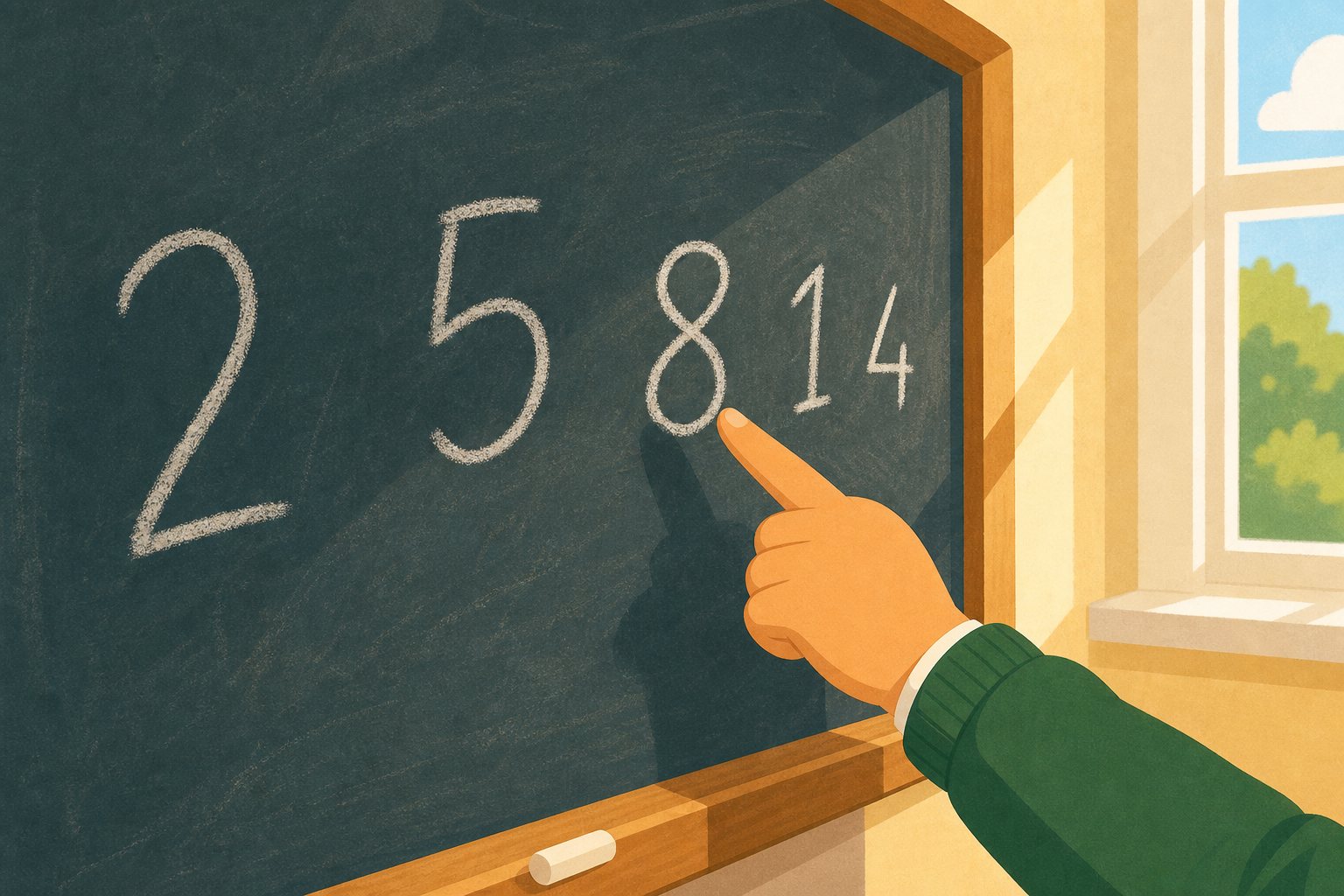
Look at these three numbers on the board: 15, 25, 40. Each one is an answer in the five times table. What do you notice about the digit at the very end of each of them? And what about the ten times table — what do all its answers end in?
Give five seconds of quiet think-time, then take three hands-up answers, not open call-outs. Steer toward they all end in 0 or 5 for the 5s and they all end in 0 for the 10s. Do not name the pattern for them yet — that lands in Watch and Notice.
Here are five hundred squares, each with one set of multiples shaded: fives, tens, twos, then fours. Look at where the shaded squares sit and the pattern they make.
Grid must run 1 to 10 across the top, ten columns, or the column patterns won't match.
Walk it square by square, don't race.
Fives: two columns; chant 5, 10, 15, 20; draw out the ending in 5 then 0.
Tens: pause before revealing, ask will it be one column or two? One column down the right edge, all ending in 0.
Twos: the even numbers, every second square, whole grid striped.
Fours: every fourth square; each four sits on a two.
Twos and fours together: the key one. Point along and ask why every four lands on a two. The fours are the twos doubled, because four groups is two groups counted twice.
Today we shade and read each table's pattern together, in this order: first the 2s, then the 10s, then the 5s, then the 4s. Each time, a pupil comes to the board to shade the multiples, and then the whole class says what shape the pattern makes and what the answers end in. Watch for the moment when the 4s land right on top of the 2s.
This round is for talking it through together — pupils take turns at the board and the class agrees or corrects out loud.
Call a table, one pupil shades its multiples on the hundred square, then ask the class: 'what shape does it make, and what do the answers end in?' Sequence it as 2s → 10s → 5s → 4s so the fours-on-twos link comes last and lands as the key one. Revoice a strong answer: 'so if you forget 4 × 6, you can double 2 × 6.'
The 'shares squares with a table we already shaded' prompt only applies from the second table (the 10s) onward — skip it on the opening 2s, when nothing else is shaded yet.
In your maths copy, write out the 4 times table all the way to 4 × 10, one fact under the other. Then go back and circle each answer that is also in the 2 times table. When you have finished, look at which answers you circled — you will spot the doubling link for yourself.
Walk the room glancing at whether the table is set out one fact per line and whether the circling is sensible — this is whole-class copybook practice, not marking.
Now we shade each table as a whole class, working up through four rounds: the 2s, then the 10s, then the 5s, then the 4s. A pupil shades the multiples, we press Check to confirm the grid is right, and the class calls out one fact from that table they could work out from its pattern.
These are the practice questions — pupils take turns at the board, check each answer, and the class confirms before moving on. Keep the board work brisk rather than over-explaining.
For each round ask a fast follow-up: 'which is the one fact people most often forget in this table, and what pattern would rescue it?' Keep the fours last so the class ends on the twos-doubled insight.
You're previewing this lesson. Get full access to this lesson and hundreds more — each one ready to teach, with interactive activities, printable resources and pupil progress tracking built in.