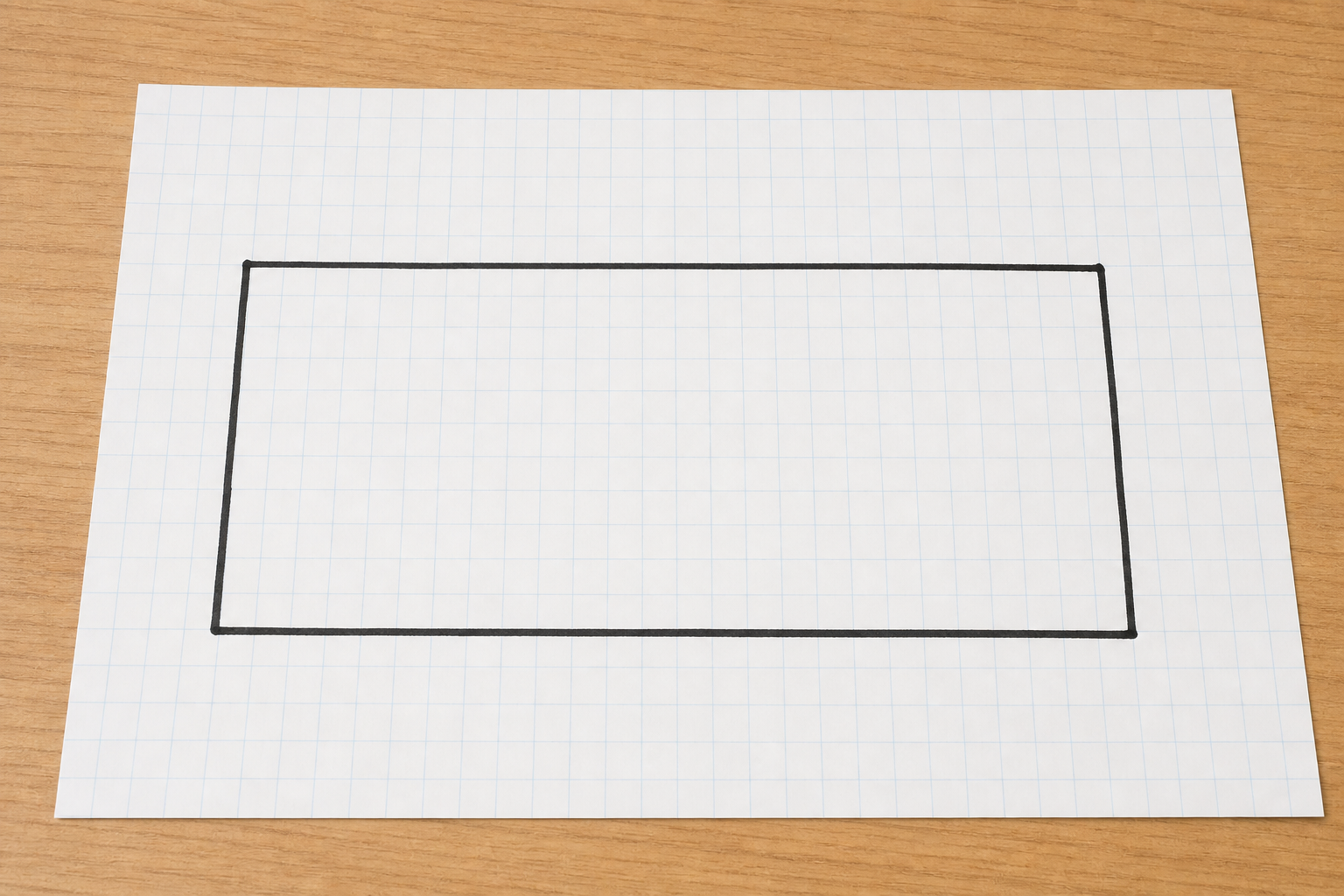
Here is a rectangle that is 5 cm along the top and 2 cm down the side. Look at it carefully. Are any of its sides the same length as each other? Which ones? Do we really need to measure all four sides to find the distance all the way around, or could we be a bit cleverer about it?
Display a simple 5 cm × 2 cm rectangle on the board with the top and one side labelled. Take three hands-up answers, not open call-outs. Listen for a pupil noticing that opposite sides match — revoice it as the top equals the bottom, and the two sides are the same too. Don't reveal the shortcut yet; that lands in the next step.
The perimeter of a shape is the distance all the way around its edge, found by adding the length of every side. The space inside the shape is its area. Today we work on perimeter.
The interactive shows three shapes in turn: a rectangle, a square and a regular pentagon. Watch how we find the perimeter of each, and look for a quicker way than adding every side one at a time.
Rectangle 7 by 4: long way 7 + 4 + 7 + 4 = 22 cm. Then the smart way, pair the equal sides: 7 + 4 = 11, doubled 11 + 11 = 22 cm. Stress both give 22.
Thumbs-up check: can they see why pairing the equal sides matches adding all four? Let it land before moving on so the two ideas don't blur.
Square side 9: four equal sides, so 4 × 9 = 36 cm rather than 9 + 9 + 9 + 9. Link to tables they know.
Pentagon side 5: five equal sides, 5 × 5 = 25 cm. Generalise: equal sides means multiply one side by the number of sides.
Pause and ask a pupil to predict the rule for a hexagon before moving on.
Here is a 6 cm by 3 cm rectangle on the board. Let's find its perimeter the smart way together. First, tell me which sides are equal. Then, instead of adding all four sides one slow side at a time, pair the equal sides: add one long side and one short side, then double it. For this rectangle that is 6 plus 3, which is 9, then double it: 9 and 9 makes 18 cm.
This round is for talking it through together. A pupil names the equal sides at the board, then the class agrees the quickest way to add them.
Ask the pupil at the board to name which sides are equal before adding (top and bottom are both 6 cm; the two sides are both 3 cm). Between the naming stage and the adding stage, take a quick hands-up prediction from the room — which pairing would you add first? — and hear two pupils, so the watching class stays with it. Then take the addition: 6 + 3 = 9, doubled is 18 cm. Revoice it as two of each, so add one pair and double it. If a pupil still adds all four one by one, accept it as a check but push them to also show the paired version. Keep this beat to the single rectangle so the on-screen shape and your words stay in step.
In your maths copy, work out the perimeter of a 6 cm by 3 cm rectangle two ways. First add all four sides, one under the other. Then pair the equal sides: add one long side and one short side, and double your answer. Check that both ways give you exactly the same perimeter. When you have those, try the same two ways for an 8 cm by 5 cm rectangle.
Walk the room glancing at whether both methods land on the same total — this is whole-class copybook practice, not marking. A pupil who gets two different answers has a slip somewhere; prompt them to recount one method rather than telling them the answer. The second rectangle (8 + 5 = 13, doubled is 26 cm) gives fast finishers a genuine extra rather than waiting idle.
On the board is a 4 cm by 4 cm square. Spot the equal sides first, then find its perimeter the quickest way you can. After that, I will draw three more shapes for us to work the same way: a 10 cm by 6 cm rectangle, a regular hexagon with sides of 5 cm, and a regular octagon with sides of 7 cm. For each one, name the equal sides, then find the perimeter. Read the side lengths straight from the shape tool, work each perimeter out in your copy, and we check every answer together before the next shape.
The square on screen (4 × 4 = 16 cm) is the first challenge. Once the class has it, draw the other three on the board in turn — the interactive shows one shape, so the rectangle, hexagon and octagon are quick teacher sketches with their side lengths labelled. Pupils take turns naming the equal sides and the class confirms before moving on. Keep it brisk.
For each shape ask which sides are equal, and how does that speed up the adding? Answers: the 10 × 6 rectangle is 2 tens and 2 sixes, so 20 + 12 = 32 cm; the regular hexagon is 6 × 5 = 30 cm; the regular octagon is 8 × 7 = 56 cm. The hexagon and octagon are the stretch — fluent pupils reach for the multiplication straight away. The 10 × 6 rectangle is the one to watch for the slip of multiplying instead of pairing; revoice it as two tens and two sixes.
Why is a regular shape's perimeter so quick to find compared with a wobbly six-sided shape where every side is a different length? What is it about a regular shape that lets us use a times-table fact instead of adding side by side?
Listen for pupils naming the key idea: in a regular shape every side is the same, so the same number is added over and over, which is exactly what multiplication is. Revoice a strong answer as equal sides turn the adding into a times-table fact. Head off the misconception that the shortcut works for any shape — it only works when sides are equal; an irregular shape still needs every side added. Draw an irregular six-sided shape with six different lengths and ask whether the multiplication shortcut would work, so the limit of the rule is clear before the lesson ends.
Next we move from the distance around a shape to the flat space inside it. We will start measuring area by counting the square units that cover a shape.
Keep this brisk. Re-state the one big idea: equal sides let us multiply instead of adding slowly. Flag the shift coming next from perimeter (around the edge) to area (the space inside) so pupils don't muddle the two.
You're previewing this lesson. Get full access to this lesson and hundreds more — each one ready to teach, with interactive activities, printable resources and pupil progress tracking built in.