Here is a mystery number's first clue: "I have three tenths and no hundredths."
Say what you think the number could be. Could there be more than one answer from just this one clue, or does it already pin the number down?
Read the clue aloud slowly, then give five seconds of quiet think-time before any hands go up.
Take three hands-up answers, not open call-outs. Listen for pupils who correctly hear "no hundredths" as a zero placeholder in the hundredths column. Do not confirm the answer yet — the point is that one clue can name some columns and still leave others open, and that is what the lesson builds on.
Three clues narrow one mystery decimal down to a single answer. Watch the place-value mat for each clue and keep track of which candidates survive. Notice that a clue can rule numbers out without naming the answer directly.
Clue 1: tenths and hundredths named, thousandths left open. Ask how many numbers still fit, draw out ten candidates 0.340 to 0.349 (0.341, 0.342, 0.343 among them).
Clue 2: name the two fences 0.3 and 0.35. Ask which numbers this crosses off, not just which it keeps, e.g. 0.36 and 0.4 sit past 0.35. Point: a clue can keep every candidate and still do work by ruling out numbers never on the list.
Clue 3: the finish. A leftover thousandths digit means x100 never lands whole, e.g. 0.343 x 100 gives 34.3. Only 0.340 x 100 gives 34, a whole number, so the answer is 0.340.
The reasoning move the lesson rests on: each clue rules candidates out until one is left.
Today we work through one full mystery number together, clue by clue. Here are the four clues in the order we will meet them:
Clue 1: I am a decimal with two decimal places. My tenths digit is 4.
Clue 2: My hundredths digit is bigger than 5.
Clue 3: When you round me to the nearest tenth, I round up to 0.5.
Clue 4: My hundredths digit is odd.
After each clue we will build one surviving candidate at a time on the place-value mat to check it still fits, and cross off any that a new clue rules out on the board. Predict, before clue 4, how many numbers are still standing.
This round is for talking it through together — pupils take turns at the board and the class agrees or corrects out loud.
Build the candidate list on the mat as you go. After clue 1: the number is 0.4?, so 0.40 to 0.49. After clue 2 (hundredths above 5): 0.46, 0.47, 0.48, 0.49. After clue 3 (rounds up to 0.5): all four still round up, so no change — let pupils notice that a clue can rule nothing out and still be useful for confirming. After clue 4 (hundredths odd): only 0.47 and 0.49 survive. Pause here on your prediction check, then ask what single extra clue would settle it to one (e.g. "my hundredths digit is smaller than 8").
Revoice a strong answer: "so the clue didn't name the number, it just crossed some off."
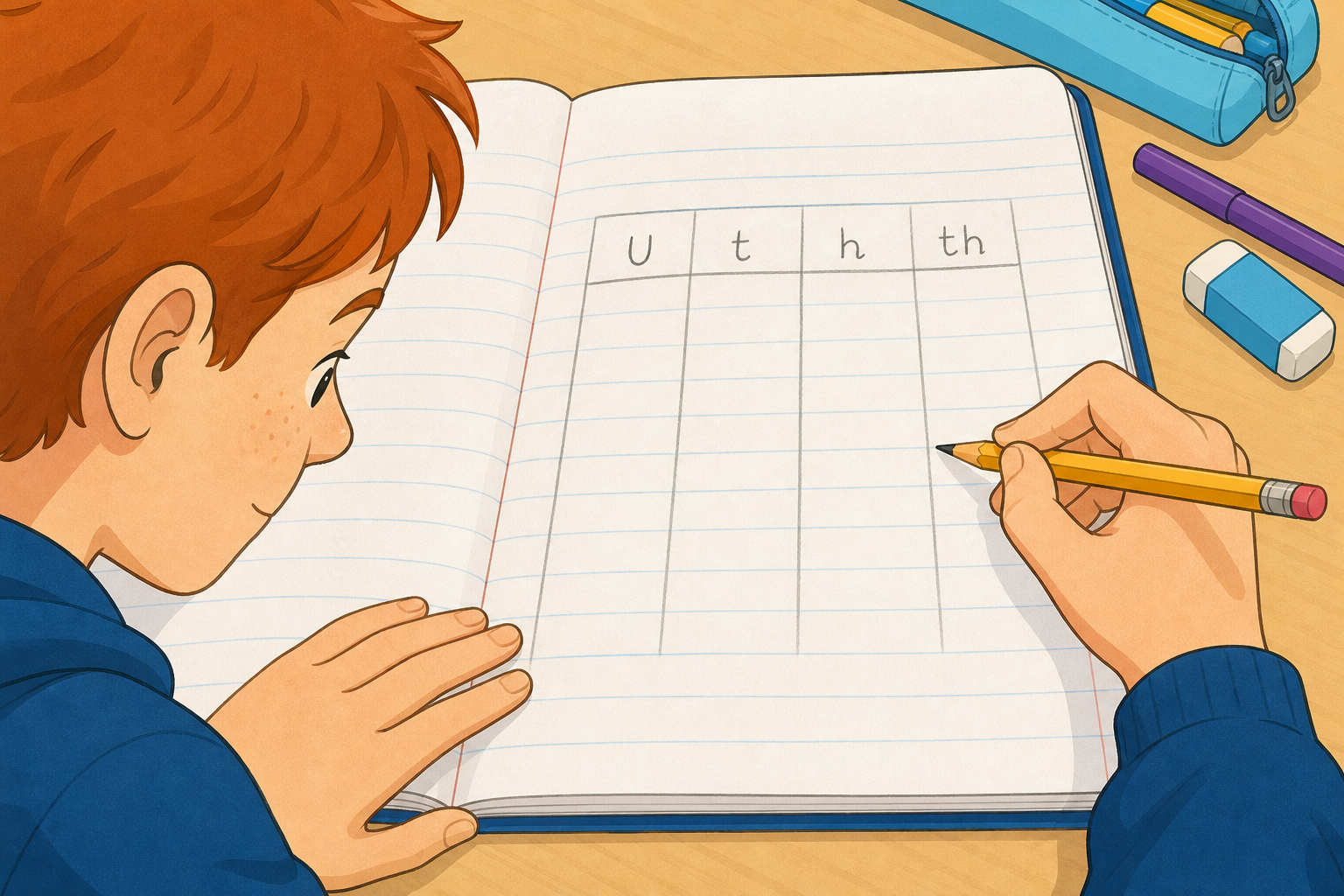
In your maths copy, sketch a place-value mat with U, t and h columns for each of the four clues we just worked. Write the candidate decimals that fit that clue underneath your mat, then cross off any that the next clue rules out.
Walk the room glancing at column labels and whether pupils are crossing off rather than starting a fresh list each time — no marking, this is whole-class copybook practice, not assessment.
Today you crack a five-clue paper puzzle to find one mystery three-decimal-place number. Solving each clue narrows the list until the last clue reveals the single answer.
The five clues, in order:
Clue 1: I have three decimal places and my tenths digit is 6.
Clue 2: My hundredths digit is zero.
Clue 3: I am bigger than 0.6 but smaller than 0.61.
Clue 4: My thousandths digit is a multiple of 4 (and not zero).
Clue 5: My thousandths digit is smaller than 6.
Work each clue in turn on your paper, crossing off numbers as you go. What single number is left when clue 5 is done?
Ways to start:
Stretch:
These are the practice questions — pupils work each clue in turn on paper, then the class confirms the surviving numbers aloud before moving on. Keep the pace brisk rather than over-explaining.
The answer is 0.604. Track the narrowing together: clue 1 gives 0.6??, clue 2 fixes the hundredths to zero (0.60?), clue 3 confirms it stays between 0.6 and 0.61, clue 4 leaves thousandths of 4 or 8 (0.604 or 0.608), clue 5 (below 6) crosses off 8, leaving 0.604 alone.
The puzzle is worked on paper; the place-value mat from the earlier steps is the model to think with. Ask a stretch question to fast finishers: "which clue did the most work — which one crossed off the biggest chunk?"
You're previewing this lesson. Get full access to this lesson and hundreds more — each one ready to teach, with interactive activities, printable resources and pupil progress tracking built in.