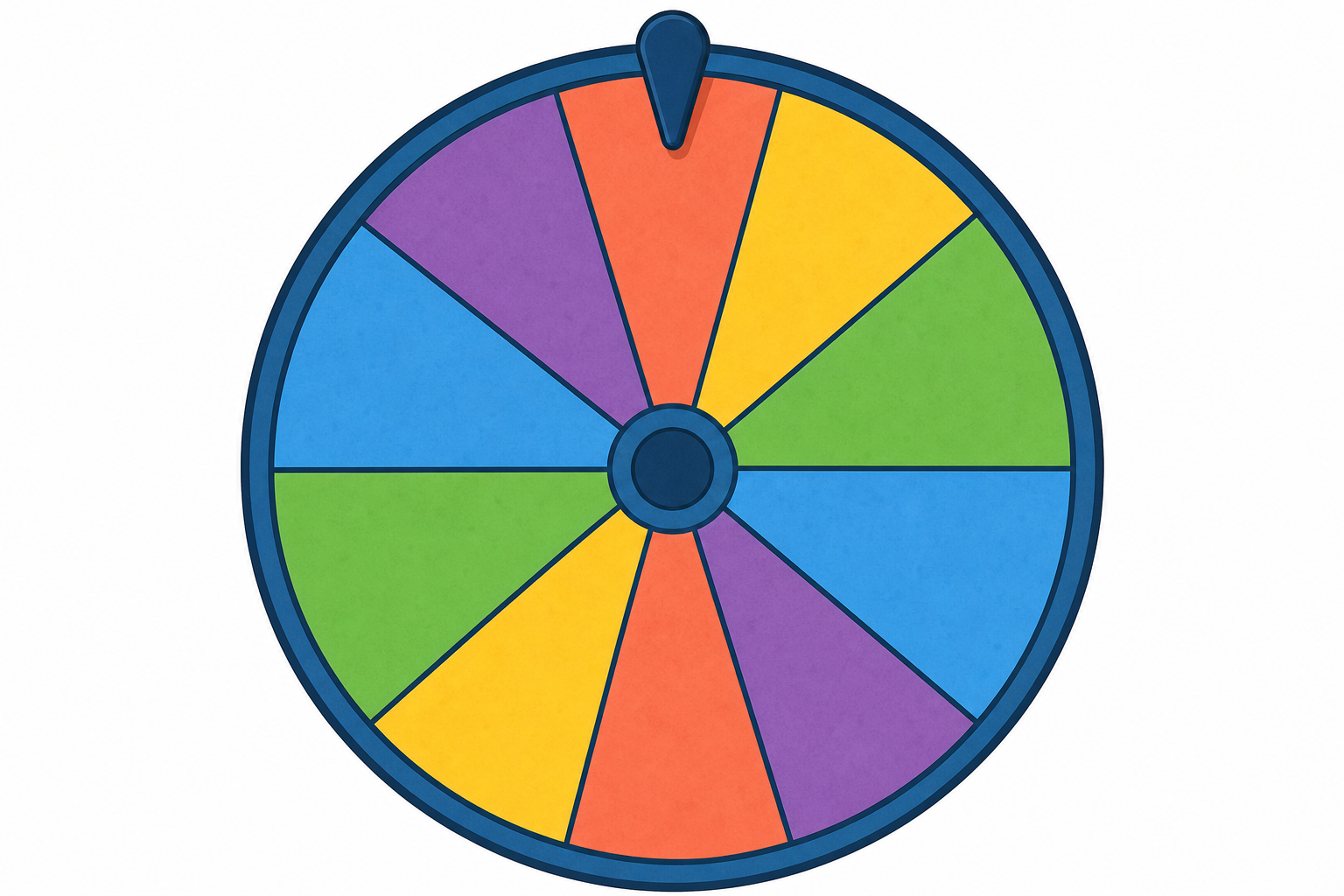
Picture a spinner split into ten equal segments, like a prize wheel at a school fair. Each spin is just as likely to stop on any one of them.
If we say the chance of landing on one segment is 1/10, what would that same chance look like written as a decimal? And as a percentage?
Sketch or picture the ten-segment wheel on the board as you pose this. Take two or three hands-up answers, not open call-outs. Some pupils will already know 1/10 is 0.1; hold out for the percentage too. Don't confirm yet — the lesson is about to show all three side by side. Give a few seconds of quiet think-time before any hands go up.
The interactive shows four fair spinners in turn — a ten-segment wheel, a four-segment wheel, an eight-segment wheel, and a fair coin. For each one we read the chance of a single segment three ways: as a fraction, a decimal, and a percentage. Watch how we get from one form to the next, and try reading the next form before it appears.
Same move each time: divide top by bottom for the decimal, then times by 100 for the percentage (out of one becomes out of a hundred).
Ten segments: ask for the decimal first — 1/10 = 0.1 = 10%, the friendly one.
Four segments: 1/4 = 0.25 = 25%, the quarter they know from money.
Eight segments: 1/8 = 0.125 = 12.5%. Slow down here — 1 ÷ 8 runs to three decimal places before it stops exactly, further than the others but it still ends; note the half a percent.
Coin: 1/2 = 0.5 = 50%, the fifty-fifty they meet first.
Then work two written conversions slowly on the board: 1/8 (1 ÷ 8 = 0.125, then × 100 = 12.5%) and 3/5 (3 ÷ 5 = 0.6, then 0.6 × 100 = 60%, so 3/5 = 0.6 = 60%).
Flag the 3/5 one — it returns in the Class Challenge.
Reading and naming the wheels is brisk; the two written conversions are where you take your time.
In your maths copy, write each of these probabilities three ways in a row: the fraction first, then the decimal, then the percentage. Keep one set under the other so they line up.
Then circle the form you find easiest to compare with.
Walk the room glancing for the three-column line-up and the divide-then-times-100 working — this is whole-class copybook practice, not marking. Watch for the 1/8 row, where the decimal should have three places.
Today we work this ten-segment wheel together — think of it as a school-fair prize wheel where some spaces win and some don't.
A prime number has exactly two factors: 1 and itself. On this wheel, 2, 3, 5 and 7 are the primes (each divides only by 1 and itself), so four of the ten spaces are winners. That makes the chance of landing on a prime 4/10.
Before we spin, say the chance of a prime three ways: 4/10, then the decimal, then the percentage. Then we record whether each spin is a hit (a prime) or a miss, and see how the run compares to our 4/10 prediction.
Talk this one through together — pupils take turns at the board and the class agrees or corrects out loud.
Hold out for all three forms of 4/10 before the first spin: 4/10 = 0.4 = 40%. Keep a hit/miss tally on the board yourself as pupils spin; nobody needs their own device here — the rest of the class watches and calls the next outcome. Revoice a strong answer: so four out of ten is the same as forty out of a hundred. Don't expect the run of spins to land on exactly 40% — name that wobble aloud, it seeds the maths-talk.
Now we convert probabilities on the battery slider. Think of the battery as a percentage bar: an empty battery is 0% and a full battery is 100%, so wherever the slider sits IS the percentage we are converting to. To show 1/10, for example, we fill the battery to one tenth of full, which is 10%.
Each round gives a fraction. Set the battery slider to the matching percentage. We'll work these in order: 1/10, then 1/4, then 3/8, then 3/5, the one we just worked out as 0.6 = 60%, and finally 7/10.
This is the practice round — pupils take turns at the board, check each answer, and the class confirms before moving on. Keep the board work brisk rather than over-explaining.
The practice set rises: 1/10 and 1/4 are recall, 3/8 forces the three-place decimal and the .5% percentage, 3/5 = 0.6 = 60% was worked on the board in Watch and Notice so pupils have it to lean on, and 7/10 = 0.7 = 70% tests whether they read tenths straight off. Before each Check, ask the class to predict the percentage. Revoice: 3 divided by 8 is 0.375, and 0.375 times a hundred is 37 and a half per cent.
You're previewing this lesson. Get full access to this lesson and hundreds more — each one ready to teach, with interactive activities, printable resources and pupil progress tracking built in.