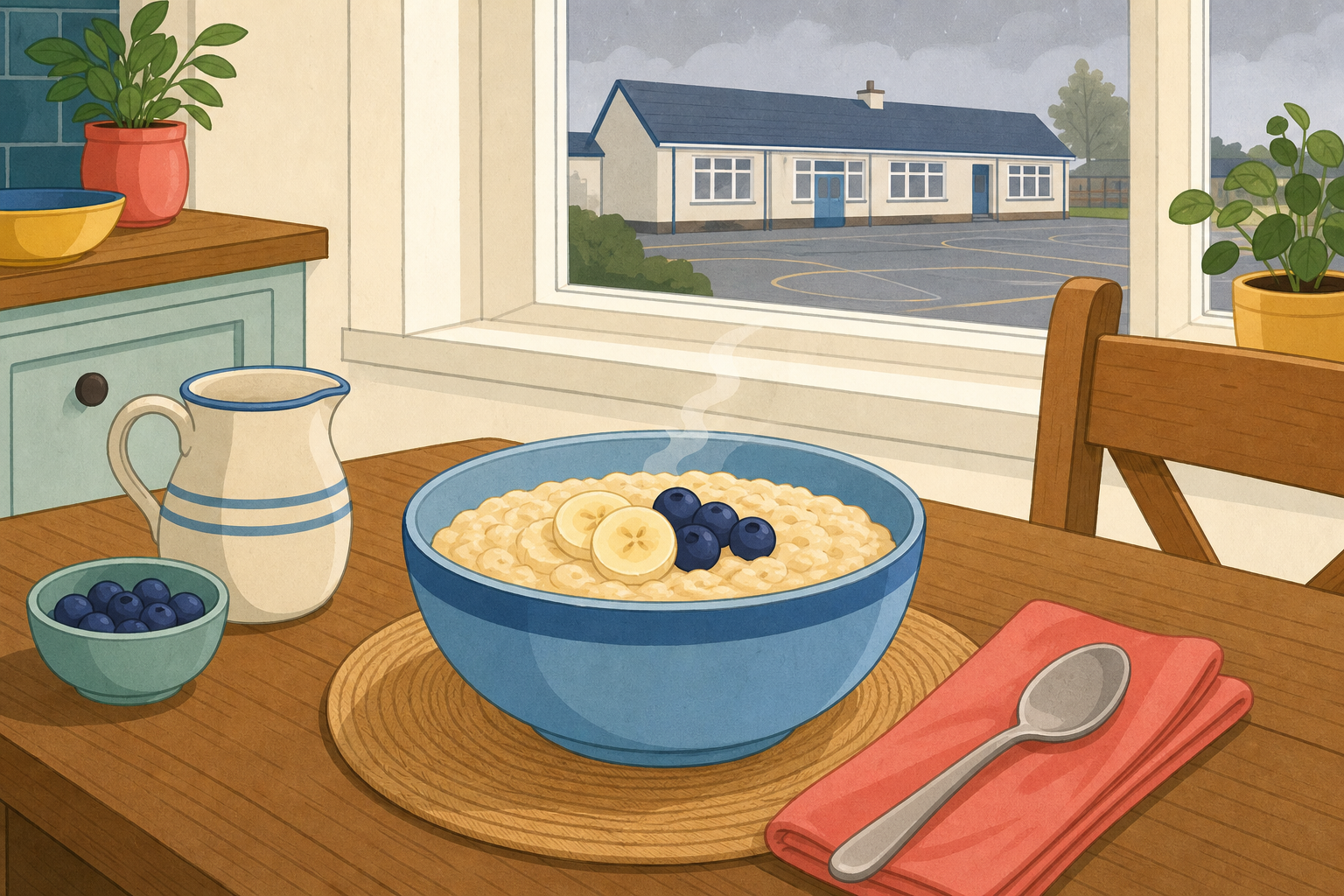
A porridge recipe makes two bowls: one cup of oats and two cups of water. But there are twenty-eight of us in the class this morning and everyone is hungry.
Roughly how much oats and water do you think we would need to feed the whole class? Have a guess before we work it out exactly.
Take three hands-up estimates, not open call-outs. Don't correct any of them yet — the point is to get pupils anchored on the idea that both the oats and the water have to grow. Listen for anyone who says only the oats need to change; that's the misconception this lesson targets.
The interactive shows a recipe scaled up to feed more people, first pancakes then soda bread. Each time, predict the new amounts before we reveal them, and notice that both bars have grown by the same factor.
This is the key one: it does not matter whether the recipe is in cups, eggs or grams — proportion always multiplies everything by the same factor.
Pancakes for 4 is the baseline: 2 cups flour, 3 eggs.
For 8, ask before revealing: crowd doubles, so what happens to the flour? Scale factor ×2, reveal 4 cups flour and 6 eggs.
For 12: 12 is three times 4, so ×3. Reveal 6 cups flour and 9 eggs. Land it here that both bars keep the same shape, just three times longer.
Soda bread baseline is a 500 g loaf, 5 parts flour to 1 buttermilk.
For the 1,500 g loaf: 1,500 ÷ 500 = ×3, so every part triples to 15 parts flour and 3 buttermilk.
Draw out that the rule holds whatever the unit — cups, eggs or grams: proportion multiplies everything by the same factor.
Today we build a class-porridge recipe on the ratio bars. Our recipe for 2 people is 1 cup of oats to 2 cups of water. We will scale it together in this order: first for 4 people (×2), then for 6 people (×3), then for 14 people (×7). Before each reveal, predict the oats and the water. Watch how both bars grow by the same factor every single time.
This round is for talking it through together — pupils take turns at the board while the whole class predicts both amounts aloud before each reveal, then agrees or corrects.
Name the scale factor before touching the bars each time: 4 people is ×2, 6 people is ×3, 14 people is ×7. Have a pupil at the board grow both bars, and the class calls out both scaled amounts. The wrinkle to watch for is that the ×7 step is the key one — pupils see the same rule cope with an awkward factor. If anyone scales only the oats, stop and ask what happens to the taste if the water stays the same?
In your maths copy, write each ingredient on its own line and put the times factor beside it — like Oats: 1 cup ×7. Then in a second column, work out and write the new amount for each line. Start with the class porridge scaled for 14 people (×7):
Fill in the new amount for each line in your second column, then do the same for the pancakes scaled to 12 people (×3).
Walk the room glancing at the times factor and the second-column answer — this is whole-class copybook practice, not marking. Check that pupils write the same factor on every ingredient line; a different factor on two lines is the exact slip to catch.
We work through these proportion problems one at a time. For each one, predict the answer, then set the bars and check before we move on:
If we have time, try the stretch: how far would that same car go on 10 litres?
These are the practice questions — pupils take turns at the board, check each answer, and the class confirms before moving on. Keep the board work brisk rather than over-explaining.
For every problem, have the class find the scale factor first (18 ÷ 6 = ×3; 6 ÷ 2 = ×3; 8 ÷ 2 = ×4). Then both quantities grow by that factor. The journey problem is the ceiling — pupils must spot that 8 litres is four times 2 litres, so the distance is four times 30 km, which is 120 km; the stretch, 10 litres, is ×5, so 150 km. Watch for pupils who add instead of multiply (they may say 30 + 30 = 60 for double the fuel, which is fine for ×2 but breaks at ×4).
On the chairs and journey problems the two bars will look very different in length (e.g. helpers beside chairs, litres beside kilometres). That is expected — tell the class the point here is the scale factor, not the bar shape, so they are not thrown by the mismatched bar lengths.
You're previewing this lesson. Get full access to this lesson and hundreds more — each one ready to teach, with interactive activities, printable resources and pupil progress tracking built in.