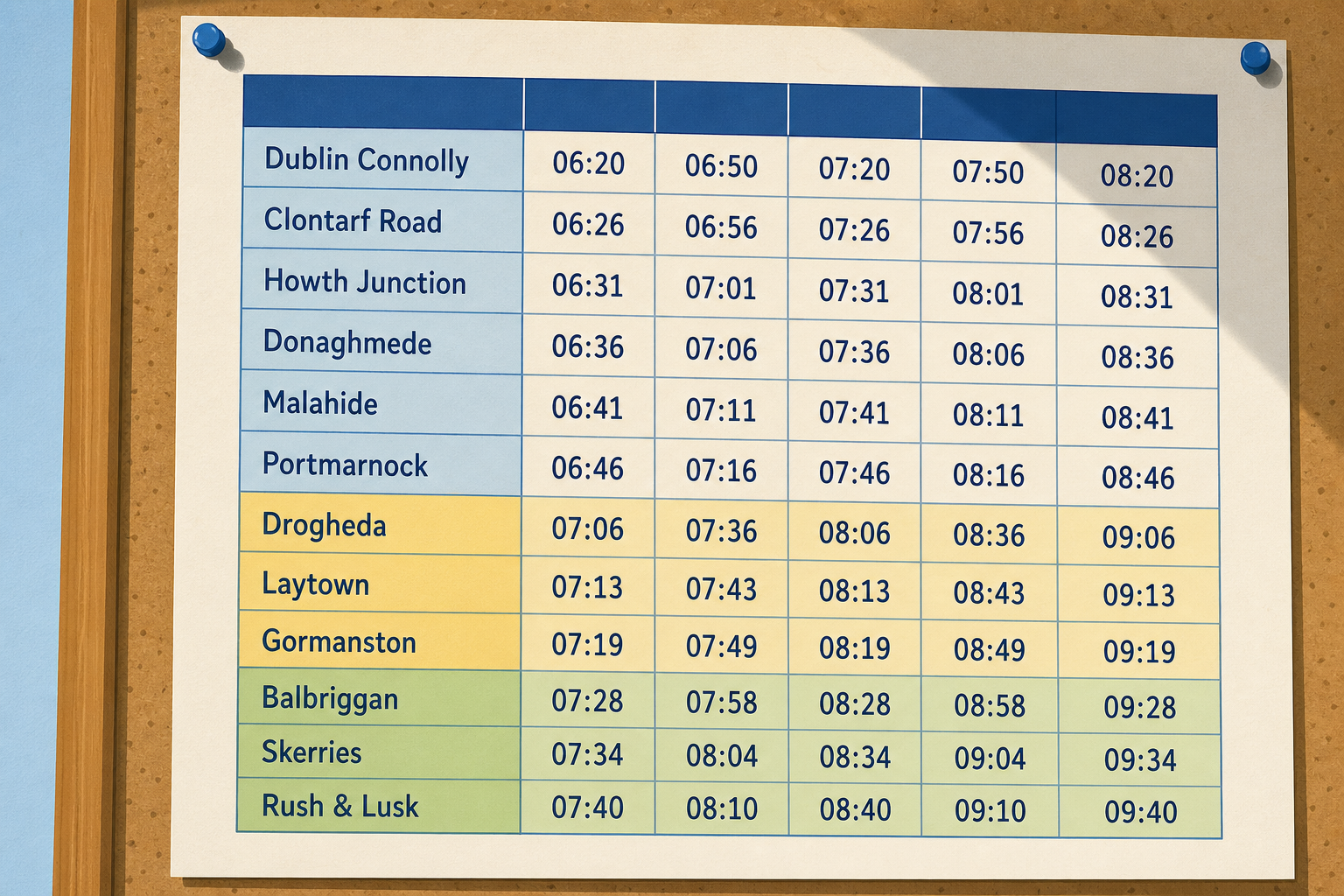
Here is an example timetable for the Cork to Dublin line. A family wants the 07:00 train from Cork. It reaches Dublin Heuston at 09:35.
How long is that journey? Take a good look before anyone answers.
Display the timetable image as pupils settle. Give five seconds of quiet think-time, then take two or three hands-up answers — do not confirm which is right yet, that lands in the next step.
Listen for the common slip: subtracting 09 minus 07 to get 2 hours and stopping there. Hold that thought; the 35 minutes is what the lesson works on.
Watch three journeys on the timetable. For each one, find the depart cell and the arrive cell, then count up from one to the other.
Notice how we bridge through the whole hour. First count the minutes up to the next full hour. Then count the whole hours. Then add the last few minutes.
This last one is a shorter hop that stays inside one hour. Watch how the count-up works when there is no whole hour to bridge.
Point at the depart cell, then the arrive cell, for each journey. Say the count-up aloud so pupils hear the bridging: 07:00 to 08:00 is one hour, 08:00 to 09:00 is two hours, then 09:00 to 09:35 is thirty-five minutes.
Do not proceed until the class can say the count-up steps back to you.
Today we work through these journeys on the timetable together. We will tap the depart cell, then the arrive cell, and read off how long the journey takes:
Each journey is a different length, so watch how the count-up changes.
Talk this one through together — pupils take turns at the board and the class agrees or corrects out loud. Model the bridging count-up on the first two. On Thurles to Portlaoise, remind the class there is no whole hour to bridge, so the answer is just the minutes.
Ask a pupil to tap depart first, then arrive; the class calls out the count-up before the interactive confirms the elapsed time. Revoice a strong answer. So you went up to the next whole hour first. Then you counted the hours. Then you added the last minutes.
Watch for pupils reading the wrong column — the depart cell and arrive cell must sit in the same service column, or the journey doesn't exist. If two cells are in different columns, ask could you catch that same train?
In your maths copy, write each journey on a line with its depart time and arrive time, reading both off the grid yourself. On the next line, work out and write the elapsed time.
When all three are done, circle the longest journey and the shortest journey.
Walk the room glancing at the count-up working — this is whole-class copybook practice, not marking. Look for pupils who write the depart and arrive but jump straight to a subtraction and lose the 35 minutes. Point them back to the count-up bridging strategy.
Today we work through these timetable questions together. Each one names a journey to find and a journey time to check:
We move from a whole journey, to a short hop, to a middle leg, then back to comparing two full journeys.
This is the practice round — pupils take turns at the board, check each answer, and the class confirms before moving on. Keep the board work brisk rather than over-explaining.
Before each Check, the class predicts the elapsed time from the count-up. On a wrong cell, ask are both cells in the same service column? The last challenge is the notice-and-compare moment: the 11:00 Cork-to-Heuston is 2 hours 35 minutes, exactly the same as the 07:00 service, so a later start does not make the journey longer.
You're previewing this lesson. Get full access to this lesson and hundreds more — each one ready to teach, with interactive activities, printable resources and pupil progress tracking built in.