Look at the three groups of blocks in the picture on the board, labelled A, B and C. Up to now, a flat meant one hundred, a rod meant ten and a small cube meant one. Today we are going to relabel them: the flat is now 1, the rod is now 0.1 and the small cube is now 0.01. Read each group as a decimal. What number is group A showing? What about B and C?
The picture on the board shows the three labelled groups: A is three rods (so 0.3), B is two rods and seven small cubes (so 0.27), and C is one flat and five small cubes (so 1.05). If the projected picture is too small or unclear, quickly sketch the three groups on the board, or build them with real blocks, and label them A, B and C — that way the class always has something concrete to look at.
Take three hands-up answers, not open call-outs. Give five seconds of quiet think-time before any hands go up. The point of the hook is just to surface that the same blocks can mean different amounts depending on how we name them — don't correct or confirm the answers yet, that comes in Watch and Notice.
Each interactive shows a decimal made from blocks in the units, tenths and hundredths columns. Notice which columns have blocks and which are empty, and read the number.
0.3 — three rods in tenths, no hundredths; read three tenths. Ask what the empty hundredths column tells us.
0.27 — two tenths, seven hundredths; name each column separately before reading the whole.
1.05 — the key one. One flat, no tenths, five hundredths. Pause: why the zero? Draw out it holds the tenths place so the 5 stays in hundredths. Don't move on until they can say what the zero is doing.
2.30 — two wholes, three tenths, no hundredths; read two and three tenths. Draw out the trailing zero means no hundredths, so 2.30 is the same amount as 2.3. This comparison returns at the end of the lesson.
Let's try a few together. When I call out a decimal, build it on the place-value mat with the U, t and h columns. The numbers we will work through are 0.6, 0.43, 0.08 and 1.04. We will read each one aloud as a class and check the columns before we move on.
This round is for talking it through together — pupils take turns at the board and the class agrees or corrects out loud.
Call the four numbers in order: 0.6 (tenths only), 0.43 (both columns), 0.08 (hundredths only — watch for pupils who write 0.8 by mistake) and 1.04 (whole plus the placeholder zero). Each time, have the pupil at the board place the blocks, then ask the class to read the number aloud as a whole before confirming. Listen for pupils saying nought point eight for 0.08 — that is the misconception to head off; ask which column the 8 is sitting in.
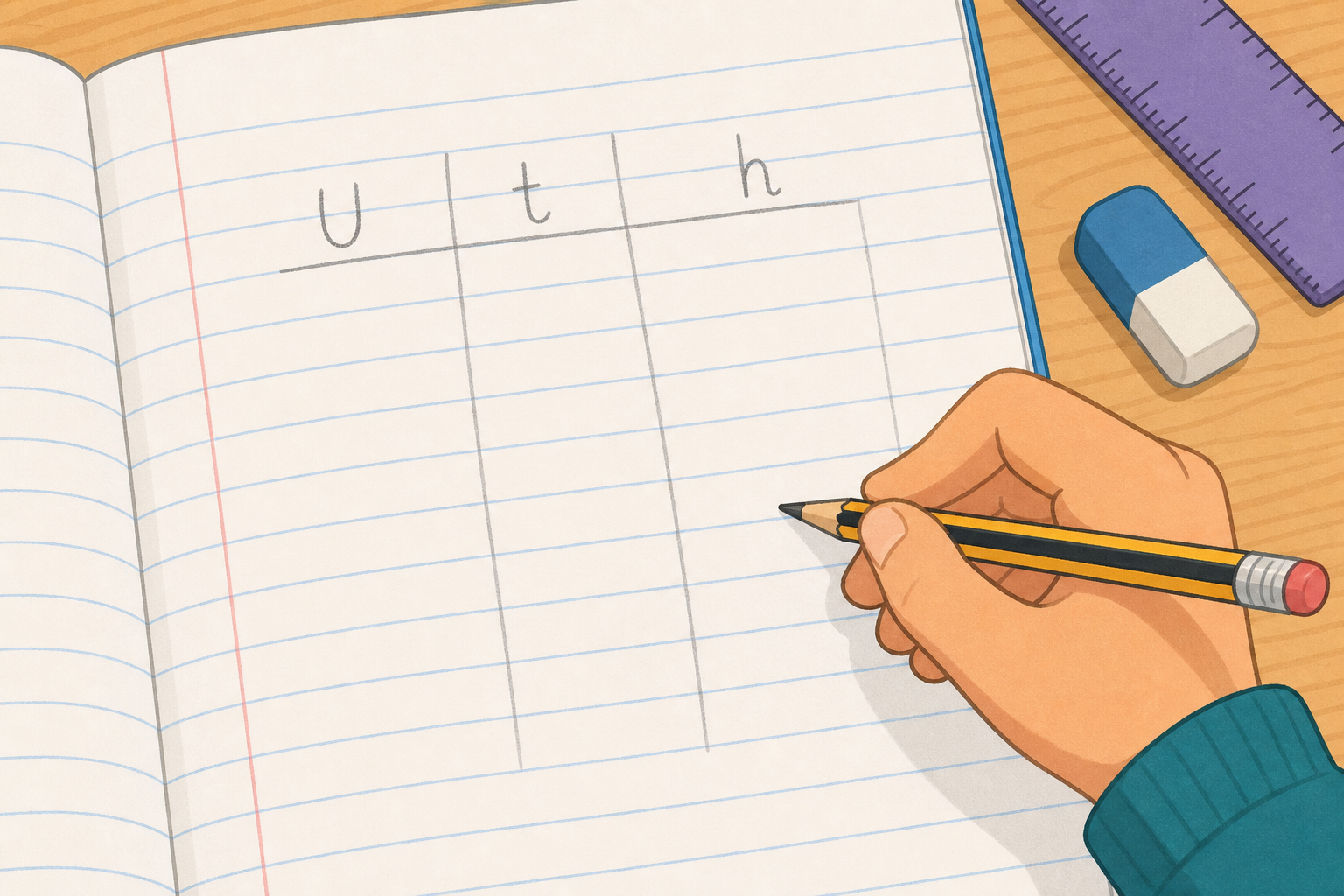
In your maths copy, sketch the three place-value columns and label them U, t and h. Then write each of these decimals into the columns, one under the other. After you write each one, read it aloud quietly to yourself.
Walk the room glancing at column labels and alignment — no marking, this is whole-class copybook practice. Watch for the 1.05 row: check that the zero is sitting in the tenths column, not skipped over.
Today we work through these numbers together: 0.06, 0.4, 0.43, 1.07 and 2.5. The zeros catch people out, so we will say each one aloud and check the columns before we press Check.
These are the practice questions — pupils take turns at the board, check each answer, and the class confirms before moving on. Keep the board work brisk rather than over-explaining.
Pupils take turns building each target on the mat. The tricky ones are 0.06 (six hundredths — no tenths, the placeholder zero) and 2.5 (two and five tenths, with no hundredths). For each, have the rest of the class predict the column layout before the pupil at the board places the blocks, then press Check together. Revoice a strong answer: so the zero in 0.06 is holding the tenths place, and that is why it is six hundredths, not six tenths.
Earlier we read 2.30 as two and three tenths, the same amount as 2.3. Talk it through: why is 0.4 the same as 0.40? What is sitting in the hundredths column of 0.40, and does it change how much we have?
Anchor the talk to the 2.30 example the class already saw built on the board: the trailing zero there meant no hundredths, so 2.30 and 2.3 were the same amount. Apply the same idea to 0.4 and 0.40. Listen for pupils naming the trailing zero as no hundredths, so 0.40 has four tenths and nothing extra — the same amount as 0.4. Revoice a strong answer: so adding a zero on the end after the decimal point doesn't make the number bigger, because it just says there are no hundredths. Head off the common slip that a longer-looking decimal must be bigger.
Next we will put decimals onto a number line, so we can see exactly where a number like 0.7 or 0.34 sits between two whole numbers.
Keep this brisk. Recap the three relabelled blocks and the placeholder-zero idea, then preview the number line lesson.
You're previewing this lesson. Get full access to this lesson and hundreds more — each one ready to teach, with interactive activities, printable resources and pupil progress tracking built in.