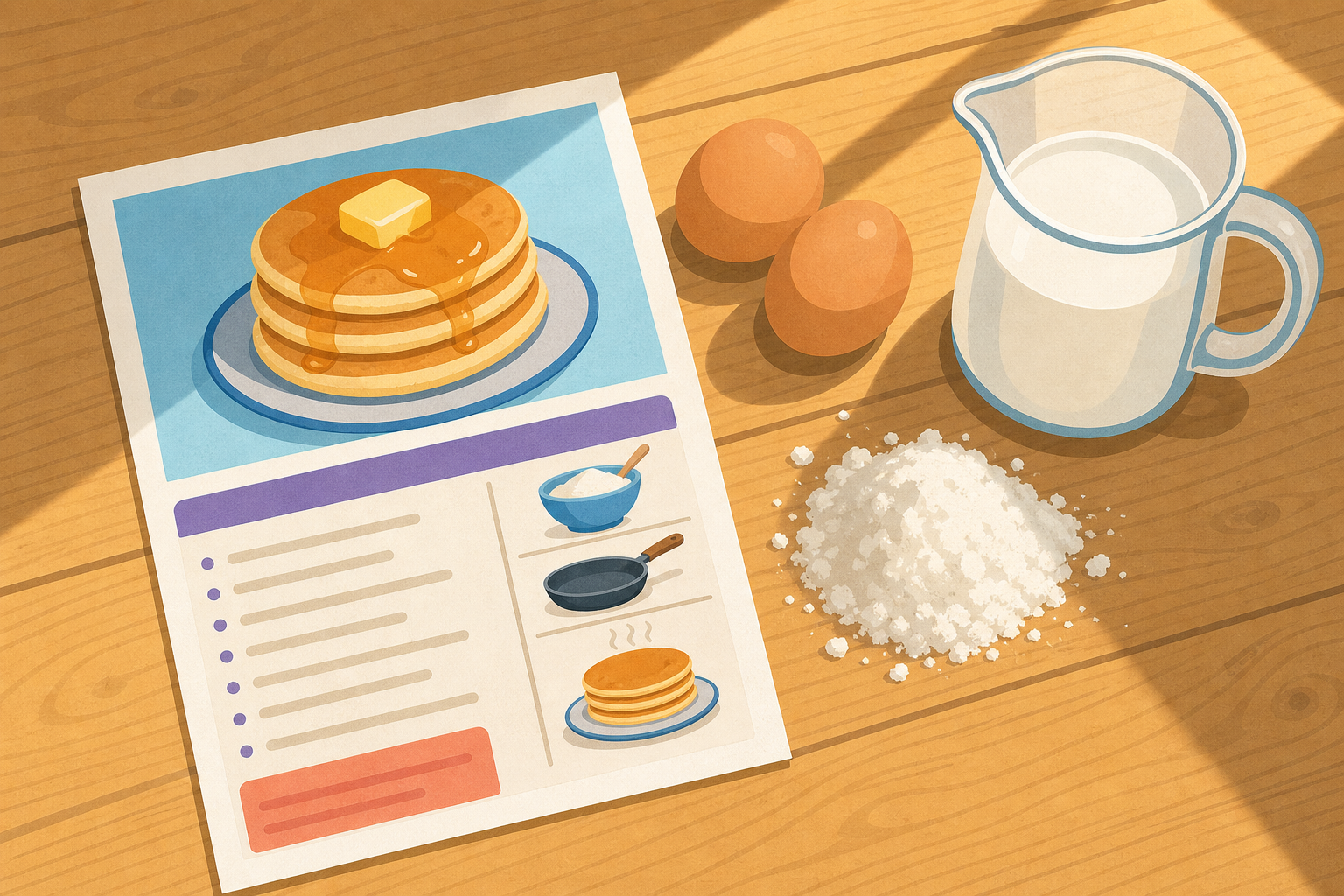
Here is a pancake recipe that feeds four people: 2 eggs, 400 g of flour and 600 ml of milk. Tonight, eight people are coming for pancakes.
How would you change the recipe so everyone gets the same-sized pancakes? What has to happen to every ingredient?
Take three hands-up answers, not open call-outs. Listen for the word double. If a pupil changes only one ingredient, hold that thought for Watch and Notice rather than correcting it now.
Give five seconds of quiet think-time before any hands go up.
The interactive shows four recipes as ratio bars, where each bar's length is that ingredient's share. Look at the four recipes shown as ratio bars. For each recipe, say what the bars show and how the amounts relate before we agree it as a class.
Pancakes for 4: name each share (2 eggs, 400 g flour, 600 ml milk); ask which bar is biggest and why.
Doubled to 8, the key move. Ask first: if the flour doubles, what must happen to eggs and milk? Hold out for every ingredient. Name the scale factor aloud (2); the bars show shares still lined up.
Smoothie tripled — a scale factor that is not 2, modelling the ×3 that comes next. 1 banana to 300 ml milk becomes 3 bananas to 900 ml milk. Ask what happens to each bar; both triple, ratio stays 1 to 3.
Squash 1:4 in 1 litre — five parts share one litre, so one part is 200 ml. Juice bar 200 ml, water bar 800 ml; ask what the two amounts add to.
In your maths copy, rewrite this smoothie's three ingredients for the new number of people. Write the scale factor at the top of your working, then check that every line uses it.
Rewrite this smoothie for 9 people. Write your scale factor first, then work each ingredient.
Walk the room glancing for the scale factor written at the top (×3) and that all three lines use it. No marking — this is whole-class copybook practice, not assessment. Catch the pupil who scales one ingredient and forgets another.
Today we'll build this on the ratio bars together. Here is a new smoothie: 1 part banana to 5 parts milk, poured into a 900 ml jug for a group. Before we reveal it, tell me how many equal parts share the 900 ml and what one part is worth. Then we'll set the bars and read off each actual amount.
Talk this one through together — pupils take turns at the board and the class agrees or corrects out loud.
Start with the smoothie 1:5 (6 parts) filling 900 ml. Before setting the total, ask the class: how many equal parts share the total? (6, so one part is 150 ml.) Then reveal the actual amounts (banana 150 ml, milk 750 ml). Keep pupils naming the one-part value each time, and try the second prompt if time allows.
Today we'll work through three mixtures together, each one a little harder than the last. Tell me how many parts share the total before we reveal each one.
This is the practice round — pupils take turns at the board, check each answer, and the class confirms before moving on. Keep the board work brisk rather than over-explaining.
The lemon drink is the easy start: 1:2 makes 3 parts sharing 900 ml, so one part is 300 ml (lemon 300 ml, water 600 ml). For the nut-and-raisin mix, the board shows how 250:100 simplifies to 5:2 (÷50); that gives 7 parts, so 100 g per part (nuts 500 g, raisins 200 g). The paint mix is the stretch: 2:3 in 2.5 litres means 5 parts, so one part is 500 ml (blue 1000 ml, white 1500 ml). Push the strongest pupils to state the one-part value out loud before touching the bars.
You're previewing this lesson. Get full access to this lesson and hundreds more — each one ready to teach, with interactive activities, printable resources and pupil progress tracking built in.