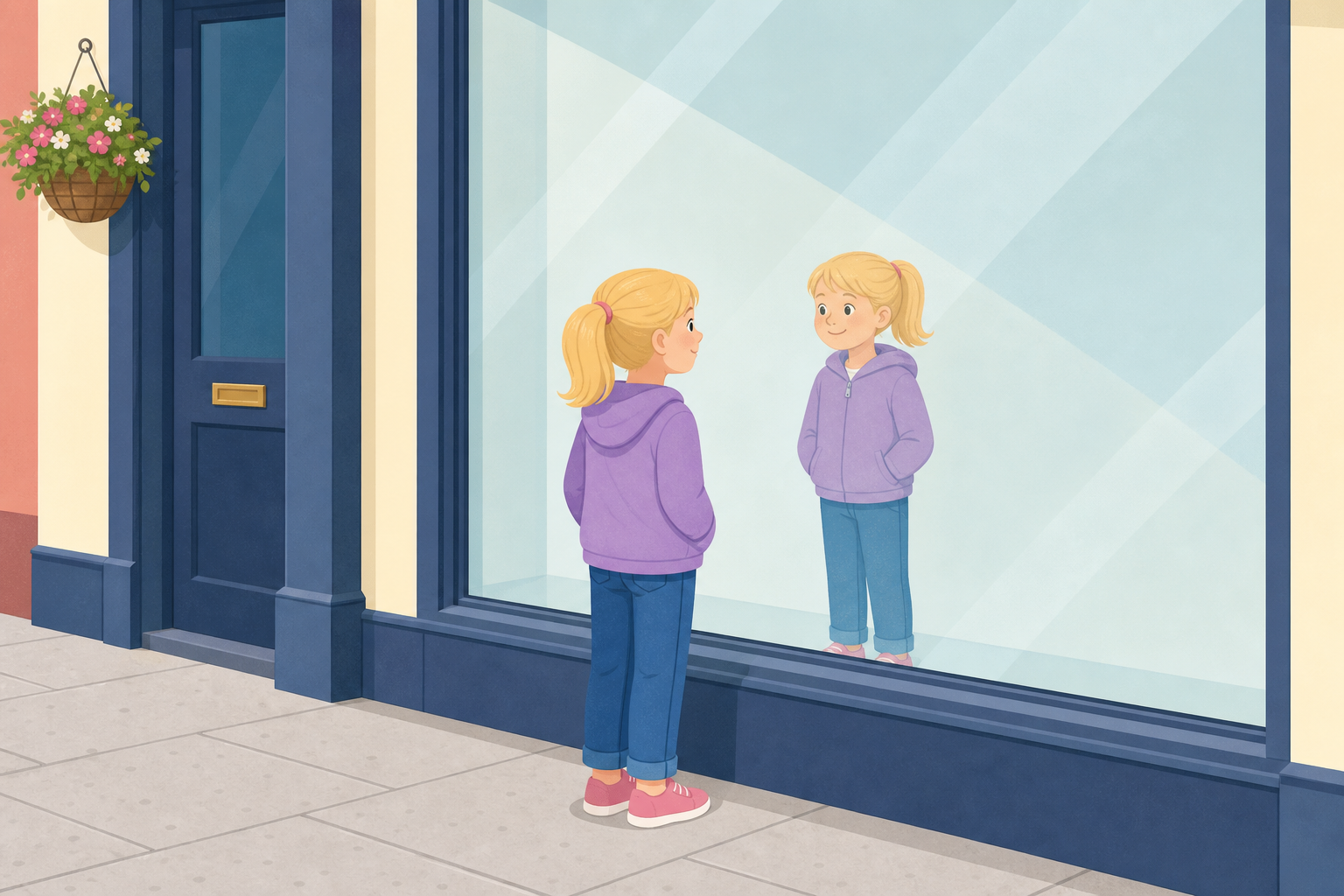
Look at your own reflection in a shop window. Your right hand looks like the reflection's left hand, but you are exactly the same distance in front of the glass as your reflection seems to be behind it.
A shape works the same way when we flip it across a line on the co-ordinate plane. What do you think happens to a point's co-ordinates when we flip it across the up-and-down line through the middle?
The new shape we get after a flip is called the image. It is the same size as the first shape but faces the opposite way.
First we look at a triangle flipped in the y-axis. Notice a corner before the flip and its image after. Look at where each corner lands, and how far each corner sits from the mirror line on each side.
Now we look at a different shape, an L-shape, flipped in the x-axis. Notice it before the flip and its image after. Be ready to say which co-ordinate changed and which stayed the same.
In your maths copy, draw a small shape on the right of the y-axis and draw the y-axis as your mirror line. Then draw its reflection on the left. Write the co-ordinates of one corner and the co-ordinates of its image underneath, so the sign change on the x-co-ordinate is clear.
Now we plot a reflection together on the board. We will name each image co-ordinate as it lands:
Now we work through the challenge questions together. Each round asks you to plot a reflected image. As you plot each one, say out loud which axis is the mirror and which co-ordinate flips its sign. On the last round no axis is named: look at the starting point, work out for yourself which axis must be the mirror, say it aloud, then plot the image to check you were right.
You're previewing this lesson. Get full access to this lesson and hundreds more — each one ready to teach, with interactive activities, printable resources and pupil progress tracking built in.