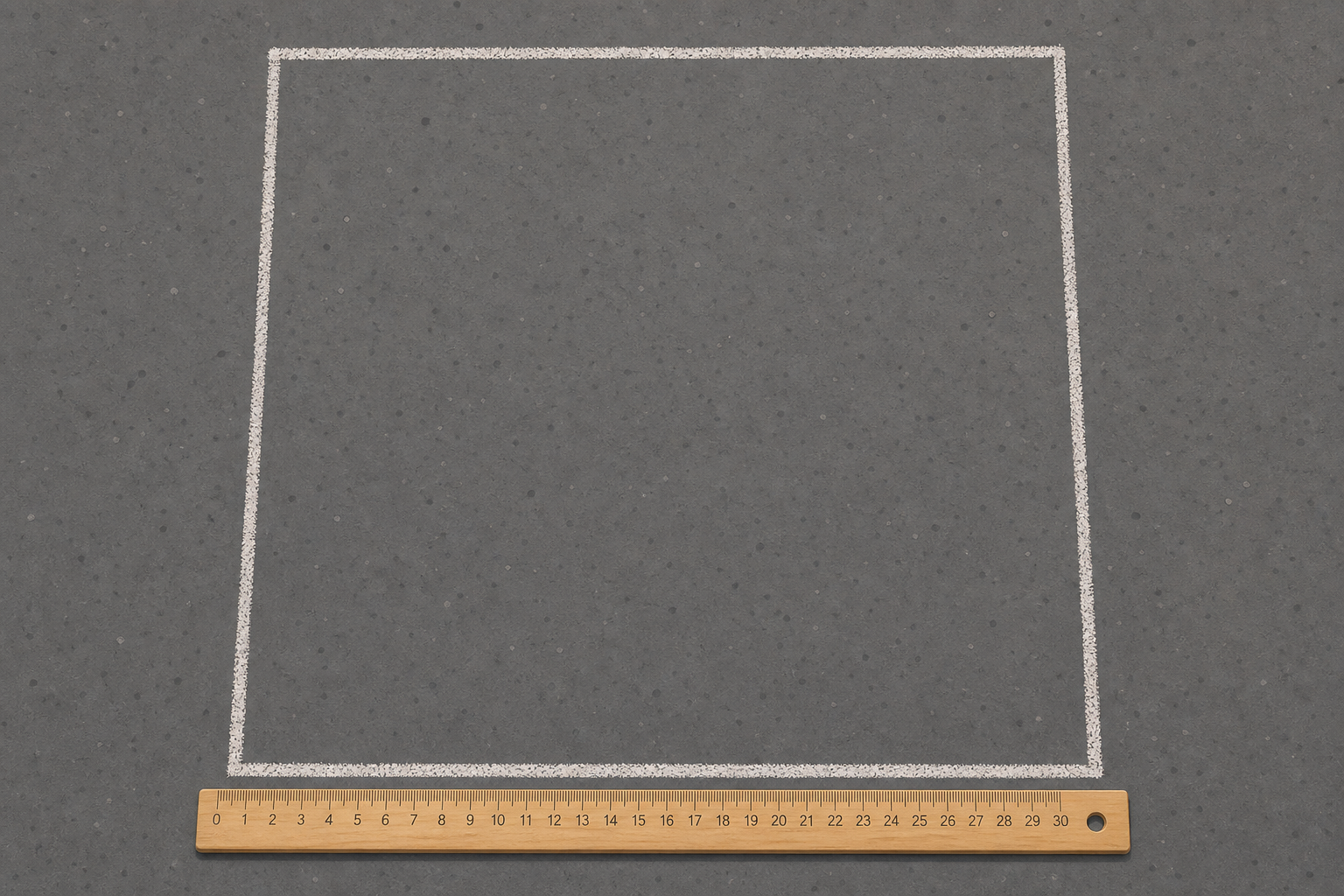
Picture a square that measures one metre along every side. Hands up: how many centimetres run along just one edge of it?
Now the harder question, hold it in your head before anyone answers: how many little one-centimetre squares would it take to cover the whole big square?
Take three hands-up answers for the edge (expect 100 cm), then let the second question hang. Do not confirm the total yet.
Listen for the common wrong prediction of 100 for the whole square, that is the misconception this lesson exists to fix. Note it without correcting; the grid in the next step settles it.
Look at the one-metre square with its grid. Notice how the grid splits each edge, so the whole square is filled with rows and rows of one-centimetre squares.
Count with the grid: how many squares in one row, and how many rows? Notice the answer is not the same as one edge count. Look at what the two counts do together.
Now look at two square metres side by side. If one whole holds that many, two wholes hold twice as many.
Hold on the first grid until the class sees the two edges are each 100 cm. Ask how many along one row, how many rows? before revealing the product.
The pivot is here: 100 along and 100 up gives 100 × 100, not 100. Say the length scaled by 100 and the breadth scaled by 100, so the area scaled by 100 twice.
On the 2 m² grid, point out the two halves as two separate square metres before revealing the total, so the class reads it as two square metres and not one long strip. Ask the class to predict the total before you point at it. Revoice a pupil who says "double 10,000".
A metre is 100 centimetres, so going down from m to cm we multiply by 100, and coming back up we divide by 100. Watch the label between the two units: it shows × 100 going down and ÷ 100 coming back up.
On screen is the conversion ladder for the edges.
Try it together: set the ladder to 1 m and watch it become 100 cm, then send 100 cm back up to 1 m. Once we can all see the edge scales by 100, we will use that to work out the area next.
Talk this one through together, pupils take turns at the board and the class agrees or corrects out loud.
What is on screen: only the edge ladder (m ↔ cm). Use it to confirm the edge conversion is × 100 down / ÷ 100 up. Reset the From value manually for each round: run 1 m → 100 cm, then 100 cm → 1 m, so the class sees both directions.
Then step off the ladder and work at the board (the ladder does not show area units, so keep this board work separate and say so): build the area factor 100 × 100 = 10,000, then work the four area conversions by hand: 3 m² = 30,000 cm², 25,000 cm² = 2.5 m², 0.5 m² = 5,000 cm², 40,000 cm² = 4 m². For 0.5 m², hold out for the prediction before you confirm. The common slip is 50,000 (multiplying half a metre as if it doubled) or dropping to 500; the correct answer is 5,000 cm², exactly half of 10,000.
Keep reminding the class: the edge factor is 100 but the area factor is 10,000, because area carries the square. This is the point the whole lesson turns on.
In your maths copy, write each area from today's lesson in both cm² and m², side by side. Between the two, draw a conversion arrow and write "×10,000" or "÷10,000" on it, pointing the way you converted.
Walk the room and glance at the direction of the arrow and the factor beside it, no individual marking, this is whole-class copybook practice not assessment.
The common slip is writing ×100 instead of ×10,000, catch it on the spot.
First, use the ladder to convert some everyday classroom lengths, each one a step harder: 4.2 m into cm, then 250 cm into m, then 3.5 m into cm.
Then watch as we build the tiling problem on the board together: how many 25 cm × 25 cm tiles cover 1 m²? We will work out the area of one tile, then share the whole 10,000 cm² between the tiles to find the answer.
Run the edge conversions on the ladder first (pupils take turns at the board, check each answer, the class confirms before moving on). All three are everyday classroom lengths: 4.2 m → 420 cm, 250 cm → 2.5 m, 3.5 m → 350 cm. Keep the board work brisk rather than over-explaining. These edge rounds keep the × 100 / ÷ 100 rule warm.
Then build the tiling problem on the board, off the converter, because the converter cannot show a division. Draw it out step by step: one tile is 25 × 25 = 625 cm²; 1 m² is 10,000 cm²; so 10,000 ÷ 625 = 16 tiles. This is the key one that ties the 10,000 fact to a real building job. Let a pupil reason it aloud before you confirm.
You're previewing this lesson. Get full access to this lesson and hundreds more — each one ready to teach, with interactive activities, printable resources and pupil progress tracking built in.