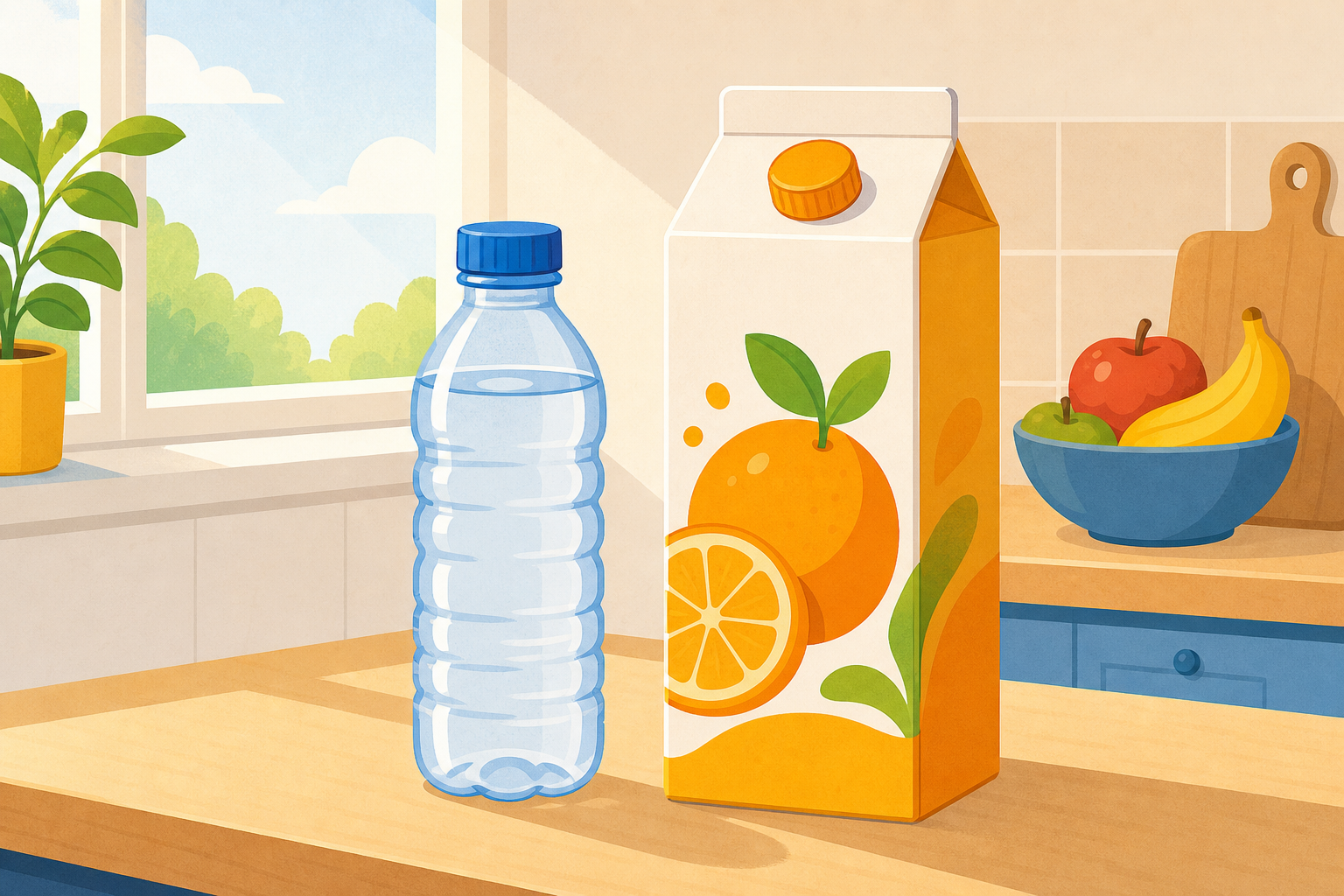
A bottle of water says 500 ml on the label. A big carton of juice says 1 litre. How many of those water bottles do you think it would take to fill the carton right up?
Have a think before any hands go up. What is it about the two labels that makes them tricky to compare?
Display the 500 ml bottle and the 1 litre carton side by side as pupils settle. Give five seconds of quiet think-time, then take three hands-up answers, not open call-outs. Write 1 l = 1,000 ml on the board once someone reaches it, but don't over-explain yet — that is the next step's job.
Watch one full rename on the board first, then notice the pattern on each display.
Worked example: rename 1 l 500 ml into millilitres only.
So 1 l 500 ml and 1,500 ml are the same amount, just written two ways.
Now look at each display. Have a prediction ready: will the number get bigger or smaller, and are we multiplying or dividing by 1,000?
Board the worked example before touching the displays. Write the two steps as you go: 1 l → 1,000 ml, then 1,000 + 500 = 1,500 ml. Say why the number grows: ml is the smaller unit, so it takes more of them.
Slip to head off: writing 1 l 500 ml as 150 ml or 1,500 l. Stress the litre alone is already 1,000 ml.
Then step through the three converter displays, asking for a prediction each time:
1 l to ml → 1,000 ml (× 1,000).
2 l to ml → pause for prediction, then 2,000 ml.
1,500 ml to l → number gets smaller; 1.5 l, read as 1 l 500 ml. Head off 15 l.
For 1 l 500 ml to ml, stay on the board with the worked example (the converter takes one value in one unit); same two board steps. This is the method they use next.
Today we work through these together on the board: first we rename 3 l into millilitres, then 4,000 ml back into litres, then the mixed amount 1 l 250 ml into millilitres, and finally 2,500 ml back into litres and millilitres. For the mixed one, we combine it by hand first the way we just did , 1 litre is 1,000 ml, add the extra 250 ml, then set that on the converter. The mixed ones catch people out, so we will say each one aloud before we check it.
This round is for talking it through together — pupils take turns at the board and the class agrees or corrects out loud.
For each call, a different pupil sets the From and To units on the converter and reads the result. Ask the class each time: are we multiplying by 1,000 or dividing by 1,000? For the mixed prompt, combine 1 l 250 ml into 1,250 ml by hand first (1 litre = 1,000 ml, add 250 ml), then enter 1,250 ml on the converter — the tool takes one value in one unit, so the combining is a board move before the tool. Watch for the pupil who converts 1 l 250 ml as 125 ml — remind them the 1 litre alone is already 1,000 ml. Keep the four values in the order named so the round builds from the clean × 1,000 up to the mixed amounts.
In your maths copy, complete this short rename column, showing your working beside each one:
Beside each answer, write whether you multiplied or divided by 1,000. For the mixed amount, turn the whole litre into 1,000 ml first, then add the extra millilitres.
Walk the room glancing at the working — did they note × 1,000 or ÷ 1,000? This is whole-class copybook practice, not marking. Watch for the mixed-amount slip on the last two rows (splitting or combining the litre part).
Today we work through these numbers together at the board: 4 l → ml (a clean times a thousand), then 6,000 ml → l (a clean divide by a thousand), then the mixed amount 1 l 250 ml, combine it by hand first the way we practised, then convert that back to litres on the board to check, and finally 2,750 ml → l and ml. Predict where the number will land before we check each one.
These are the practice questions — pupils take turns at the board, check each answer, and the class confirms before moving on. Keep the board work brisk rather than over-explaining.
The practice set rises in difficulty: the first two are clean single-step conversions, the last two need the litre part combined or split. For the third, combine 1 l 250 ml into 1,250 ml by hand first, then convert 1,250 ml back to litres on the converter to check the figure. For the final challenge the converter shows 2.75 l; make the mixed read explicit on the board — 2 whole litres, and 0.75 of a litre is 750 ml, so 2,750 ml = 2 l 750 ml. Ask the class to predict each answer before the pupil presses Check. The point is that final split — that is where the whole round has been heading.
You're previewing this lesson. Get full access to this lesson and hundreds more — each one ready to teach, with interactive activities, printable resources and pupil progress tracking built in.