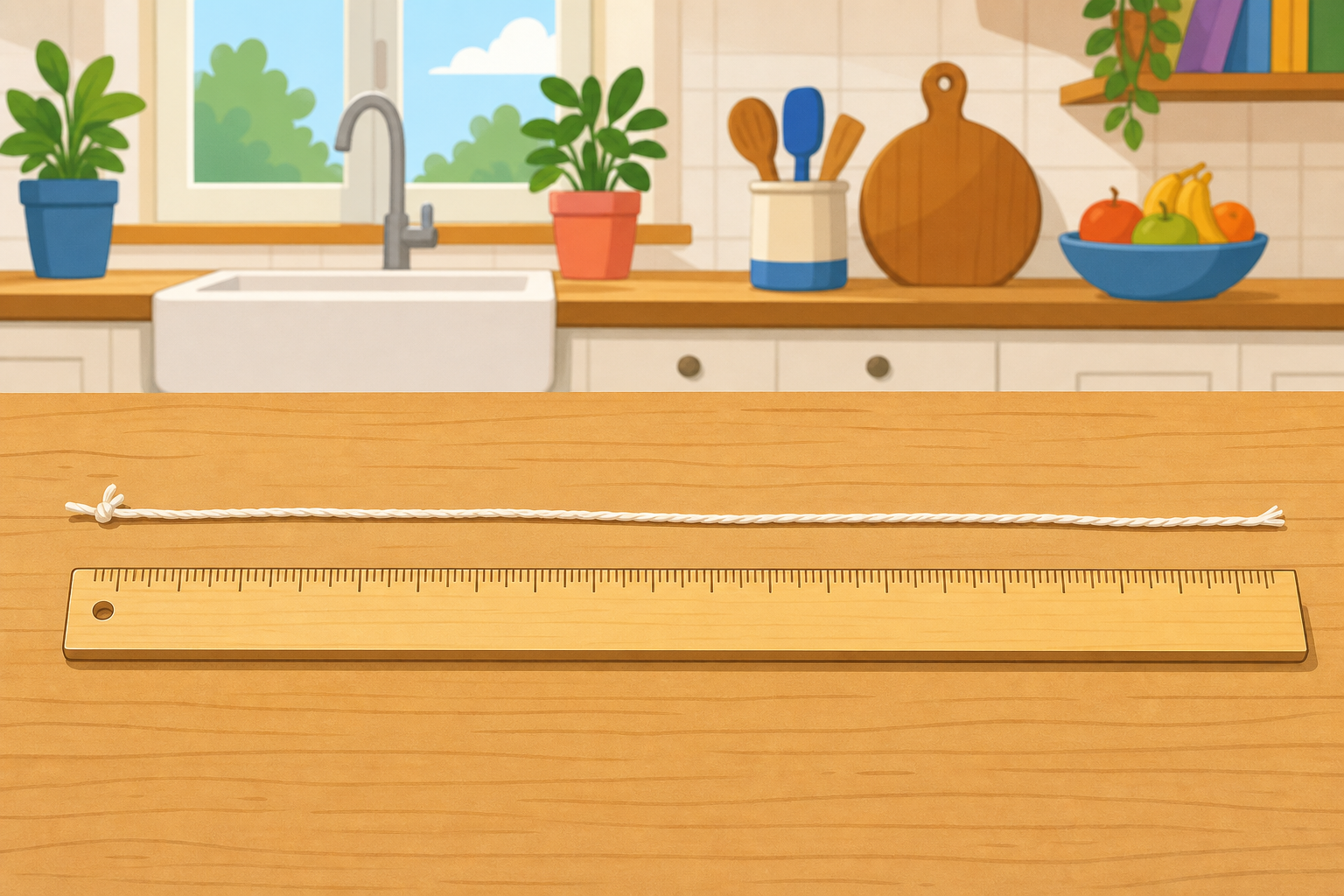
Here is a question. This piece of string is one metre long, so how many centimetres long is it as well?
The string did not get any longer or shorter when we asked the question. We are just about to give the same length a different name.
Hold up the piece of string (about a metre long) as you pose the question. Take three hands-up answers, not open call-outs. Give five seconds of quiet think-time first.
Write 1 m = 100 cm and 1 cm = 10 mm on the board as the anchors for the whole lesson. Listen for the idea that the string is the same length either way — revoice that as renaming.
The converter changes lengths from one unit to another. Watch what happens to the number each time the unit changes, and see if you can spot the rule.
1 cm = 10 mm: smaller unit, bigger number. Point at the digits.
3 cm to mm: multiply by ten, gives 30 mm. Keep returning to 1 cm = 10 mm.
2 m to cm: multiply by one hundred (1 m = 100 cm), gives 200 cm. Name it as a bigger jump.
150 cm to m: pause first, ask how many whole metres fit inside 150 cm? The converter shows 1.5 m, then name that yourself as the mixed length 1 m 50 cm.
Today we work through these renamings together on the board, one at a time. Before each one is checked, follow along and decide for yourself: are we going to a smaller unit or a bigger unit?
This round is for talking it through together — pupils take turns at the board and the class agrees or corrects out loud.
Reveal each renaming in turn. Send one pupil up to set the converter, and have them say smaller — multiply or bigger — divide before they slide it. Rotate pupils across cm↔mm and m↔cm.
Watch for the common slip of dividing when they should multiply (or the reverse) — head it off by asking will the number get bigger or smaller? first.
In your maths copy, complete this short rename column. Beside each one, write the ×10 or ÷10 (or ×100) that you used.
Walk the room and glance for the working shown beside each answer — this is whole-class copybook practice, not marking. Watch the last one: 250 cm should split into 2 m and 50 cm.
Today we work through these renamings one at a time, getting trickier as we go. We will take them in turn: first 8 cm to millimetres, then 90 mm back to centimetres, then 6 m to centimetres. The last one, 325 cm to metres.
These are the practice questions — pupils take turns at the board, check each answer, and the class confirms before moving on. Keep the board work brisk rather than over-explaining.
For each one, prompt multiply or divide? before the pupil sets it. The final 325 cm needs them to enter 3.25 on the interactive (divide by 100). After it checks, call out that this is the same as the mixed length 3 m 25 cm.
Why does the number get bigger when we change a length to a smaller unit, like cm to mm? Think about how many small parts it takes to make one big part.
Listen for pupils explaining that a smaller unit is, well, smaller, so you need more of them to make the same length. Revoice a strong answer: so the length stays the same — we just need more pieces to describe it.
Head off the misconception that 'multiply always means more length' — the length never changed, only the count.
Next we travel much further and meet the kilometre, the unit we use for journeys and distances that are too long to measure with a ruler.
Keep this brisk. Point back at the two anchors on the board one last time so pupils leave with 1 m = 100 cm and 1 cm = 10 mm firmly in mind.
You're previewing this lesson. Get full access to this lesson and hundreds more — each one ready to teach, with interactive activities, printable resources and pupil progress tracking built in.