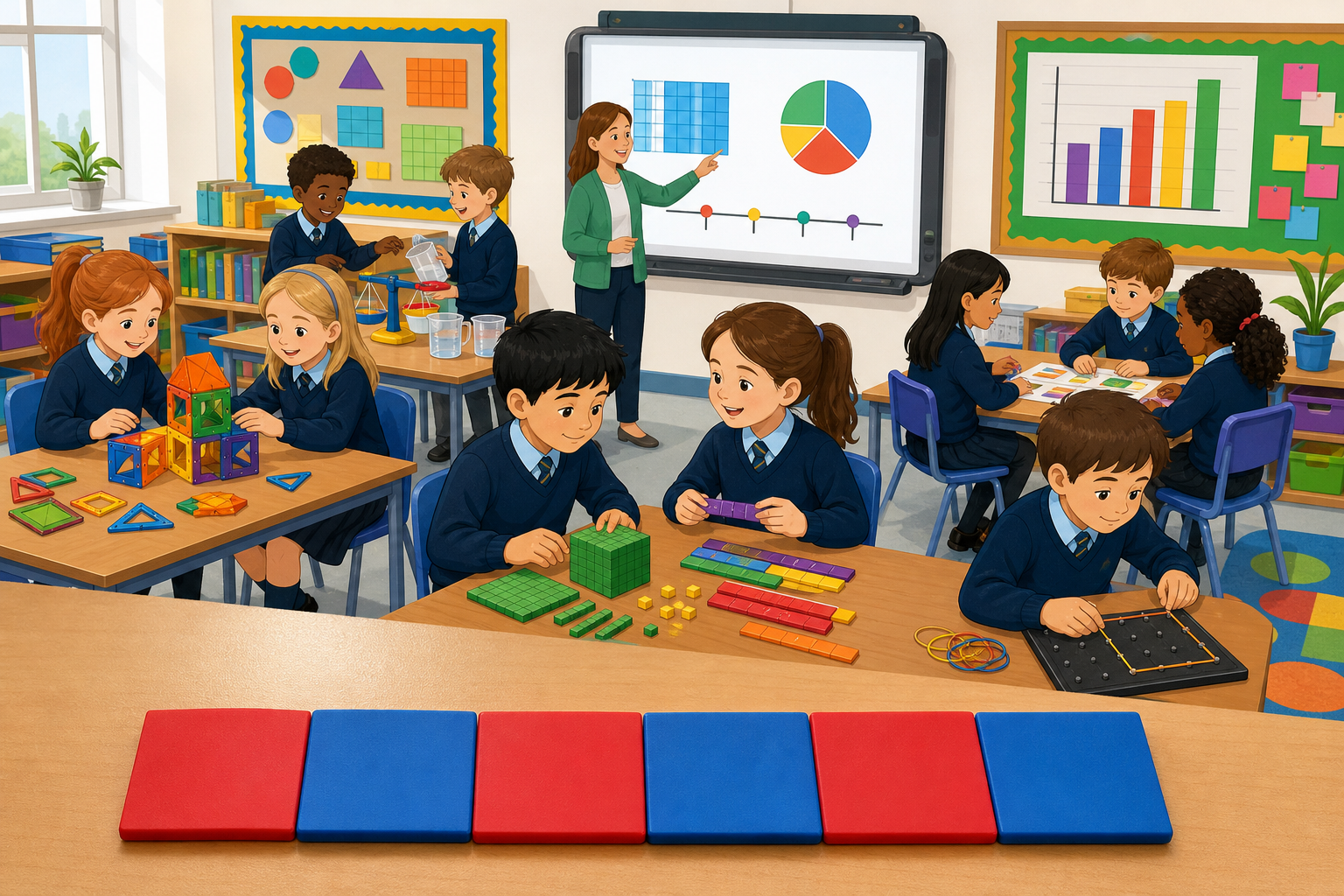
Look at this row of blocks: red, blue, red, blue, red, blue. Now hands up: what colour do you think the tenth block would be, without laying all ten of them out one by one? Have a think about how you could be sure.
Lay out (or display) a red-blue-red-blue strip of six pattern blocks as pupils settle. Take three hands-up answers, not open call-outs. Don't confirm the answer yet — the method to be certain is what Watch and Notice will build. Give five seconds of quiet think-time before any hands go up.
Two repeating patterns are on screen: one made of triangles and squares, one made of triangles and a square. Watch for the part that keeps coming back, and keep an eye on where the squares land in each one.
Two-shape unit (triangle, square repeating): ring the first triangle-square pair with your finger. This repeating part is the unit, two shapes long. Ask for the eighth shape and how the unit helped; every second shape is a square.
Three-shape unit (triangle, triangle, square repeating): unit is three shapes long. Ask where the squares keep landing. They land on the third, sixth and ninth shapes. This is the key point the lesson rests on, so hold here until the class can say every third shape is a square.
Skipping ahead: count along the row in threes, three, six, nine, landing on a square each time. Make the point that we needn't lay out nine blocks. Counting in threes is faster, and the unit length is the times-table we count in to skip ahead.
Today we explore patterns together on the board. We will start a repeating unit, then continue it for two more full repeats, and ring the unit so everyone can see the part that keeps coming back. After each one, we'll say which shape comes next and why.
This round is for talking it through together — pupils take turns at the board and the class agrees or corrects out loud.
Start a unit on the pattern-blocks board (e.g. circle, square, triangle), then call an individual pupil up to add two more full repeats and ring the unit. Have the class agree the next shape before the pupil places it. Rotate four pupils across units of length two and three. Watch for the common slip of ringing too many or too few shapes as the unit, that is the moment to revoice where does the pattern start to repeat?
In your maths copy, design your own repeating pattern with a unit of three shapes. Draw two full repeats of your pattern, then underline the repeating part so anyone reading your copy can spot the unit at a glance.
Walk the room glancing for two things: the unit is exactly three shapes, and the underline sits under one full unit (not the whole row). No marking — this is whole-class copybook practice, not assessment. If a pupil's pattern doesn't actually repeat, point at where it should start again rather than correcting it for them.
Today we work through these patterns together, one at a time:
The longer positions are where the unit really earns its keep, so we'll use it to skip ahead rather than count every shape.
These are the practice questions — pupils take turns at the board, check each answer, and the class confirms before moving on. Keep the board work brisk rather than over-explaining.
For each target, ask the class first: how does knowing the unit length help us skip ahead? For the twentieth shape of a three-shape unit, model counting in threes on the board (three, six, nine, twelve, fifteen, eighteen) and then stepping the last two on, so pupils see they don't need to lay out twenty shapes. The on-screen Check confirms each one — use the ✓ as part of your narration (yes, that's it).
You're previewing this lesson. Get full access to this lesson and hundreds more — each one ready to teach, with interactive activities, printable resources and pupil progress tracking built in.