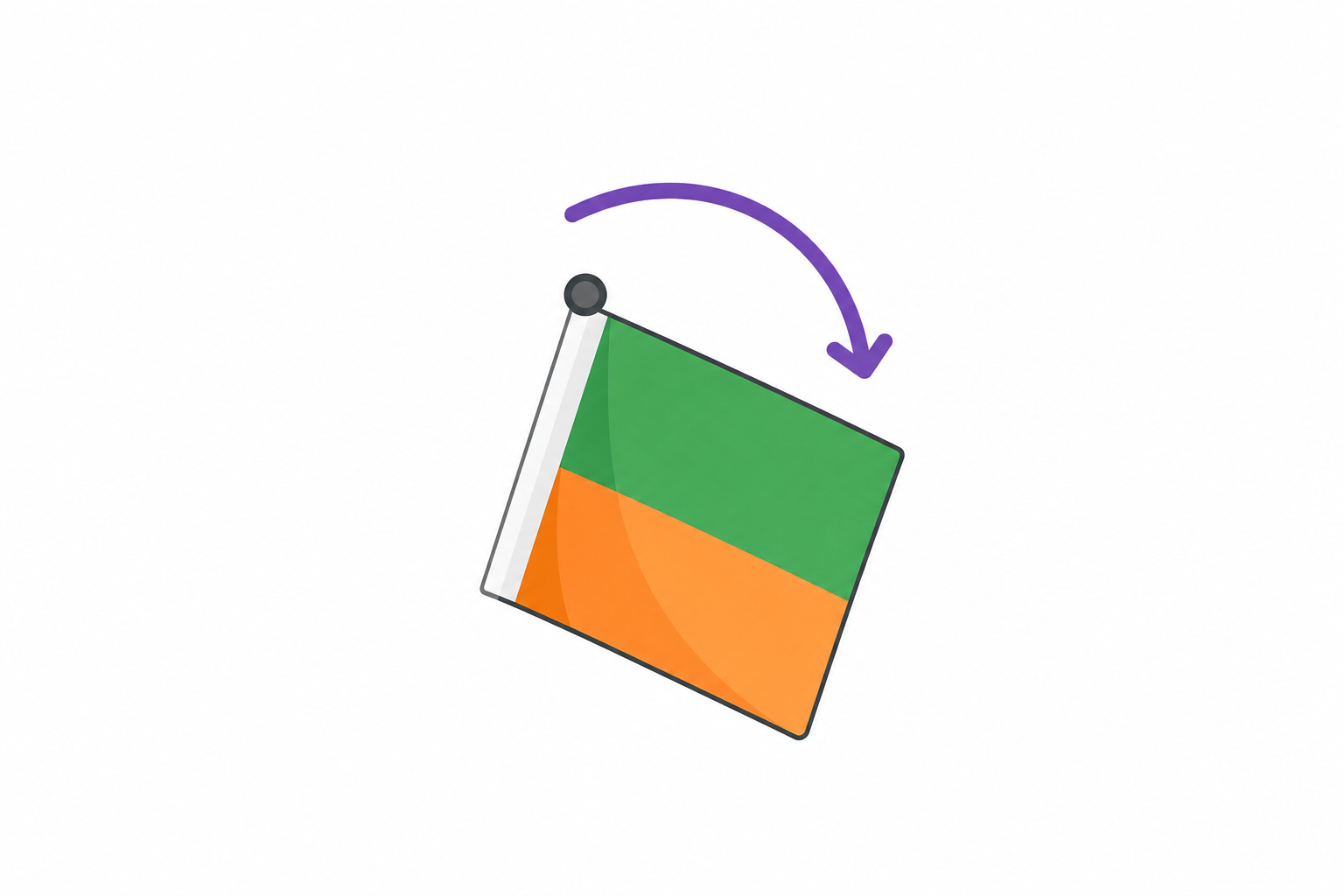
Your teacher is going to pin a flag at one point and turn it a quarter-turn clockwise around that pin. A quarter-turn is the same as a 90° turn, and a half-turn is the same as a 180° turn.
What changed about the flag when it turned? What stayed exactly the same?
Pin the flag at a point and turn it a quarter-turn clockwise on the IWB, or turn a paper shape around a pencil point held at the front.
Take two or three hands-up answers. Listen for it still has the same size and shape, just faces a different way — revoice that, it is the whole lesson in one sentence.
Your teacher will show some rotations, each around a fixed point called the marked point. A vertex is a corner of the shape. Watch the shape's facing direction in each turn, and be ready to say what stayed the same.
For one turn, think quietly to yourself: where has the chosen corner landed? Then put your hand up. The last one is different. It starts with the shape already turned, and we work backwards. Look at where one corner started and where it ended, count the quarter-turns, and say which way it went.
Today we work through these rotations together, one at a time.
First we turn the flag 90° clockwise about the marked point.
Next we turn it 180° about the marked point.
Then we turn it 90° anticlockwise about a corner of the shape.
Before each turn we predict where a chosen corner will land. Then we check it.
Talk this one through together — pupils take turns at the board and the class agrees or corrects out loud. While one pupil works the board, the watching class predicts: hands up to say where the chosen corner will land before the pupil reveals it.
Set the centre of rotation first every time — mistakes come from forgetting the shape turns around a fixed point, not the middle of the shape. For each turn, pick one corner, ask the class to predict its new spot, then let the pupil at the board apply the rotation and check. Revoice: same distance from the centre, just facing a new way.
First we work one full example together on the board so everyone sees how to sketch a rotation on squared paper. Then you try your own in your maths copy.
Mark a centre C on the grid. Draw a small L-shape with one corner, A, three squares right and one square up from C.
To move corner A through a 90° clockwise turn about C:
For a 180° turn about C, the same corner at 3 right and 1 up lands at 3 left and 1 down. Same distance from C, opposite side. Sketch and label that image too.
Now in your maths copy, draw a simple shape on squared paper and mark a centre of rotation with a clear dot. Sketch its image after a 90° clockwise turn, then sketch its image after a 180° turn. Label each image with the turn you made.
Board demo before any copy work. Draw a clear grid. Mark C near the middle. Plot A at 3 right, 1 up from C and build a simple L or flag from a few more corners. Count out loud from C: 3 right, 1 up.
90° clockwise about C: that offset becomes 1 right, 3 down. Plot A′. Repeat the same count-and-turn for each other corner, join them, label 90° clockwise about C.
180° about C: reverse both directions, so 3 right 1 up becomes 3 left, 1 down. Plot, join, label. Note no direction word is needed for a half-turn.
Slip to watch: rotating about the middle of the shape instead of C, or swapping the counts but forgetting to change direction. Revoice: same distance from C, new direction.
Then copy work. Walk the room glancing at the marked centre and the facing direction of each image. This is whole-class copybook practice, not marking. Tracing paper helps any pupil who is unsure: trace the shape, pin the pencil on the centre, and turn the paper.
Today we match the shape onto the dashed target outline. To match it, we turn the shape so it lands exactly on top of the target.
First we make a single 90° clockwise turn.
Next we make a 180° turn.
Then we make a 90° anticlockwise turn about a corner.
Finally you work out which rotation lands the shape exactly on top of its target.
This is the practice round — pupils take turns at the board, check each answer, and the class confirms before moving on. Keep the board work brisk rather than over-explaining. While one pupil works, the watching class stays active: hands up to name the turn before it is tested.
On the last challenge there is no move handed over — the class has to describe the rotation (centre, angle, direction) that fits the target, then test it. Use the reading-backwards method from Watch and Notice: track one corner from start to target, count the quarter-turns, read off the direction. Hold out for all three parts of the description; 'it turned' is not enough.
You're previewing this lesson. Get full access to this lesson and hundreds more — each one ready to teach, with interactive activities, printable resources and pupil progress tracking built in.