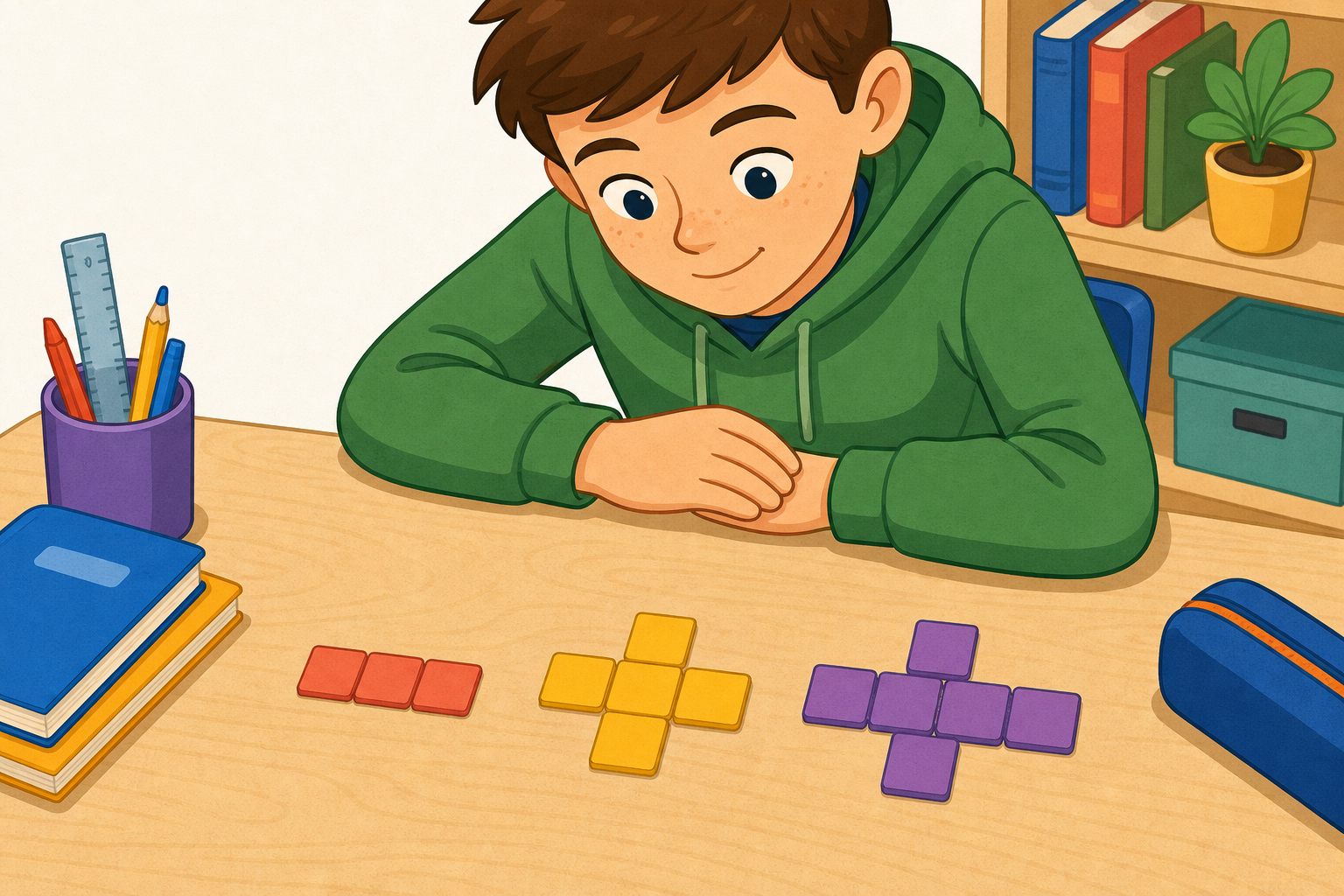
Here is a growing tile pattern: pattern 1, then pattern 2, then pattern 3, each one a little bigger than the last. Pattern 1 uses 3 tiles, pattern 2 uses 5 tiles, pattern 3 uses 7 tiles.
Now the big question: how many tiles would pattern 10 need? Could you work it out without drawing all ten patterns?
Display the three growing patterns as pupils settle. Give five seconds of quiet think-time before any hands go up, then take three hands-up answers. Do not confirm a correct answer yet — the point is to leave the question open so the table feels useful in the next step.
This machine takes a term-number in and hands back a value using a hidden rule. We feed in 1, 2 and 3, read off what comes out, and work out the rule each time. Watch the jump between the values.
First machine: values 3, 5, 7. Point at the jumps, 3 to 5 up 2, 5 to 7 up 2, so grows by 2 each term. Check term 1: 2 x 1 = 2 but we have 3, so 1 extra. Rule: tiles = 2 x term + 1.
Second: ask them to predict the jump before you send these through. Values 3, 6, 9, up 3 each time. Check term 1: 3 x 1 = 3, nothing extra. Rule: tiles = 3 x term.
Third: predict the jump again. Ask what number the values jump by. Values 3, 7, 11, 15, up in fours. Check term 1: 4 x 1 = 4 but we have 3, so 1 short, take one off. Rule: tiles = 4 x term - 1.
Revoice from a pupil: the step between values tells you the number you multiply by.
Today we work through this growing pattern together: term 1 gives 4, term 2 gives 7, term 3 gives 10. I will send the next term-numbers through the machine and build a two-row table on the board as the values land, while you watch and call out each value. Then we will agree on the rule in words together.
This round is for talking it through together — pupils take turns at the board and the class agrees or corrects out loud.
Send term 4 and term 5 through the machine; write each term-number and value into a two-row table on the board as it lands, so pupils see the table take shape before they copy it next step. Ask 'what is the step between values?' (3) before anyone names the full rule, then ask how many lots of the term that gives. Revoice a strong answer as 'so it is three times the term number, then add one'. Watch for pupils who say the rule is just add three — that continues the pattern but cannot leap to a far term; steer them to the three times the term form.
In your maths copy, draw a two-row table with the top row labelled term-number and the bottom row labelled value. Fill in terms 1 to 5 for our pattern, then write the rule as a sentence underneath the table.
Walk the room glancing for two things: the table is drawn with two clear rows, and the rule sentence underneath uses times the term number, not just add three. This is whole-class copybook practice, not marking.
Now we crack the rule for three of these patterns by sending term-numbers through the machine and watching the values. Once we have the rule, we will use it to leap straight to a far term, without drawing every step in between. Here are our three patterns:
These are the practice questions — pupils take turns at the board, check each answer, and the class confirms before moving on. Keep the board work brisk rather than over-explaining. The three patterns and their rules are:
For each challenge, have a pupil probe one more input to test their guess, then build and check the rule. After the rule is confirmed, ask the class 'so what would term 10 be?' so they practise leaping to a far term. Pattern C has a minus part — watch for pupils stopping at four times the term and forgetting to take 2 off.
How does the table help us see the rule that the picture hides? Which was easier for you: reading the rule from the row of patterns, or reading it from the table of numbers?
Listen for pupils naming the step between values as the clue to the multiplier. Revoice a strong answer: so once we know the step, we know the times-number, and the rest is just the adjustment. Head off the idea that add the step each time is a full rule — push them to see why times the term is what lets you leap to term 50 without listing every term in between.
Next we look at the properties of operations and the distributive law — how multiplication shares out over addition, so a tricky product becomes two easy ones.
Keep this brisk. Recap the three bullets, then point forward to the distributive law lesson.
You're previewing this lesson. Get full access to this lesson and hundreds more — each one ready to teach, with interactive activities, printable resources and pupil progress tracking built in.