Here are two different rectangles. Walk your finger all the way around the edge of each one and you would travel exactly the same distance, twelve centimetres, on both. They have the same perimeter.
So here is our real question for today: if the fence around two gardens is the same length, must the two gardens hold the same amount of space inside? Have a think, then hands up. What is your first guess, yes or no?
Three shapes coming up, each with the same 12 cm fence around the outside. Before each one, show me your thumb: up if you think it holds more space than the last, sideways if less. Then we count the squares inside.
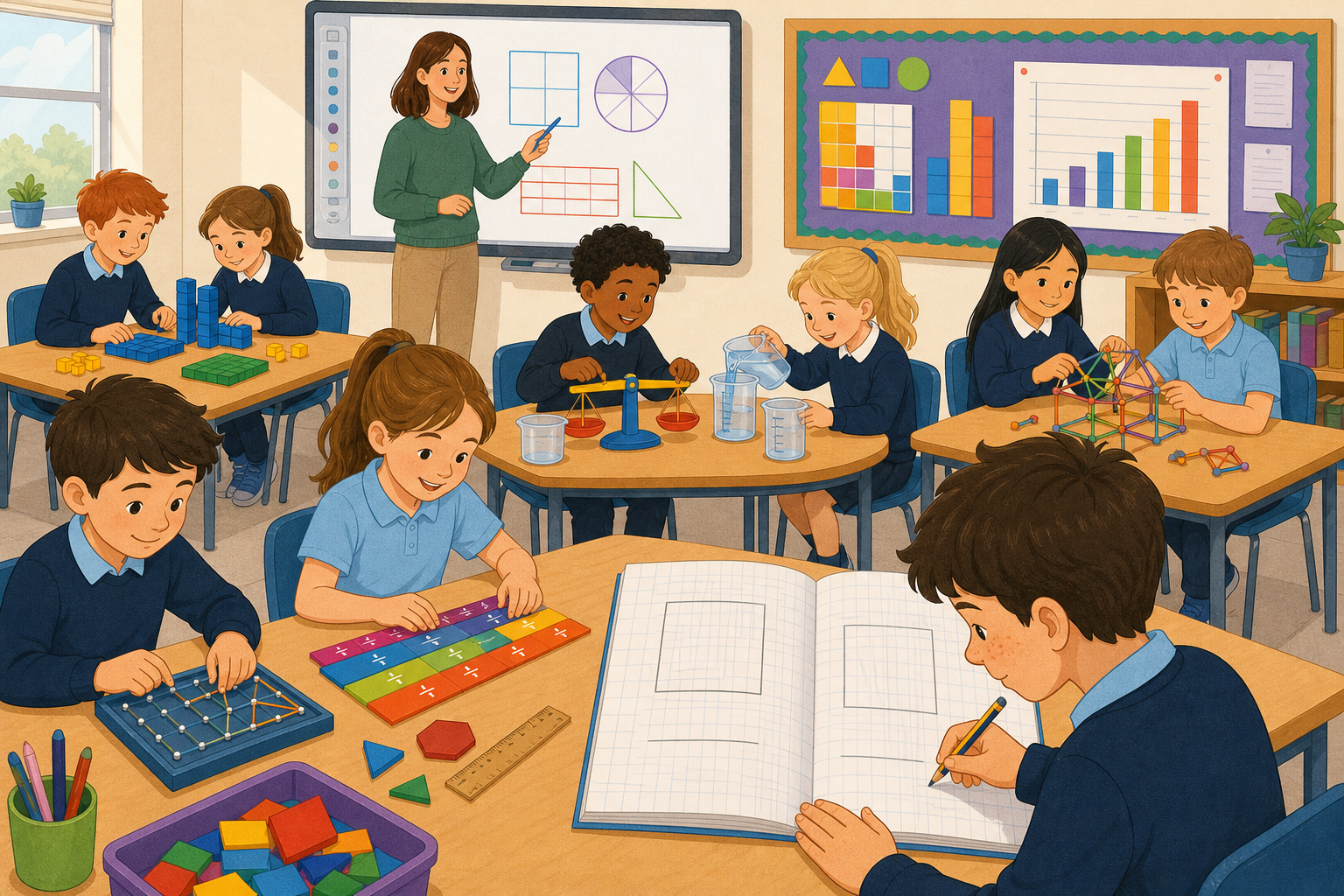
In your maths copy, draw two different rectangles that each have a perimeter of 10 cm. Then write the area of each one underneath, and circle the rectangle that holds more space.
Now we keep the fence a bit longer, exactly 16 cm, and we hunt for rectangles. We build these together on the board, in order: first the long thin 1 × 7, then the 2 × 6, then the 3 × 5, and finally the 4 × 4 square. Before each one, show me your thumbs guess for its space, then we build it and read the space inside off the tool.
Keep an eye on that very last one, the 4 × 4 square. Before we build it, tell me with your thumbs, do you think it will hold more space or less than the others? Let's build them all and find out.
This is our investigation. We fix the fence at 12 cm and find every whole-number rectangle that fits, then compare the space each one holds. A whole-number rectangle is one whose sides are a whole number of squares, like 2 by 4 (we don't use half-squares).
We work these in order on the board, one job at a time:
Does the rectangle that holds the most space always turn out to be the one closest to a square?
You're previewing this lesson. Get full access to this lesson and hundreds more — each one ready to teach, with interactive activities, printable resources and pupil progress tracking built in.