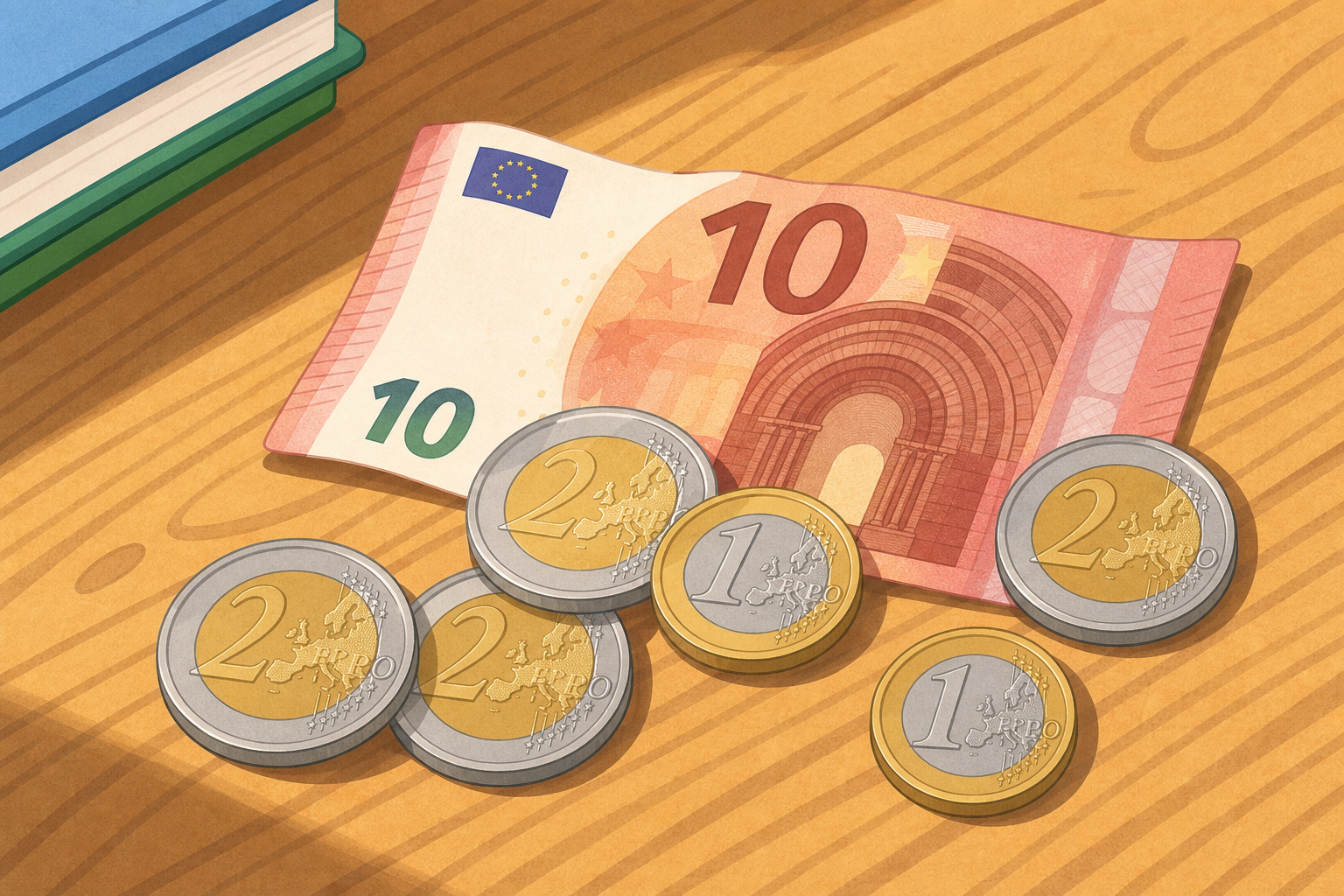
Here is a real one for you. There is €20 to be shared between two children, but not equally: the older child gets three times as much as the younger one. We write that share as the ratio 3:1.
How would you split the €20 so that the older child really does get three times as much?
Take three hands-up answers, not open call-outs. Don't confirm or correct yet, just collect the thinking. Listen for the common slip of giving €15 and €5 by guessing, versus reasoning it out by counting parts.
The ratio bars will share each total for you, one example at a time. Watch how the parts are added first, then how the size of one part decides every share.
Same order each time: add the parts, find one part (total divided by total parts), then build each share.
12 in 2:1 - 3 parts, one part 4, shares 8 and 4. Point to the two bars and the live values.
20 in 3:1 - 4 parts, one part 5, shares 15 and 5. This answers the hook's €20; let them connect it back.
24 in 1:2:3 - three-way share, parts still just add: 1+2+3 = 6, one part 4, shares 4, 8 and 12.
€90 in 5:4 - 9 parts, one part €10, shares €50 and €40. Extra step: ask how much more the older one gets, subtract €50 - €40 = €10. Name this difference move; they meet it again in the Class Challenge.
Today we work through this one together: share 18 in the ratio 4:5.
This round is for talking it through together — pupils take turns at the board and the class agrees or corrects out loud.
Build the two bars at 4 and 5 first, then set the total to 18. The class should call out: 4 + 5 = 9 parts, 18 ÷ 9 = 2 for one part. Then read each share off the bars (8 and 10). Head off the slip of dividing 18 by 2 because there are two people — the divisor is the total parts (9), not the number of people. Rotate two or three pupils to set and read the bars.
In your maths copy, for each sharing problem write "total parts = ___, one part = ___" then list each person's amount. Check your shares add back to the total.
Try these:
Walk the room glancing at the "total parts" and "one part" lines — this is whole-class copybook practice, not marking. The check-back line (shares adding to the total) is the habit to praise.
Today we work through these sharing problems together, each one a step harder than the last:
The last one has an extra step, just like the €90 share we saw earlier: first find both shares, then subtract the smaller from the bigger to see how much more the older cousin gets.
These are the practice questions — pupils take turns at the board, check each answer, and the class confirms before moving on. Keep the board work brisk rather than over-explaining.
For each one set the two (or three) bars, then enter the total, and read the shares off the live bars. The interactive steps through the four challenges in order; the top-level parts only seed the opening bar (3:1), so just work down the list. The final question is the stretch: the bars set to €50 and €40, but the tool does not do the subtraction — read €50 and €40 off the bars and compute the difference (€10) aloud with the class. Keep stressing the three-step order: add the parts, find one part, build each amount.
Why do we add the parts of the ratio together before we share? What would go wrong if we forgot that step?
Listen for pupils naming the total parts as the divisor — that adding 3 + 1 gives the 4 we divide by, not the 2 people. Revoice a strong answer: so the parts tell us how many equal shares to cut the total into, no matter how many people there are.
Next we meet direct proportion and the unitary method: finding the value of one thing, then scaling up to find the value of many.
Close by re-saying the three-step chant one last time: add the parts, find one part, build each amount.
You're previewing this lesson. Get full access to this lesson and hundreds more — each one ready to teach, with interactive activities, printable resources and pupil progress tracking built in.