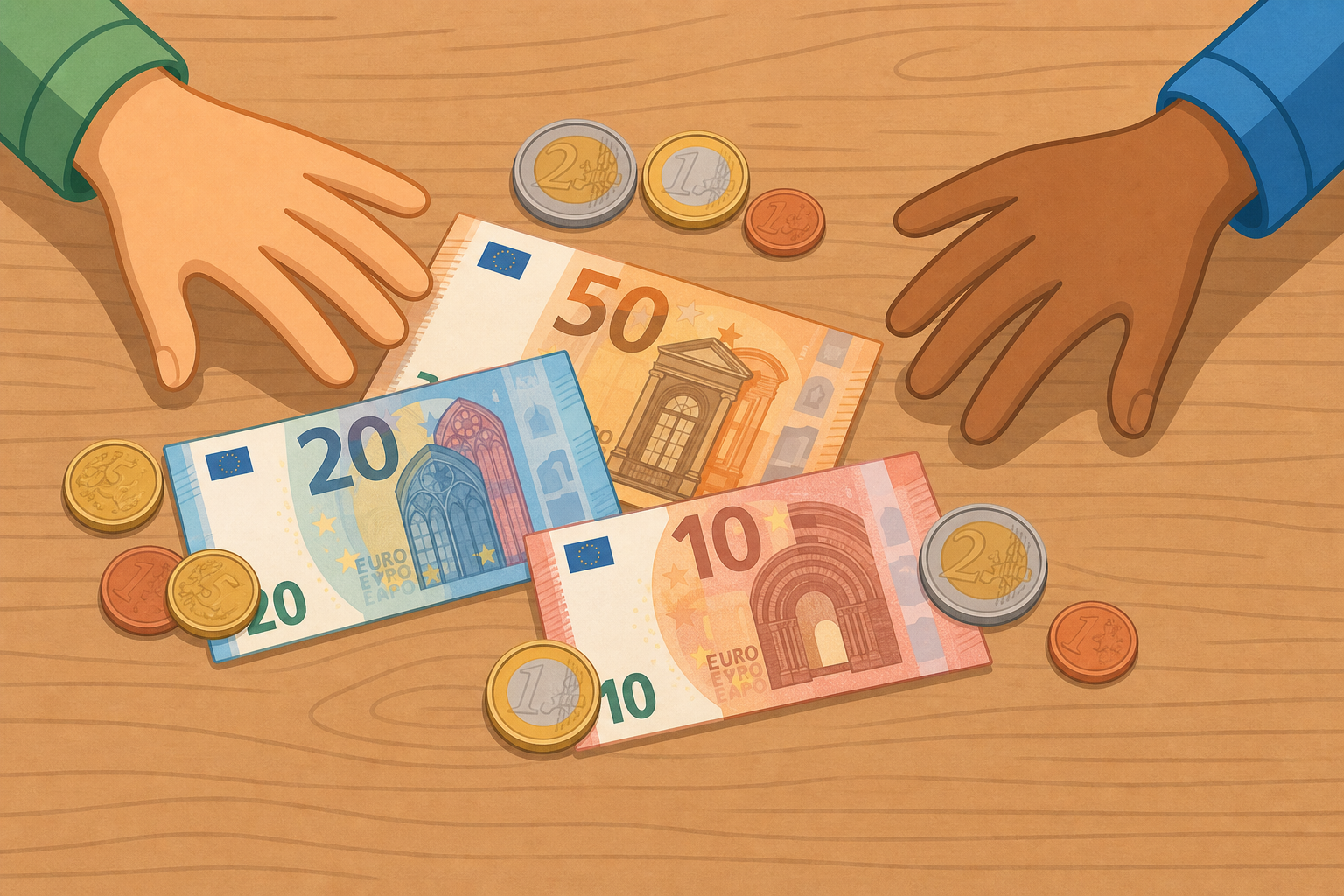
You have already seen ratio bars used to describe a split, like two parts juice to three parts water. Today we go one step further and actually share out a real amount.
Here is the question: share €30 between two people in the ratio 2:3. Before we work anything out, how many equal parts do you think €30 needs to be split into?
Take three hands-up answers, not open call-outs. Listen for pupils who say 5 (2 + 3) rather than 2 or 3 — the count-the-parts idea is the whole hinge of the lesson.
Revoice a strong answer: so we add the parts of the ratio together first. Don't confirm the euro shares yet — that is the model step.
Look at four finished shares on the ratio bars, one after another. For each one the teacher talks through the same three moves in order: count all the parts, divide the total by that count to find one part, then multiply to find each share. Notice how the moves stay the same even as the ratios change.
Point at the bars, don't drag them (static snapshots). Say the three moves aloud each time, count, divide, multiply, this is the script pupils reuse all lesson.
€30 in 2:3: 2 + 3 = 5 parts, €30 ÷ 5 = €6, Aoife 2 × €6 = €12, Niamh 3 × €6 = €18, check €12 + €18 = €30.
After example 1: ask what we did first before any dividing, take two hands-up, re-establish count the parts.
€40 in 3:5: 3 + 5 = 8 parts, €40 ÷ 8 = €5, gives €15 and €25. Pause before revealing, ask the class to predict whether the shares add back to €40, then confirm €15 + €25 = €40.
24 sweets in 1:2: 1 + 2 = 3 parts, 24 ÷ 3 = 8, shares 8 and 16. Draw out that the bigger share is twice the smaller, matching 1:2.
Before example 4: point to one pupil, ask them to say the three moves in order to re-engage the room.
€100 in 1:2:2: three-way share, 1 + 2 + 2 = 5 parts (stress ALL parts, 5 not 3), €100 ÷ 5 = €20, shares €20, €40, €40, check €20 + €40 + €40 = €100.
Hold here until they can recite count the parts, divide the total, multiply each share back to you.
Now we build the shares together on the ratio bars. We work through these one at a time at the board as a class: share €60 in 1:5, then €72 in 3:5, then €50 in 2:3, and finally the three-way €120 in 1:2:3.
One pupil sets each share at the board while everyone else watches, agrees, or corrects out loud — that is your job at each round. For every problem we say the three moves aloud before we set the bars: count the parts, divide the total, multiply each share. The three-way one at the end has six parts, so the value of one part is smaller than you might guess, watch for it.
This round is for talking it through together — pupils take turns at the board and the class agrees or corrects out loud. The bars start on €60 in 1:5; after each problem, reset the parts and total on the interactive yourself and hand the next turn to a new pupil, working through the four in the stated order.
Order the round so it builds: €60 in 1:5 (six parts, €10 each — clean); €72 in 3:5 (eight parts, €9 each — the divide is the wrinkle); €50 in 2:3 (five parts, €10 each — a friendly reset); then €120 in 1:2:3 (six parts, €20 each — the key one where the three-way share is the harder count).
Each time, make a pupil name the part-count aloud before they touch the total. The most common slip is dividing by one of the ratio numbers (3 or 5) instead of by the sum (8). Watch for it on €72 in 3:5 and revoice: we divide by all the parts added together.
In your maths copy, work these two shares that we have already seen at the board: share €40 in 3:5, then share €50 in 2:3. Set each one out in three lines: count the parts, divide the total by the part-count, then multiply each share by its parts. Keep the three moves clear so they are easy to check.
Both problems here have already been modelled — €40 in 3:5 in Watch and Notice and €50 in 2:3 in Try It Together — so pupils are rehearsing a familiar method, not meeting a new one. Walk the room glancing at whether pupils divide by the sum of the parts, not by one of the ratio numbers — that is the slip to catch on the spot. This is whole-class copybook practice, not marking.
Now we work through some shares: first €80 in 3:5, then €72 in 3:5, then €100 in 2:3, and finally the three-way €120 in 1:2:3. Before each one is checked, put a hand up with your prediction of the value of one part. A wrong prediction is completely fine — guessing first and then checking is exactly how we spot our own slips.
These are the practice questions — pupils take turns at the board, check each answer, and the class confirms before moving on. Keep the board work brisk rather than over-explaining. Take a quick show of hands for the one-part prediction before each Check, and reassure that a wrong guess is fine.
The round escalates: €80 in 3:5 (eight parts, €10 each) is a fresh warm-up; €72 in 3:5 (eight parts, €9 each) makes the divide the tricky bit; €100 in 2:3 (five parts, €20 each) is a friendly reset; €120 in 1:2:3 (six parts, €20 each) is the key one — three shares, six parts. Watch for pupils dividing by a single ratio number instead of the sum.
You're previewing this lesson. Get full access to this lesson and hundreds more — each one ready to teach, with interactive activities, printable resources and pupil progress tracking built in.