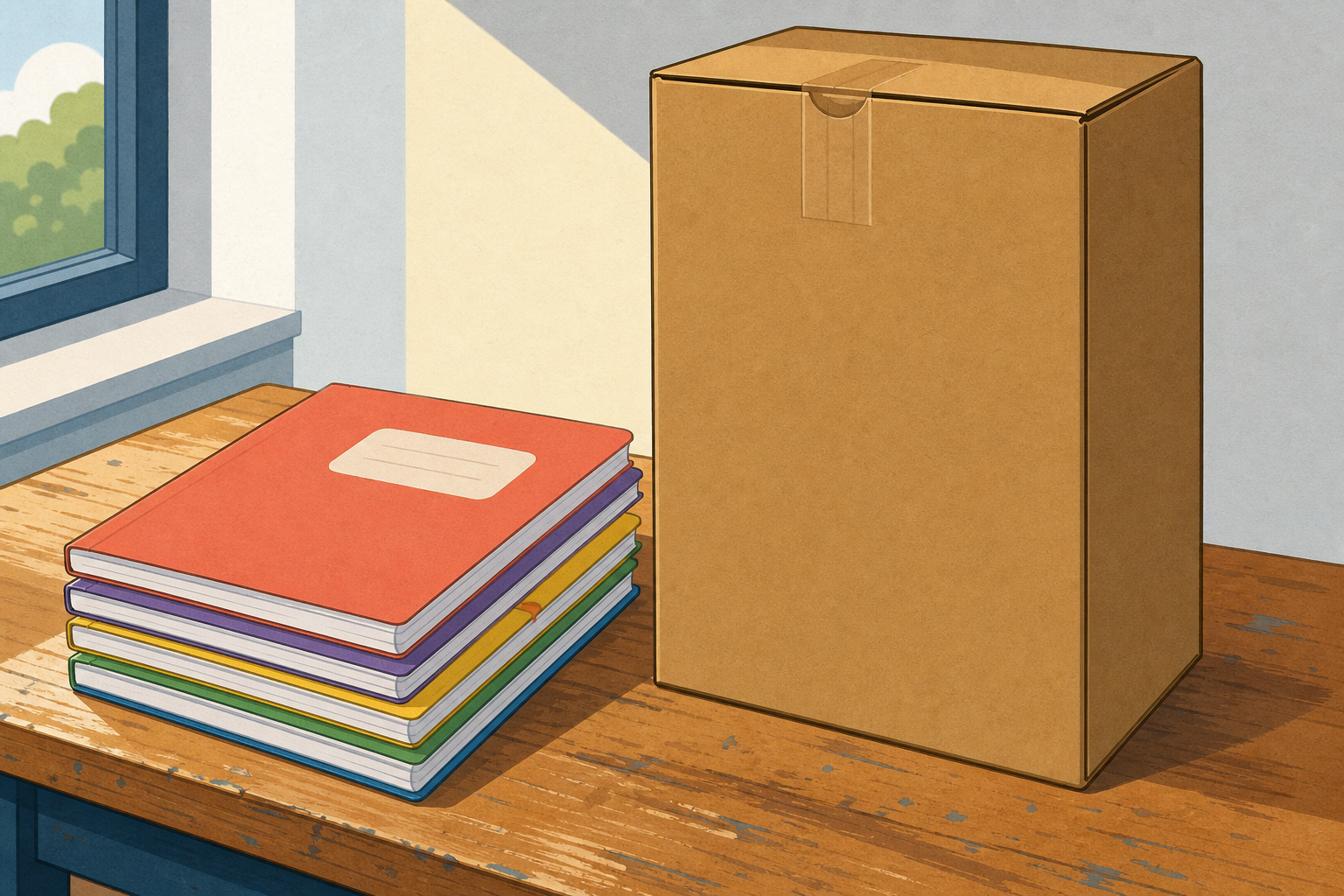
Here is a real job: we have 12 Maths books to pack, each one 24 cm tall, and a box that is 60 cm tall. Before we work anything out, the first skill today is choosing the right measuring instrument. Ask yourself: are we finding a length or height, a mass, or how much liquid? Length or height means a ruler, mass means a weighing scale, and liquid means a measuring jug. For these books and this box we need heights, so the instrument is the ruler. We read both heights off the ruler first, then we can think about the calculation. What is the very first thing we need to know?
Show the packing scenario as pupils settle. Cue the choice first: length/height → ruler, mass → weighing scale, liquid → measuring jug. Worked example end to end: books and box are heights, so ruler (not scale or jug); read 60 cm and 24 cm; only then divide later. Take three hands-up answers on what we need first, not open call-outs. Steer toward we need the two heights off the ruler first. Slip to watch: pupils jumping straight to 60 ÷ 24 without naming the tool. Do not confirm the full answer yet; the lesson builds to it.
Your teacher works three real problems on the board. Each one works the same way: read the two measurements first, then do one calculation. When two measurements are in different units, we change one first so they match. There are 1,000 grams in every kilogram (1 kg = 1,000 g) and 1,000 millilitres in every litre (1 l = 1,000 ml). Look for what the calculation tells you, and watch the unit stay on the answer.
After the three on-screen problems, work a fourth aloud if the class is with you: four 30 × 20 × 10 cm shoeboxes into a 60 × 40 × 20 cm carton, 8 fit — count the layers together on the board.
The through-line to name each time: read first, match the units, then calculate, and keep the unit.
Today we work through three problems together. Only the shelf is on the board for you to read — the pasta weight and the bottle amount are given to you in the words. First, a length problem: read the shelf length off the ruler, and each folder is 3 cm wide, so how many fit? Next, a mass problem: a pasta pack weighs 750 g, shared into 250 g portions. Last, a capacity problem: a 1.5 l bottle (that is 1,500 ml) poured into 300 ml cups. Read or use the number, say what the calculation tells us, and keep the unit on the answer.
Talk this one through together — pupils take turns at the board and the class agrees or corrects out loud.
Only the shelf is on the board to read; be clear that the pasta and bottle figures are given, so pupils don't hunt for a scale that isn't there. Ask what number are we using, and how did we get it? before accepting an answer.
In your maths copy, set up each measurement problem as a labelled calculation with the units shown, and work each step with the class. Write the answer with its unit at the bottom of each one.
Walk the room glancing for two things — units written on every line, and the answer carrying its unit (5 cups, not 5). This is whole-class copybook practice, not marking.
Today we work through these four in order, reading the scale before we calculate each time. First: a ribbon cut into 8 cm lengths. Then: a bag of rice shared into 300 g bowls. Then: a carton poured into 400 ml glasses. Last: a shelf holding books that are each 4 cm thick, work out how many fit, and check whether any space is left over. Read the tool, then solve, then check.
This is the practice round — pupils take turns at the board, check each answer, and the class confirms before moving on. Keep the board work brisk rather than over-explaining.
The last one lands exactly with no remainder — a satisfying contrast to the books-in-a-box example, which had 12 cm to spare. Draw that comparison out.
You're previewing this lesson. Get full access to this lesson and hundreds more — each one ready to teach, with interactive activities, printable resources and pupil progress tracking built in.