1 - Getting Started ~5 mins
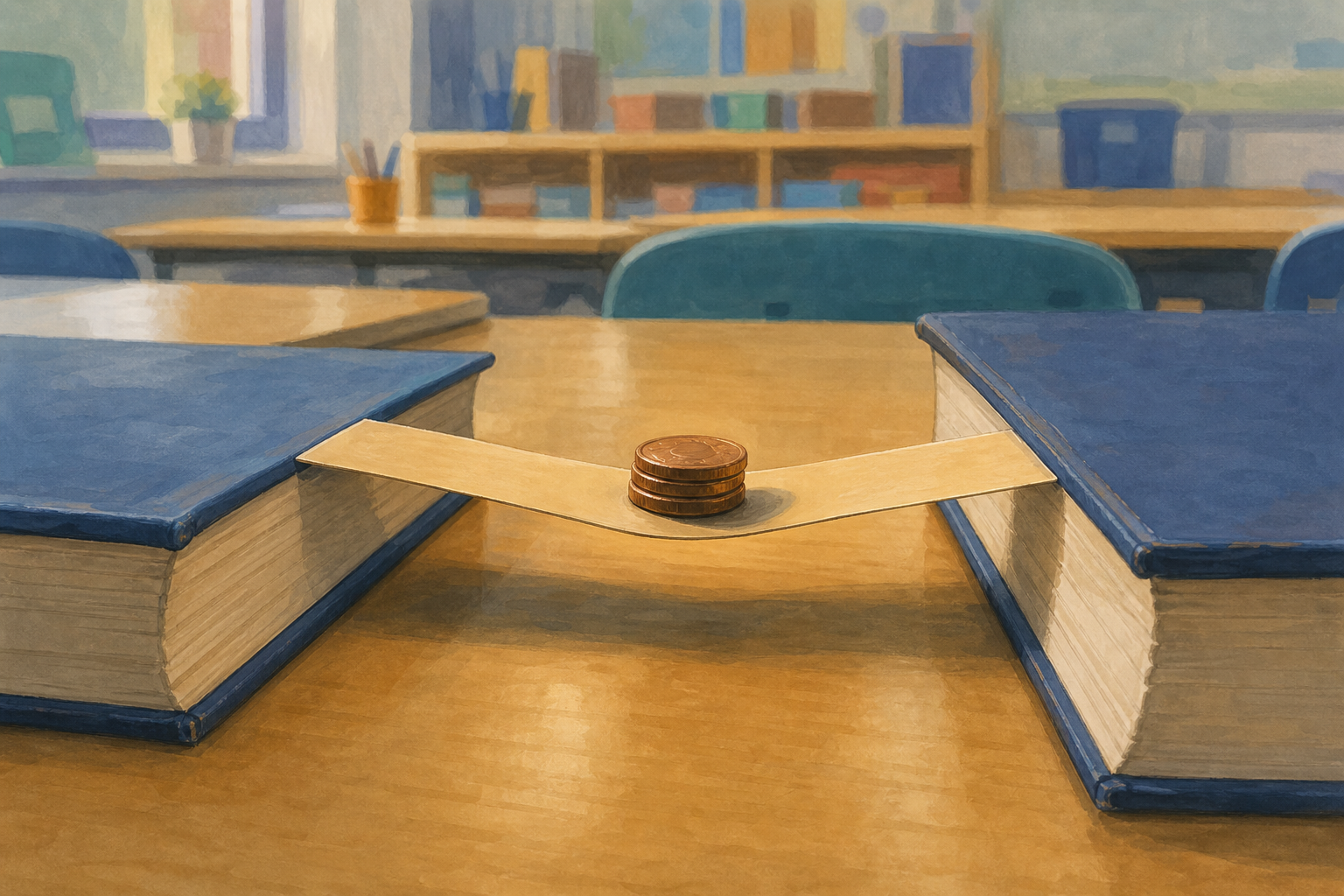 We have three card strips, all the same length, and one gap to cross. Which shape do you think will hold the most coins before it gives way: a flat beam, a curved arch, or a beam braced with triangles underneath?
Keep this light: a quick show of hands, three guesses, no set-up yet. Have one flat card strip and two books to hold up as you ask, if you like, but do not build the test yet.
Do not reveal which wins. Let their predictions stand as the start of the science.
2 - Three Ways to Cross a Gap ~8 mins
Today's words: span — the part that reaches across a gap. beam — a flat span that sags in the middle. arch — a curved span that pushes out to its feet. braced beam — a flat span with triangles underneath to hold its shape.
We will tape both ends of every span down. Why do you think taping matters for a fair test?
Key concepts (teacher reference)
| Concept | Why it matters | Example |
|---|---|---|
| Span — the part of a structure that reaches across a gap with nothing holding up the middle | Every bridge and shelf has a span; the shape you choose decides how much it carries | A card strip stretched between two books with nothing under its centre |
| Beam — a flat, straight span that sags when loaded | Beams are simple but the weakest of the three; they bend and drop through in the middle | A flat classroom shelf loaded with heavy books bows in the centre |
| Arch — a curved span that pushes its weight outward to the feet | An arch turns downward weight into an outward push, so it carries far more than a flat beam | The arched stone bridges over the River Shannon carry heavy traffic |
| Braced beam — a flat beam strengthened with folded card triangles underneath | Triangles cannot be pushed out of shape, so a braced beam holds until a join gives | Modern footbridges have triangular frameworks beneath the walkway |
Why taping matters: if the ends can slide, a sagging strip pulls its own ends inward and drops through the gap. Then the class is measuring slipping, not strength. Taping both ends of every span to the books is what keeps the test fair.
What to expect: the flat beam holds fewest coins and sags in the middle. The arch spreads at the feet. The braced beam usually holds most, until a join or the tape gives way.
Misconception to head off: children think a thicker or heavier card is 'stronger'. Here every strip is the same card and the same length, so only the shape is being tested.
3 - Model the Load Test ~7 mins
Watch closely. First I will show you how to make each of the three shapes, then I will build one flat beam, tape both ends down, and add coins to the middle one at a time. Where do you think it will give way, and about how many coins will it hold?
First, show how each of the three shapes is made so groups can start all three without guessing:
- Flat beam: lay a strip flat across the gap and tape both ends to the books.
- Arch: gently curve one strip upward into a bridge shape, then tape both feet down so the curve stays. The feet want to slide outward, so tape holds them.
- Braced beam: lay a flat strip across, then tape a row of folded card triangles underneath, point-up along its length, before taping both ends down.
Then run the full cycle aloud on the flat beam so groups copy every beat:
- I wonder how many coins a flat beam will hold before it drops through.
- I predict it will sag in the middle and hold only a few coins, because a flat strip bends easily.
- I test: tape both ends down, then add coins one at a time to the centre, counting aloud.
- I observed the strip sagging more with each coin and dropping through at, say, six coins.
- I think the flat beam is weakest because it has nothing to stop the middle bending.
Keep the watchers folded in during the slow count: after every couple of coins, ask the class 'Thumbs up if you think it will take one more' or 'Watch the middle — is it starting to sag? Shout when you think it is about to go.' Take a running guess of the final number from two or three pupils. This keeps the back rows judging along with you rather than drifting.
Show the taping deliberately: both ends taped to the books so nothing slides. Stop before you fully load the arch or braced beam — groups will build and test all three themselves.
Ask the watchers: 'Was your prediction close? Which shape will beat this one?'
4 - Build and Load Three Spans ~20 mins
In your group, bridge the same 15 cm gap three ways with equal card strips: a flat beam, a curved arch (curve a strip up and tape both feet), and a beam braced underneath with folded card triangles.
Tape both ends of every span down to the books, just as we did. Then load the middle with 1c coins one at a time and count until each gives way. Write your three counts and where each span failed on your ExperimentRecord sheet.
Hand out the ExperimentRecord sheet now (one per pupil or per group) so pupils have somewhere to write their three counts and where each span failed as they test.
Set-up: each group needs two same-size books, several equal card strips (about 15 cm), tape, folded card triangles for the braced beam, and a tub of 1c coins. Push desks together so each group has a flat working space.
Remind them how to form each shape (just modelled): flat beam taped flat; arch curved up with both feet taped; braced beam with triangles taped point-up underneath before the ends are taped down.
Keeping it fair: the gap is the same for all three, the strips are the same card and length, and both ends of every span are taped down. Coins go one at a time onto the centre.
What to watch for: the beam sags and drops in the middle; the arch spreads at the feet; the braced beam holds until a join or the tape gives. Groups count and record the number each span held.
Circulate and question: 'Where did that one fail? Which is your weakest span so far?' Fast finishers predict a fourth shape or re-run their arch to check the count.
5 - Chart the Three Spans ~12 mins
Let's pool our results at the board. Call out your group's count for each span and I will type our class figure for the flat beam, the arch and the braced beam into the table, then show the chart. Which bar is tallest? What does that tell us about the shape?
How many coins did each span hold?
You drive the recorder on the IWB while the class calls out their numbers. There are three rows, one per span: Flat beam, Arch, Braced beam, with a single Coins held column. This recorder holds one pooled figure per span, not every group's count — so as groups read out their numbers, agree a single class figure for each span (a typical value, or the best result) and type that one number into each row. Then tap to show the bar chart.
Expect the flat beam bar lowest, the arch higher, the braced beam usually highest. Ask: 'Which bar is tallest? Which shape is weakest? Why does the flat beam drop through the middle?'
Pupils have already written their own group's three numbers and where each failed on the ExperimentRecord sheet during the last step.
Unlock the full learning experience
You're previewing this lesson. Get full access to this lesson and hundreds more — each one ready to teach, with interactive activities, printable resources and pupil progress tracking built in.
This lesson is copyright of Coding Ireland 2017 - 2025. Unauthorised use, copying or distribution is not allowed.