Watch the paper heart being folded down the middle. The two halves land exactly on top of each other.
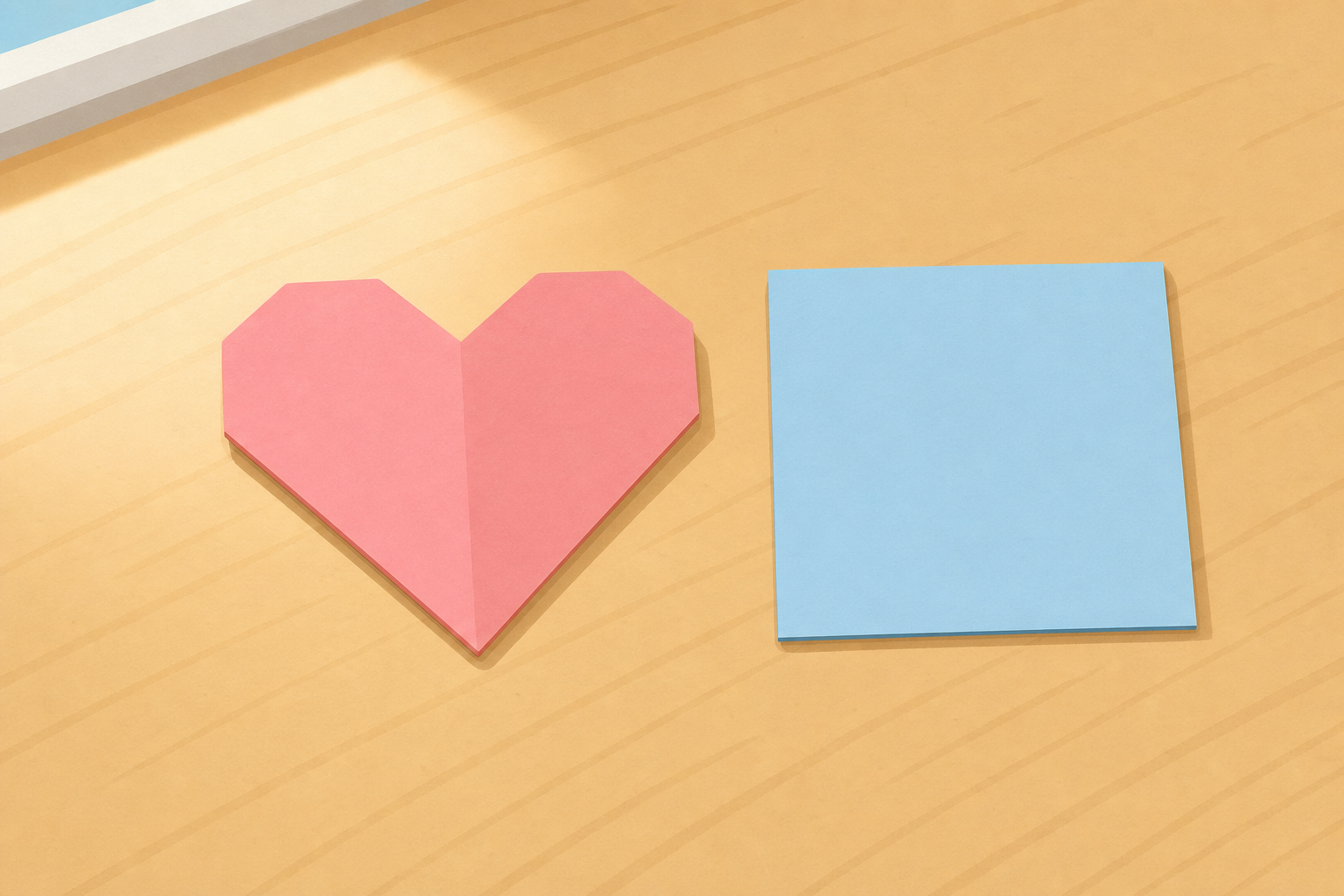
Now watch the square card being turned slowly, all the way round once. Count in your head: how many times does it look exactly the same as it did at the start?
Fold a real paper heart in half at the front so the halves match, then slowly turn a square card through one full turn. Take three hands-up answers for the turn count before saying anything.
The point of the hook is to plant the two different ideas side by side: folding (line symmetry) and turning (rotational symmetry). Don't name either yet — that lands in the next step.
Today we test shapes in two different ways.
Folding. A fold-line (also called a line of symmetry) is a line you could fold along so one half lands exactly on the other. A shape can have none, one, or many fold-lines.
Turning. A turn-match is when a shape looks exactly the same again as you turn it round, without lifting it off the page. This is called rotational symmetry.
Read the two tests out plainly and keep the words 'fold-line' and 'turn-match' on the board as your key language for the rest of the lesson. Point back to the heart (a fold-line) and the square (a turn-match) from the hook so both words have something to hold on to before any counting starts.
First, folding. Each shape below has its fold-lines drawn on it. A fold-line only counts if folding along it would land one half exactly on the other. Before each one is revealed, guess how many fold-lines it has, then count the lines you can see.
Now, turning. Each of these shapes is turned all the way round once. The order of rotational symmetry is the number of times a shape matches its starting picture in one full turn, and the starting picture counts as your first match. Count how many matches each shape makes. Watch the last one carefully.
Run the folding shapes first, then the turning shapes — keep the two ideas in separate blocks so pupils don't blur them.
Remind the class that the starting picture counts as the first match, so their count matches the stated order. Do not announce the S result — let the class count the turns and discover it.
Now we hunt for fold-lines together. On the board we build a symmetric pattern that stays the same across two fold-lines at once. One fold-line runs straight down. The other runs straight across.
Each time a cell is tapped, its mirror partners shade themselves across both fold-lines, so the pattern always stays symmetric. Predict where the partner cells will appear before they do.
Talk this one through together — pupils take turns at the board and the class agrees or corrects out loud.
Tap the first cell and let the tool shade its three mirror partners at once across the vertical and horizontal fold-lines. Pause and ask how many cells lit up this time, and why? Build the pattern up cell by cell so the mirror idea stays clear.
When the board pattern is finished, run a short folding sub-beat: pupils fold the paper shapes from the printed sheet at their desks (square, rectangle, kite, isosceles triangle), then report the fold-line count they found on each. Do the folding after the board work, not alongside it, so the beat stays easy to time.
Keep it moving — a couple of taps per pupil, then pass on.
In your maths copy, sketch a regular pentagon (five equal sides). Draw every line of symmetry through it and write the count underneath.
Then sketch the same pentagon again beside it. This time write its order of rotational symmetry underneath, and mark the centre of rotation with a small dot in the middle.
Walk the room glancing at the line count and the centre dot — this is whole-class copybook practice, not marking. Watch for pupils who draw a line through a vertex to the middle of the opposite side (correct for a pentagon) rather than vertex-to-vertex.
You're previewing this lesson. Get full access to this lesson and hundreds more — each one ready to teach, with interactive activities, printable resources and pupil progress tracking built in.