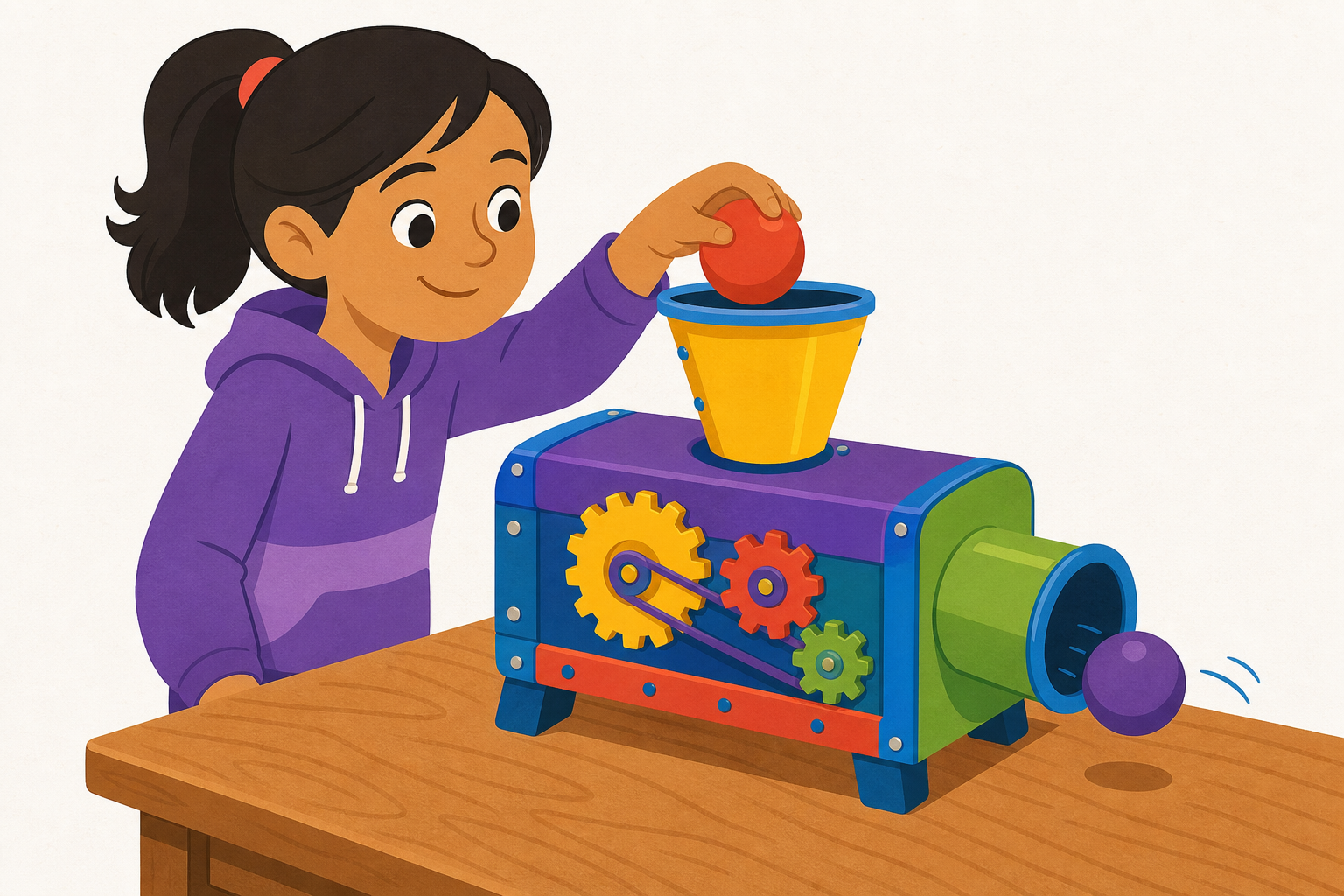
Picture a machine on a conveyor belt. You drop a number in one end, the machine does the very same thing to it every single time, and a new number rolls out the other end. Today the machine's rule is × 3.
If we drop a 4 into this × 3 machine, what number do you think rolls out the other side?
Each machine takes a number in and follows a rule to give a number out. Watch the four machines in turn and see if you can work out the rule before the output appears.
Today we work through one machine together: the × 3 machine. We will feed it numbers one at a time and write each input-output pair into a table on the board. You call out the output, we check it, and we add the row.
In your maths copy, draw a four-row input/output table for each of these four rules and fill in four pairs for that rule. Put the rule label at the top of each table.
So far we have always known the rule and worked out the output. Now we work the other way. First we build a full table for a two-step machine, the × 2 then + 1 machine, together. Then we play detective: I will show you a pair, like input 3 gives 7, and we will try to find the rule.
Here is the catch. More than one rule can turn the same input into the same output. One pair is not enough to be sure of the rule. To tell them apart, we send a second number through and check which rule still fits.
Now we work through these rules and complete a full table of four pairs for each one. The last rule is a two-step machine, and one round asks you to work backwards: given an input and its output, find the rule that fits.
Remember to test a second pair before you commit to a rule.
If two different rules both give the same answer for input 3, what input could you try next to tell them apart?
Next we turn this around fully: given a table of pairs with the rule hidden, we work out what the machine is doing.
You're previewing this lesson. Get full access to this lesson and hundreds more — each one ready to teach, with interactive activities, printable resources and pupil progress tracking built in.