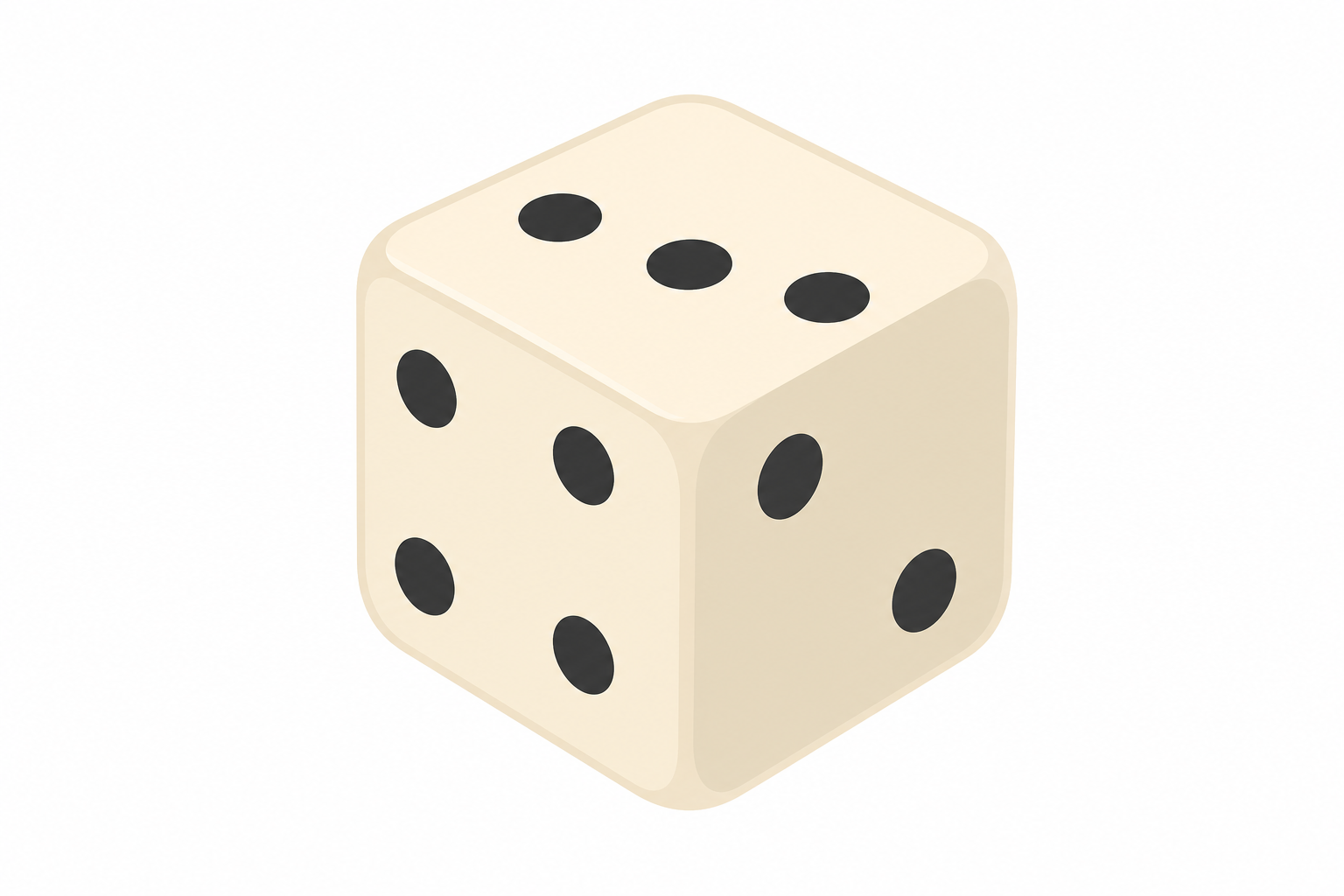
Here is a fair six-sided die. If we roll it lots and lots of times, will every number come up about the same, or will one number win?
Hands up: which number do you think will come up most?
Take three hands-up answers, not open call-outs. Don't confirm or correct any of them yet — the whole lesson is about testing these guesses, so leave the question open.
Listen for the pupil who says "they'll all be about the same" — that is the idea a fair die is built on, but hold it lightly for now.
Watch the dice-roller. First one roll on its own, then a run of many rolls with a tally kept beside them.
On a single roll, nobody can say for sure what will come up. Watch what happens to the counts once we roll many times — the bar chart below shows the counts, and the taller a bar, the more often that number came up.
Roll the single die first. Ask what came up and whether anyone knew it would — hold out for no, you can't know one roll ahead.
Then roll the many-rolls version. Pause the roll and point at the bars: early on the counts look lumpy and one number can be well ahead, but the more we roll the more even they become. This is the beat the whole lesson turns on — a single roll is chance, many rolls show a pattern.
Today we test our guess together. First we all predict which number will come up most in twelve rolls. Then a pupil rolls the die twelve times at the board while the class keeps a tally: roll 1, roll 2, all the way to roll 12.
After the twelve rolls we compare the tally with the prediction: did the number we guessed really come up most, or did another number win this time? Twelve rolls is only a small test, so any number can win this time — that does not mean our thinking was wrong.
Talk this one through together — pupils take turns at the board and the class agrees or corrects out loud.
Take a whole-class prediction first (a show of hands for each number) before any rolling. Then have one pupil roll twelve times while another adds each mark to the tally on the IWB; the rest of the class calls the running count.
Twelve rolls is a small test, so the result will often surprise the prediction — that is the point, not a mistake. Revoice it: twelve rolls is not many, so anything can win — we would need lots more rolls to see the even pattern. Head off the belief that a number is "due" because it hasn't come up yet.
In your maths copy, write your prediction for which number would come up most in the twelve rolls. Then write the tally beside it, so you can compare your prediction with what really happened.
Walk the room, glancing that each pupil has written their prediction and the tally from the twelve rolls beside it, no individual marking, this is whole-class copybook practice, not assessment.
Now we move to the spinner and test our guesses again. This spinner is fair, with two equal colours. First we predict: will red or blue come up most over many spins? Then we spin many times and read the bar chart of the counts.
If one colour never comes up in a short run of spins, does that prove it is impossible, or was it just unlucky this time?
This is the practice round — pupils take turns at the board, spin, and the class confirms the count before moving on. Keep the spinning brisk rather than over-explaining.
Take a whole-class prediction first (red or blue). Because the spinner is fair, each colour should come up about the same over many spins — the two bars settle close together. Keep the predict-then-test rhythm.
The final beat is the reasoning one: if a colour did not appear in a short run, it is not proven impossible — just unlucky, because that colour is still on the spinner. Ask what more spins would show. This sets up the wrap.
You're previewing this lesson. Get full access to this lesson and hundreds more — each one ready to teach, with interactive activities, printable resources and pupil progress tracking built in.