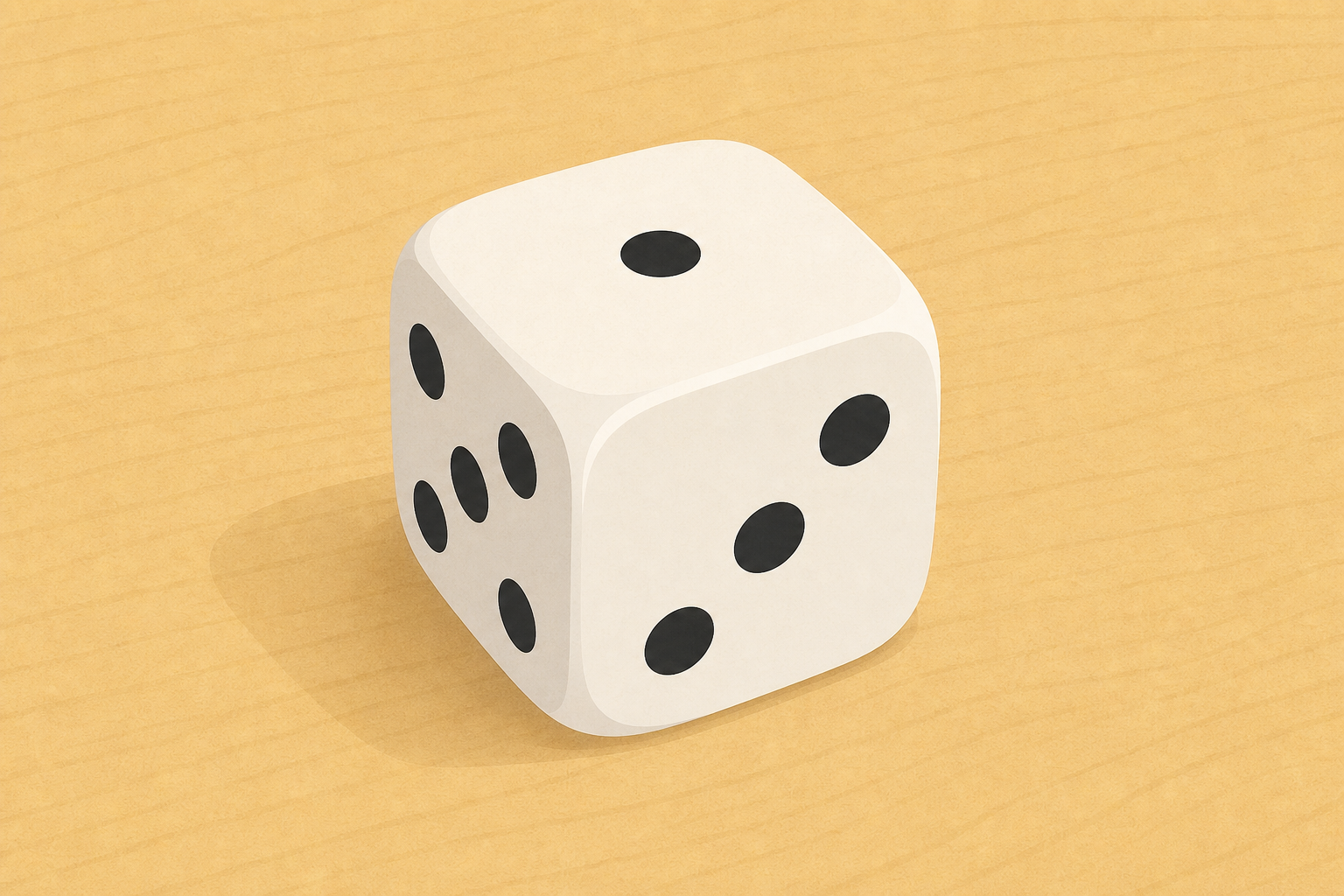
Here is one ordinary six-sided die. If we roll it lots and lots of times, do you think every number will come up about the same amount, or will one number win in the end?
Take three hands-up answers, not open call-outs. Some pupils will insist one number is 'lucky' — hold that thought without correcting it yet; the rolling later will do the arguing. Give five seconds of quiet think-time before any hands go up.
Watch three things here. First, a single roll shows one face. Next, ten rolls can look lopsided — one number pops up more than its share over a short run. Last, a fair spinner has equal segments, so no colour is favoured even when a short run looks uneven.
Look for the equal-sized parts: on the die every face is the same, on the spinner every segment is the same.
Work each snapshot live, drawing out the surprise before you explain it.
Today we work through this together: we predict, then spin, then check. First the class predicts which colour a fair spinner will favour over twenty spins. Then a pupil spins twenty times and we tally each result on the board. After ten spins we pause and read the running tally, then finish to twenty and read it again.
Talk this one through together — pupils take turns at the board and the class agrees or corrects out loud.
Collect the prediction first and write it where everyone can see it. On a fair spinner the honest answer is 'no colour should win' — but let the class predict a winner anyway, because catching a fair spinner not obeying the prediction is exactly the point. At the ten-spin pause, ask 'is the front-runner really better, or just ahead for now?' Revoice a strong answer: so the counts are still settling. Twenty spins animate quickly — tap through them briskly so both tally reads fit the slot.
In your maths copy, write your own prediction for twenty rolls of one die: how many times do you think each number will come up? Write that down first. Now I will roll the die at the board twenty times and call out each result. Keep a tally as I call them. When we finish, write one sentence saying how close the real results were to your prediction.
Give everyone a moment to write the prediction before the first roll — do not start rolling until pencils are down. Then roll the die at the board and call each result aloud so pupils know exactly what they are tallying. Walk the room glancing at tallies — check pupils cross the gate on every fifth mark and are keeping to their own row per number. This is whole-class copybook practice, not marking.
Today we test three predictions, one harder than the last. For each one we predict first. Then we roll and tally. Then we judge whether the prediction held. Watch the board and agree or correct out loud.
This is the practice round — pupils take turns at the board, check each answer, and the class confirms before moving on. Keep the first two tests brisk.
The third test is the anchor and needs the most time: run ten rolls, note how uneven the histogram looks, then run thirty and let the class see the bars level out. Hold out for the idea that the die was fair the whole time — only the number of turns changed. For the second test, let a run of the same number stand out and ask pupils to explain why a fair die can still do that over a few rolls.
You're previewing this lesson. Get full access to this lesson and hundreds more — each one ready to teach, with interactive activities, printable resources and pupil progress tracking built in.