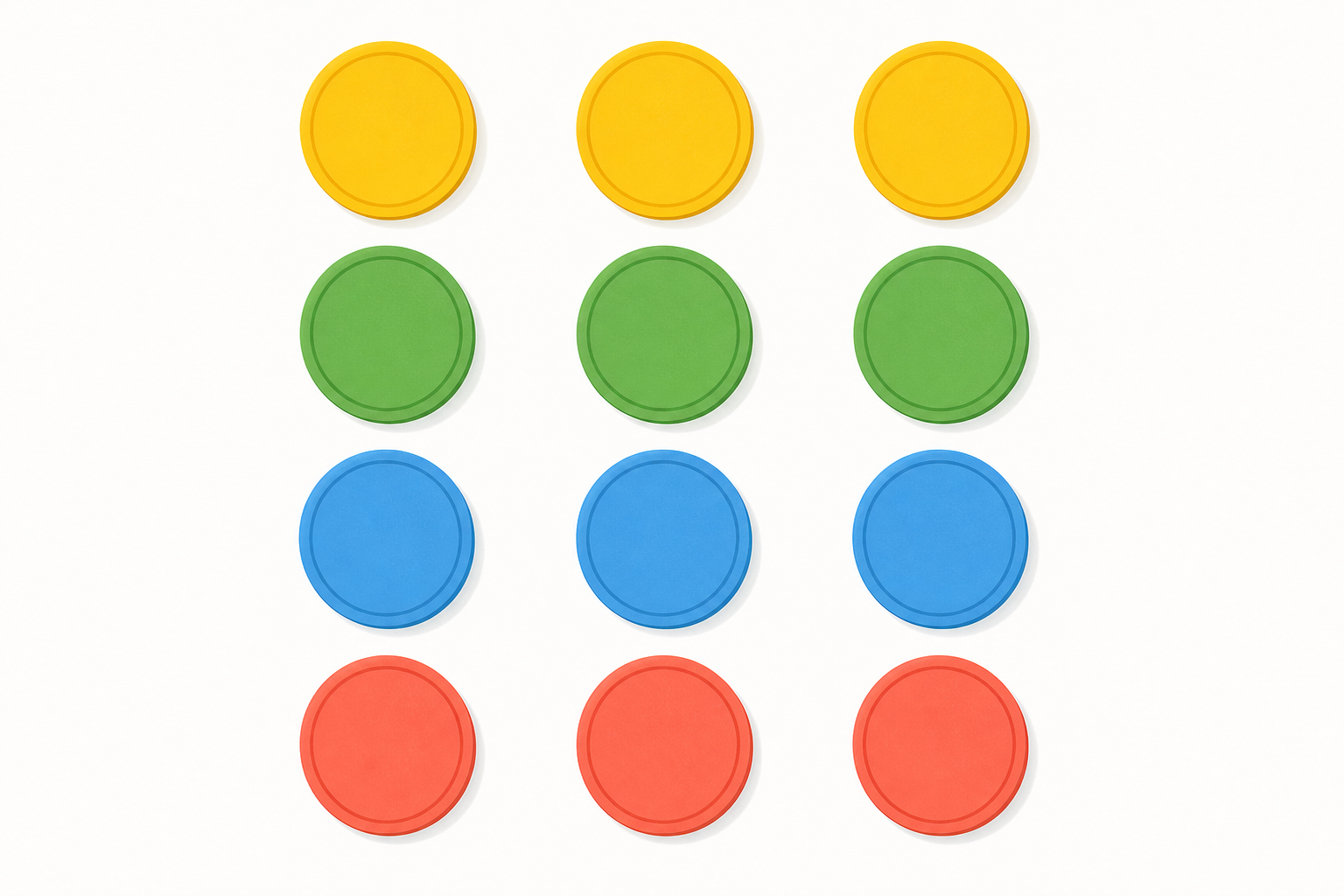
Look at the counters. They are set out in 4 rows, with the same number in each row. How many counters are there altogether?
Now here is a wondering for us. What do you think would happen if we scooped them all up and shared them back out into 4 equal rows again?
Take two or three hands-up answers to the counting question, then hold out for the wondering: does sharing them back give us anything we started with? Treat the second question as a prediction, not a sum they should already know. Don't confirm the link yet — that is what the lesson draws out.
Two words we will use all lesson: a times fact multiplies groups together, and a share fact deals a total back out — both use the same three numbers. The interactive deals out three sharings. After each one, ask yourself: what times fact matches this share?
First: 12 dealt into 3 groups, 4 in each. Point to the counters, read them as 3 rows of 4: 3 × 4 = 12, and 12 ÷ 3 = 4 — same three numbers, share undoes the times fact.
Second: the same 12, now into 4 groups, 3 in each. Draw out that 12 splits two ways — 12 ÷ 4 = 3 and 4 × 3 = 12.
Third: 20 into 5 groups, 4 in each — get the class to say it: 20 ÷ 5 = 4 and 5 × 4 = 20.
Only after the third: the total, the number of groups and the size of each group make one family that works forwards and backwards.
Today we work through four sets together. For each one, we deal the total into equal groups on the board. Then we read the times fact off it. Then we say the share fact that undoes it.
Here are our four sets: 2 groups of 5, then 3 groups of 4, then 5 groups of 4, and finally 6 groups of 3. Reset the tool for each new set.
Talk this one through together — pupils take turns at the board and the class agrees or corrects out loud.
For each set, an individual pupil sets the total and the number of groups so the counters deal into equal groups; the rest of the class builds the same array at their desks. After each deal, have the class say all four facts in the family. Listen for the swap: 2 × 5 and 5 × 2 both make 10. Revoice a strong answer: so dividing gave back the number of counters in each row. Reset the tool between sets rather than leaving it on 10-into-2.
In your maths copy, draw an array of 2 rows of 5 counters. Underneath it, write the two times facts and the two share facts it shows.
Walk the room glancing at the dot arrays and the four facts — this is whole-class copybook practice, not marking. Watch for pupils who write only the two times facts and forget the two shares.
Today we build and share four totals in turn. For each one, we write the whole times-and-share family of four facts. Here are the four totals: 10 shared into 2, then 12 shared into 3, then 20 shared into 5, and finally 18 shared into 6.
Keep the model four-fact family from your copy on the board while you write. Your families follow the same four-fact shape.
This is the practice round — pupils take turns at the board, check each answer, and the class confirms before moving on. Keep the board work brisk rather than over-explaining.
For each target, a pupil deals the counters into equal groups and presses Check, then the class calls out the two times facts and the two share facts. The 18 ÷ 6 one is the one to slow down on: it uses the least-familiar table fact of the set and it is the largest total, so pupils are most likely to slip here. Callout: which multiplication fact checks this share?
You're previewing this lesson. Get full access to this lesson and hundreds more — each one ready to teach, with interactive activities, printable resources and pupil progress tracking built in.