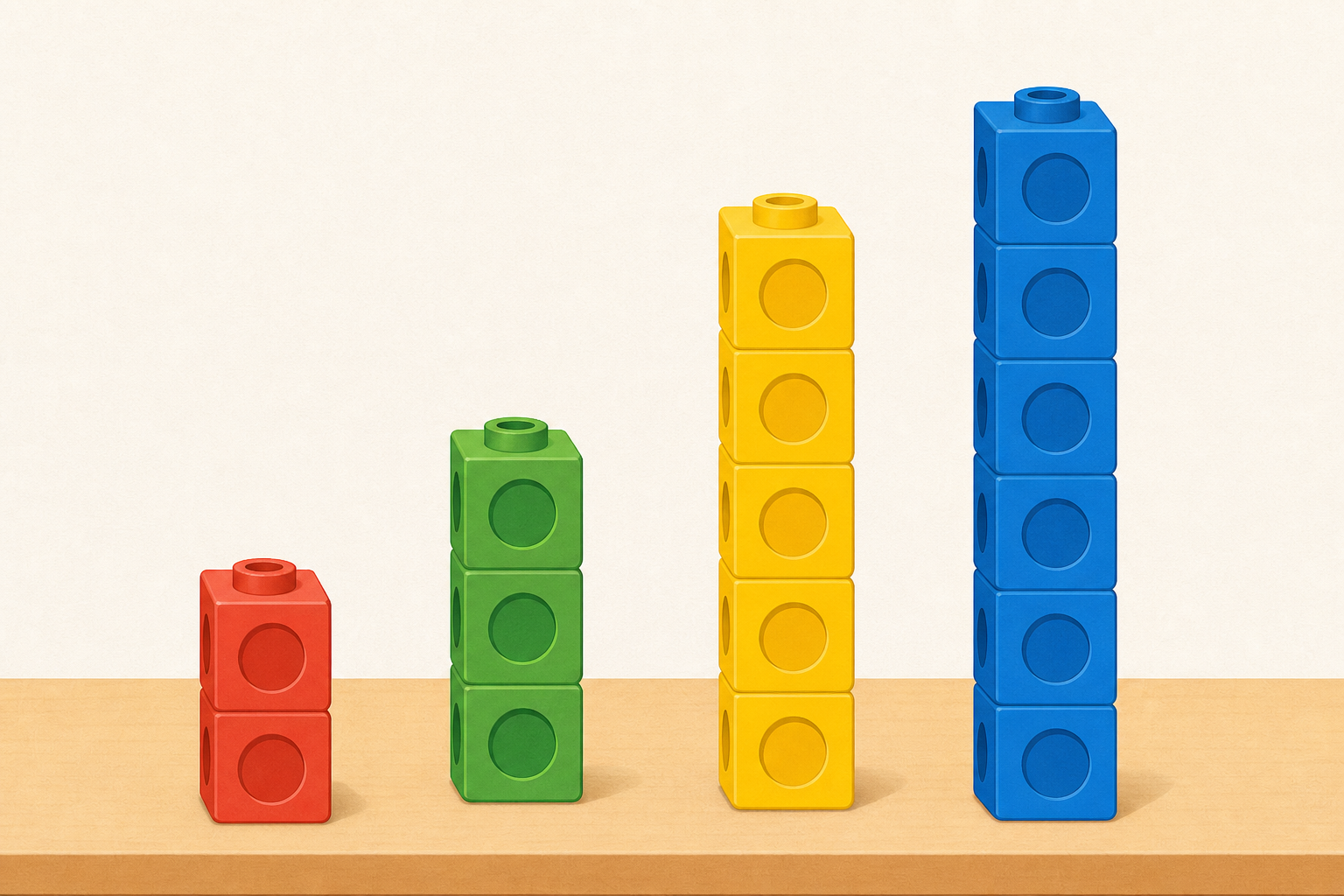
Look at these four towers of cubes: one is 3 high, one is 5, one is 2, and one is 6. They belong to four friends.
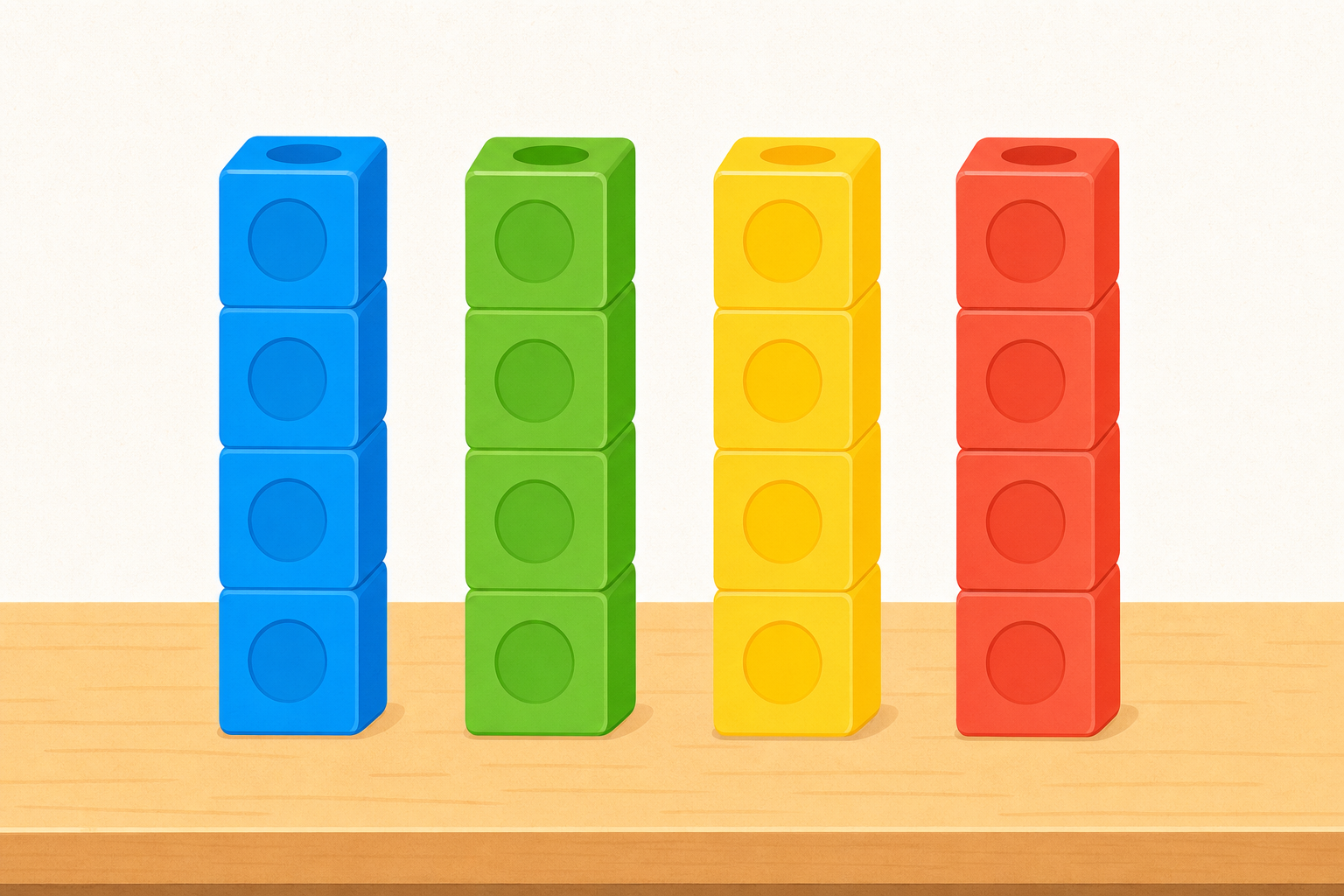
If the four friends shared all their cubes fairly, so everyone had the same, how many would each one get?
Stack the four real towers (3, 5, 2, 6) where the class can see them, or show the photo. Give five seconds of quiet think-time, then take three hands-up guesses before any counting. Do not confirm the answer yet — the levelling in the next step is where it lands.
Watch what happens when we make the four towers the same height. We move cubes off the tall towers and put them onto the short ones, taking care not to add or lose any.
When every tower is level, that even height is the fair share for everyone. We call this fair share the mean.
There is also a quicker way to reach the same answer: add all the heights together, then share the total between the towers.
Level the four real towers (3, 5, 2, 6) in front of the class — move one cube from the 6-tower and one from the 5-tower onto the 2-tower and up to the short ones until all four sit at 4. Say aloud as you go: the tallest gives to the shortest. Then write the same idea as numbers on the board: 3 + 5 + 2 + 6 = 16, then 16 shared between 4 is 4.
The point to draw out: levelling and adding-then-sharing give the same answer. Hold out for a pupil to notice both roads reach 4 rather than announcing it.
We level each set of towers together, one set at a time. Watch the pupil at the board move the cubes, then read off the fair share with them.
For each set, we move cubes from the tall towers to the short ones until they are all the same, then read off the even height.
Reveal one set on the IWB at a time — do not show the whole list up front. To fit the time, give 4, 4, 4, 8 a full board build (a pupil comes up and levels the real towers); the other three sets are quicker verbal levelling with the class calling out the fair share.
Watch for two slips: moving a cube to make a tower too tall (they need to check every tower matches at the end) and quietly losing a cube. Check each answer by re-counting one tower. The set 4, 4, 4, 8 is worth pausing on — the mean (5) is not one of the tower heights, which surprises pupils. Rehearse this beforehand: 4 + 4 + 4 + 8 = 20, which levels exactly to four towers of 5, so a stray cube will not undermine the point.
Here is the add-then-share method written out for the four friends' towers, so you can see each step clearly before you use it on your own.
Walk the annotated working line by line on the IWB — point at each highlighted piece and say what it does. The load-bearing move to stress is sharing by how many towers there are, not by one of the heights. This is the beat that makes the copybook and challenge work self-checking.
In your maths copy, draw three towers from the heights the teacher gives you. Then write the total of the three heights, and underneath write the fair share.
Remember: add the heights first, then share the total between the number of towers, just like the working we have just seen.
Give three heights that share evenly (for example 2, 4 and 6). Point pupils back to the annotated working from 'Watch the Working' as their reference. Walk the room glancing at the total and the share — this is whole-class copybook practice, not marking. Look for pupils who add correctly but forget to share, or who share by the wrong number of towers.
You're previewing this lesson. Get full access to this lesson and hundreds more — each one ready to teach, with interactive activities, printable resources and pupil progress tracking built in.