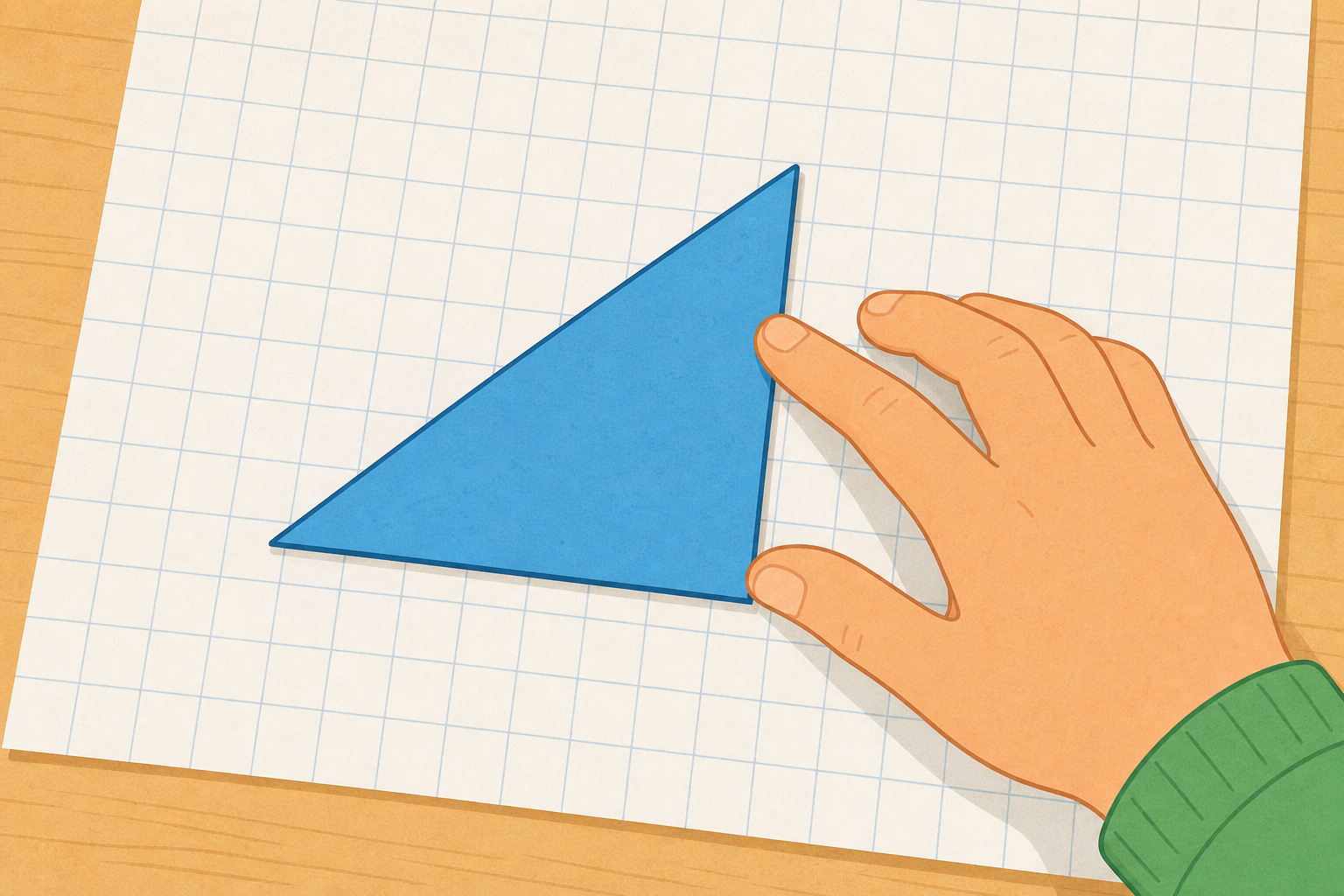
Watch me change a shape in four ways, one after another. First I slide it across the desk. Then I flip it over. Then I turn it. Then I make it bigger.
What name would you give each of those four changes? And which one is the odd one out?
Do the four moves live with a real paper triangle if you have one, or on the board. Take three hands-up answers for the naming, not open call-outs.
Hold out for the odd-one-out — the enlargement changes the shape's size, the other three don't. Don't confirm it; you want the class chasing that all lesson.
The interactive shows the end result of four moves on the grid: a slide, a flip, a turn, and an enlargement. For the first three, look at the shape and its copy together and notice what stays the same and what changes. Before you look at the fourth copy, say what you think will happen to the sides and what will happen to the area.
Slide, flip, turn are light review — run them briskly. Point along the grid for the slide: same distance, same direction, every corner.
Each time ask what changed: slide changes only position; flip and turn change only the way it faces; size never changes.
Enlarge is the load-bearing move and the odd one out. Hold the reveal — get predictions for both sides and area first.
Many will say the area doubles. Count the grid squares on the enlarged copy together so they see it is four times as big.
Use the enlarged copy on the grid as the 'why': sides double in both directions, so area is 2 x 2 = 4 times as big. Give this a real beat, the wrap depends on it.
Now we try the four moves ourselves. Each move starts fresh from the same triangle, so we always go back to the start before the next one. First we slide it 4 right and 1 down. Then we flip it across a vertical mirror line. Then we turn it a quarter turn about a corner. Last, we enlarge it by scale factor 2.
Before each move, everyone predicts what will stay the same and what will change. Call out your prediction, then we check it on the board.
Talk this one through together — pupils take turns at the board and the class agrees or corrects out loud. The watching class predicts what stays the same and what changes before each reveal.
Reset to the starting triangle before each move — the four moves do not chain onto one another, so the enlargement is applied to the original and stays on the visible grid. Run them in order: translate 4 right 1 down, reflect across the vertical line, rotate a quarter turn about the corner, enlarge by 2.
The enlargement is the beat to slow down on — get the class to say sides ×2 and area ×4 before you confirm it.
In your maths copy, sketch the starter shape and each of the four transformation results side by side: translation, reflection, rotation, and enlargement at scale factor 2. Label each result with the move that produced it.
Underneath the enlargement, write:
Walk the room glancing for the four labels and the two enlargement notes — no marking, this is whole-class copybook practice. Look for pupils drawing the enlarged triangle too small; the sides should visibly double.
Now we match the triangle to a dashed target outline, one round at a time. The rounds are:
Each round, predict the move before anyone touches the board.
This is the practice round — pupils take turns at the board, check each answer, and the class confirms before moving on. Keep the board work brisk rather than over-explaining.
The last round combines two moves — pupils will want to rush. Ask which move to do first and why before anyone touches the board.
You're previewing this lesson. Get full access to this lesson and hundreds more — each one ready to teach, with interactive activities, printable resources and pupil progress tracking built in.