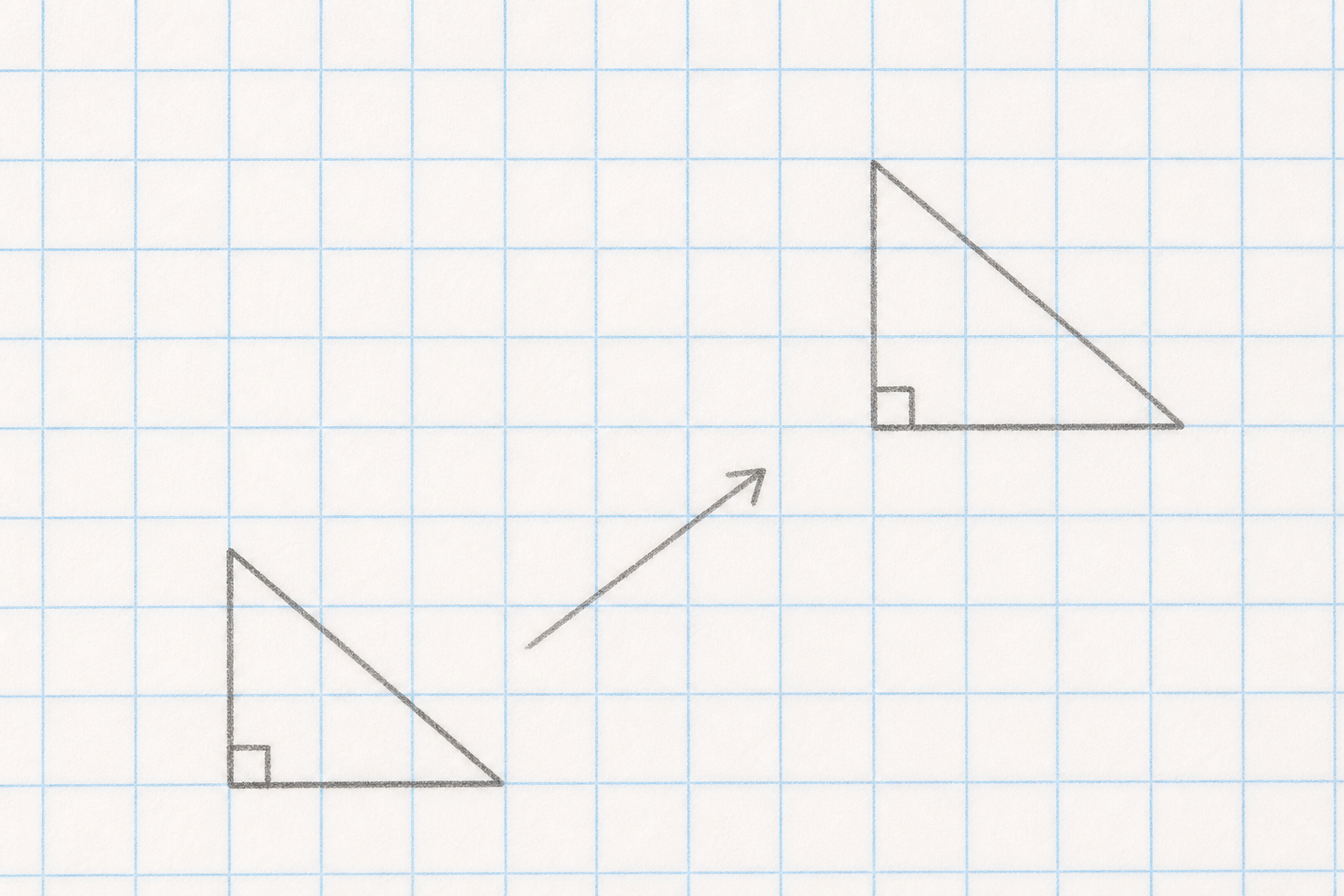
I am going to slide this triangle across the grid: three squares to the right, then two squares up. Same triangle, new spot on the map.
Watch closely. What stayed exactly the same about the triangle? What is the only thing that changed?
Slide the shape once on the board, then pause. Take two or three hands-up answers before revealing anything. Listen for pupils saying the size and shape stayed the same and only the position changed — that is the whole idea of a translation.
Watch four slides on the grid. Each time, a shape moves without turning or flipping — every corner travels the same distance in the same direction. The new shape we get after a slide is called its image. Read the corner numbers off the labelled grid and keep your eye on where each corner lands.
Before each slide, say what you think the new co-ordinates of one corner will be, then we check them on the grid together.
Every corner moves the same amount — revoice this after the third example.
Now we work three slides together on the board. First slide the triangle 3 right. Then start again from the same triangle and slide it 4 down. Then start again and slide it 2 right and 3 up.
Each time, read the new co-ordinates of every corner off the labelled grid. Then we check them together.
Talk this one through together — pupils take turns at the board and the class agrees or corrects out loud. Tap reset so the triangle returns to (2,2) before each of the three slides, so every slide starts from the same place rather than continuing from the previous image.
Pick the corner you want the class to track and stick with it across the three slides, so pupils see the pattern in how the co-ordinates change. Watch for pupils who add to both numbers on a straight-right or straight-down slide — remind them a right/left slide only touches the x-number, an up/down slide only touches the y-number. Rotate a different pupil to the board for each slide.
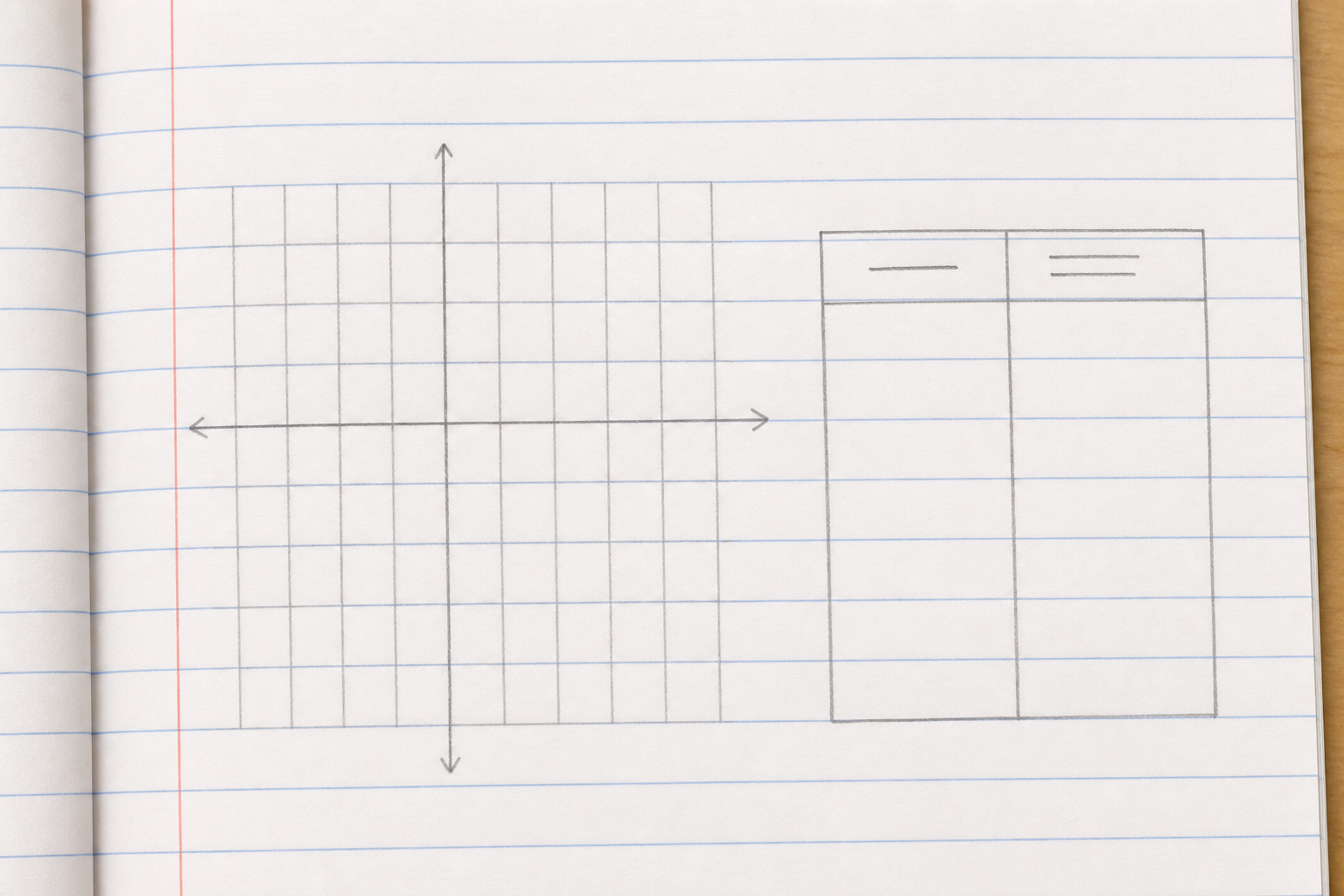
In your maths copy, plot a small triangle on a grid. Then plot its image after a "4 right, 2 down" translation.
List the original and image co-ordinates of each corner — or vertex, the maths word for a corner — in two columns, like this: original on the left, image on the right.
Walk the room glancing at whether pupils added 4 to the x-number and subtracted 2 from the y-number for every corner — this is whole-class copybook practice, not marking. No individual grades. If a pupil asks what 'vertex' means, remind them it is just the maths word for a corner.
Now we work through these together on the board. Match the shape to the dashed target outline. First comes a straight slide to the right. Then comes a slide down. Then comes a diagonal slide. Last comes a slide where you have to describe the move that gets there.
This is the practice round — pupils take turns at the board, check each answer, and the class confirms before moving on. Keep the board work brisk rather than over-explaining.
The practice set rises from a single-direction slide to a two-direction slide. For the last one, ask the class to say the slide in words ("so many right, so many up/down") before a pupil applies it. Use the Check button as part of the narration — a ✓ means the image landed exactly on the dashed target.
You're previewing this lesson. Get full access to this lesson and hundreds more — each one ready to teach, with interactive activities, printable resources and pupil progress tracking built in.