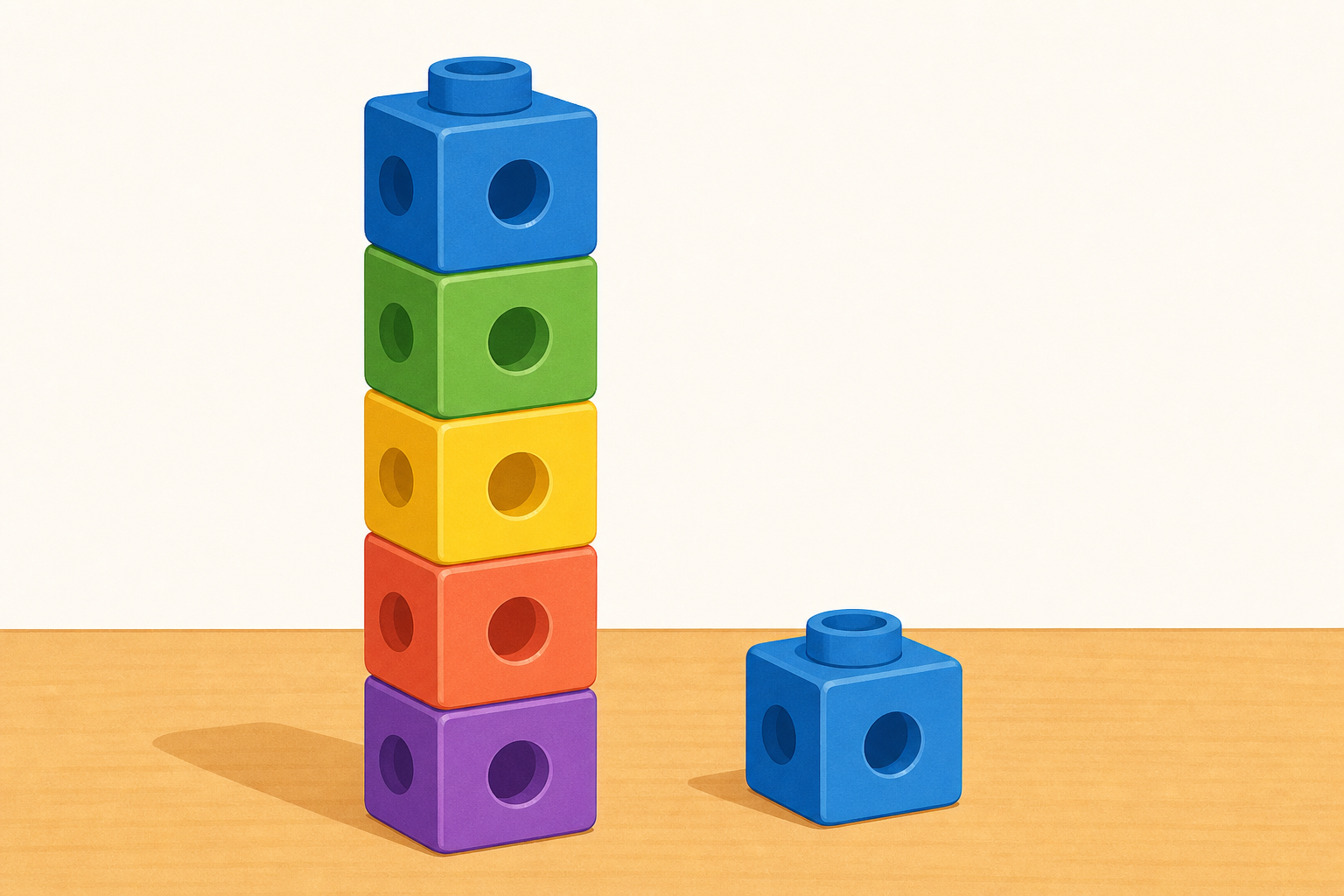
Look at the little tower of building cubes on the screen, and the one loose cube beside it.
If that one loose cube is our unit, how many cubes do you think are hiding inside the whole tower?
Hold up a real stack of a few cubes and one loose cube if you have them. Take three hands-up estimates, not open call-outs.
Don't reveal the count yet — the point is the guess, and the idea that some cubes hide behind others.
Volume means how much space a solid fills. We measure it by counting the equal cubes that fit inside.
Watch two solids on the screen. Each one is filled with cubes that are all the same size.
The first solid is one row of cubes. Count them with me.
The second solid has cubes stacked in two layers. Watch for the ones hiding underneath — they still count.
First solid (3 in a row): point to each cube as the class counts 1, 2, 3 — volume is 3 cubes.
Second solid (2 × 2 × 2): hold out for the hidden layer — "four cubes on the bottom, four on top, so how many in all?" Let the class predict the total before you confirm it is 8. The bottom-layer cubes are the make-or-break here.
First, watch how the three steppers work. When I move the width stepper on its own, one more cube appears in the row and the count goes up. Height stacks cubes upwards; depth adds cubes behind. We change one at a time and read the new count each time.
Now we build solids together and read the cube count. We will build a solid of 4 cubes first. Then we will build one of 8 cubes. Then we will build one of 6 cubes.
Set the width, height and depth, then read the count off the cubes — remember to count the cubes we cannot see.
Talk this one through together — pupils take turns at the board and the class agrees or corrects out loud.
Start by moving one stepper at a time yourself and reading the live count, so pupils see how a stepper maps to the total before they build. Then call a cube count, an individual pupil sets the steppers, and the class reads the live count to check it matches.
Before the count settles on a two-layer solid, ask a quick prediction: "how many do you think, counting the hidden layer?" and take two hands. On the hidden-layer check, turn-and-name a pupil: "did you count the bottom layer too?" Rotate three pupils across the three builds. Keep it brisk — the point is reading the count off the cubes, not perfecting the shape.
In your maths copy, build a solid from 6 real cubes. Then sketch your solid and write underneath how many cubes you used.
Walk the room glancing at each sketch and the count written underneath — this is whole-class copybook practice, not marking. Watch for pupils who forget to count a hidden cube in their own build.
Today we build a solid to match each target and press Check. First, build a solid of 4 cubes. Next, build a 2 × 2 × 2 box of 8 cubes. Then build a 3 × 2 × 2 box of 12 cubes. After that, build a 3 × 2 × 3 box of 18 cubes. Last, build any solid at all with 6 cubes.
That last one has more than one right answer — see if you can find a second solid, shaped differently, that also makes 6.
This is the practice round — pupils take turns at the board, check each answer, and the class confirms before moving on. Keep the board work brisk rather than over-explaining.
The 12-cube box steps us up gently from 8 before the 18. On the 18-cube box, read it layer by layer: "count one layer of 9, then the second layer of 9 on top of it — how many altogether?" Ask pupils for the dimensions they chose before checking, so they own the reasoning.
The 6-cube target is the one where the class sees there is more than one right answer: a flat row of 6, an L, a 3 × 2 slab all reach 6.
You're previewing this lesson. Get full access to this lesson and hundreds more — each one ready to teach, with interactive activities, printable resources and pupil progress tracking built in.