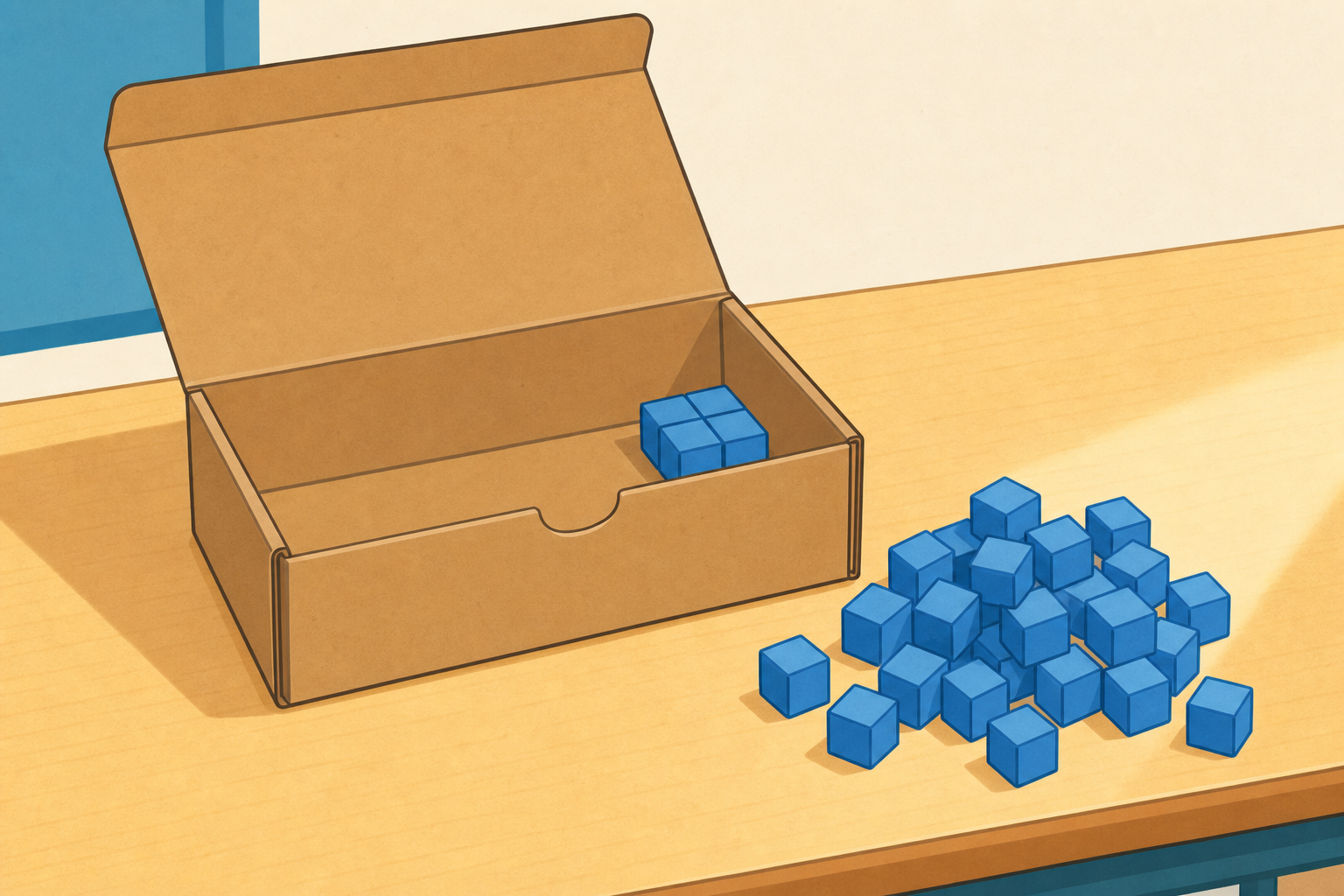
Look at the picture on the board: an empty box, with a pile of little centimetre cubes beside it.
Roughly how many of those little cubes do you think would fill the box right up to the top? Have a good look before you guess.
Take three hands-up estimates, not open call-outs. Don't confirm or correct any yet — hold the guesses for the class to test against once they know the method.
Resist the urge to name the answer here — the whole lesson is about how we can work it out instead of counting one cube at a time. If you happen to have a real box and a tub of cubes to hand, holding them up makes a good extra prompt, but the picture on the board is all you need.
Three boxes in the picture, each already filled with little cubes. Take the length, breadth and height of each one from the teacher notes, and notice how the cube count grows.
For each box, count one flat layer of cubes first. Then count how many layers are stacked up. One layer, times the number of layers, gives the whole box.
The last box is a plain cube: every side is the same length. Together, tell me what happens to the count when all three sides are the same length.
Keep saying the unit aloud: cubic centimetres, cm³. This is where pupils drop the cubed unit later.
We build and measure at the board together. Whoever is at the board drags the sliders while the whole class works each answer out loud.
First set the box to 3 × 2 × 2. Then grow it to 5 × 4 × 2. Then raise the height to 3 cm.
Each time, work out the base layer first, then how many layers high the box is, and call out your prediction before we read the volume off the tool.
Talk this one through together — pupils take turns at the board and the class agrees or corrects out loud.
Set the three sliders in the 3D mode. For each box, ask for the base-layer count, then the number of layers — so what's the volume? — then check against the live readout. Three boxes, a turn at the board each, and a full predict-check cycle on every one fills the time. Watch for pupils who add the three dimensions instead of multiplying; catch it on the first box.
In your maths copy, sketch these three shapes: the 5 × 3 × 2 box, the 6 × 4 × 3 box, and the 4 cm cube.
Label the three dimensions on each one, then write the volume formula and the answer in cm³. Underline the unit on every one.
Walk the room glancing for the cubed unit (cm³, not cm) and for three labelled dimensions on each sketch — this is whole-class copybook practice, not marking.
We work through these volumes together. First a 3 cm cube. Then a 7 × 2 × 2 cuboid. Then a 5 × 5 × 4 cuboid.
Last of all comes a puzzle that turns it around: a box has a volume of 48 cm³ and a 4 cm × 3 cm base, so how high is it? Work each one together and confirm the answer before moving on.
Find the volume of each box in cm³. Last of all, a box holds 48 cm³ and its base is 4 cm by 3 cm — work out how high it is.
Ways to start:
Stretch:
This is the practice round — pupils take turns at the board, check each answer, and the class confirms before moving on. Keep the board work brisk rather than over-explaining.
The last task reverses the rule: volume ÷ (base area) gives the missing height. Hold out for the class to spot that 48 ÷ 12 = 4 before anyone guesses. Every pupil can enter on the cube; the reverse problem is the stretch.
You're previewing this lesson. Get full access to this lesson and hundreds more — each one ready to teach, with interactive activities, printable resources and pupil progress tracking built in.