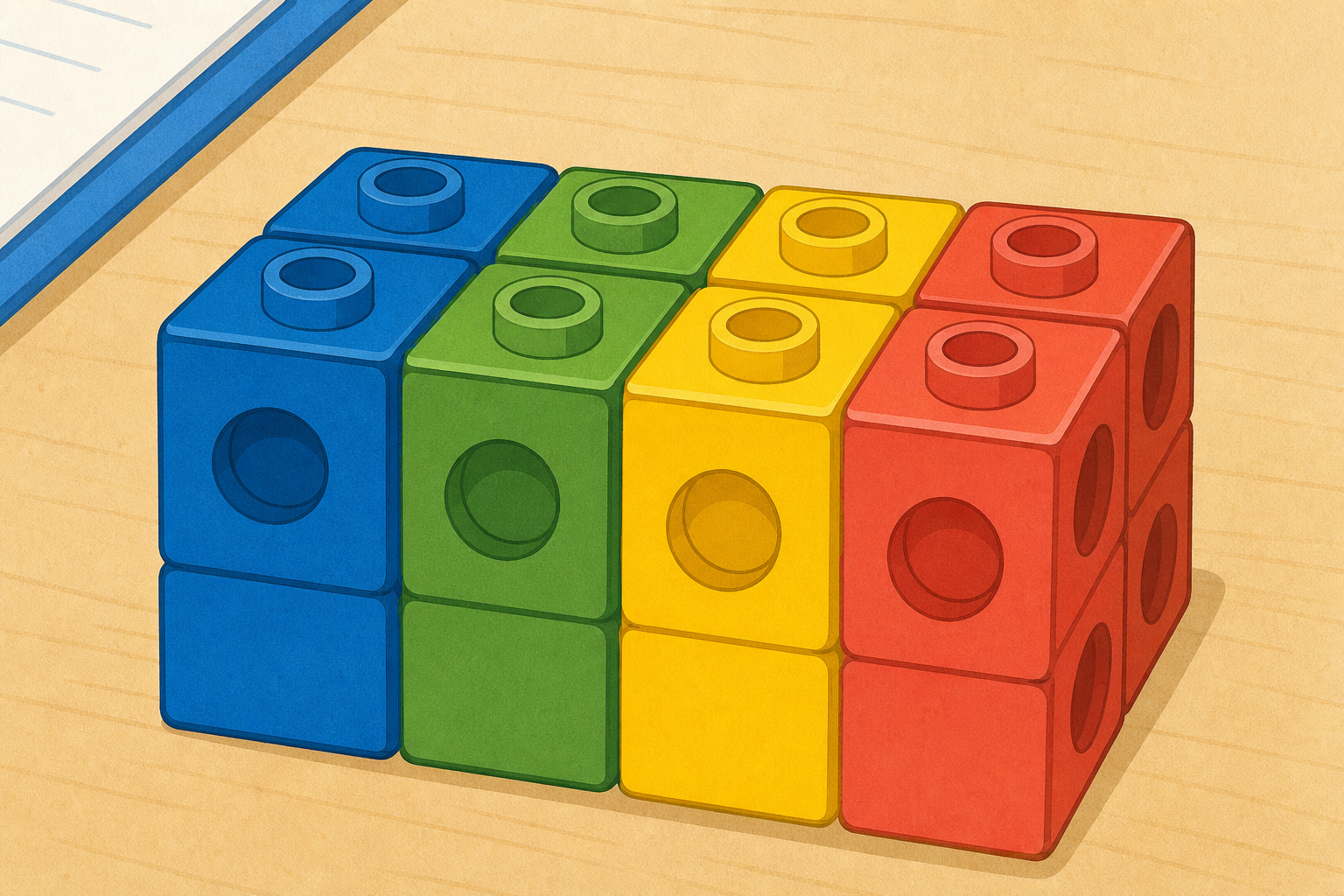
Here is a small box built from little cubes. Roughly how many cubes do you think are hidden inside it? Have a guess before we count.
Hold up (or show) a 4 × 3 × 2 multilink box. Take three hands-up guesses, not open call-outs. Do not count yet — the point is that some cubes are hidden inside, so guessing is hard. That tension is what the lesson resolves.
Look at three cuboids on screen, each already filled with unit cubes. For each one, look at the bottom layer first: how many cubes cover the floor of the box? Then count how many layers are stacked on top. The volume is the cubes in one layer times the number of layers.
This next box has every side the same length. Be ready to say how the base and the layers work when the box is a perfect cube.
Every readout carries cm³ — point to the little 3 and say the units matter.
Together we build and read three cuboids on the shape-measurer. First we do 3 × 2 × 2. Next we do 4 × 4 × 4. Last of all we do 10 × 10 × 10. One pupil at a time sets each cuboid on the board while everyone watches. As a class we call out the bottom layer, then how many layers, then check the volume against the screen. The last box is worth a good look.
This is a whole-class board activity: one pupil at a time comes up to set the sliders on the single shape-measurer while the rest watch and call out the bottom layer and the layer count together. Re-set the same interactive's length, width and height sliders for each of the three targets in order. Three slider-and-read reveals with class prediction fill the ten minutes.
Before each reveal, ask the class to work out the bottom layer and the layer count. 3 × 2 × 2 = 12 cm³; 4 × 4 × 4 = 64 cm³; 10 × 10 × 10 = 1000 cm³. Stop on the last one: a box 10 cm on every side holds exactly a litre of water. That link back to capacity is the key one — hold out for a pupil to remember 1000 ml = 1 l.
In your maths copy, sketch each cuboid as a 3D box outline with its dimensions labelled (l × w × h). Work out the volume in cm³ under each box and underline the answer.
Walk the room glancing at the labelled dimensions and the cm³ units — this is whole-class copybook practice, not marking. Watch for pupils writing cm² instead of cm³.
Build each cuboid from your cubes to match the volume called out, then we check by counting the cubes together. Build a box with volume 12 cm³, then 24 cm³, then 36 cm³. If you have no cubes at your desk, work out the length, width and height in your head and predict them out loud when a build goes up on the board. For the stretch: build a box with volume 24 cm³ that uses the most cubes on the bottom layer.
Hand out the tubs of multilink cubes before this step. This is the practice round — pupils build at their own desks and one pupil brings each build to the board to check it against the shape-measurer set to the same dimensions; the class confirms before moving on. Keep it brisk.
If cubes are not available, run it as a whole-class board activity: read out each target, the class predicts a length, width and height, and you (or a pupil) set the shape-measurer to check.
Look for pupils who realise there is more than one right answer for each target.
You're previewing this lesson. Get full access to this lesson and hundreds more — each one ready to teach, with interactive activities, printable resources and pupil progress tracking built in.