Secondary Leaving Certificate Applied

LCA English & Communications

A Leaving Certificate Applied English and Communications course covering personal identity, digital citizenship, media literacy and creative expression.

  • Mapped to the NCCA curriculum

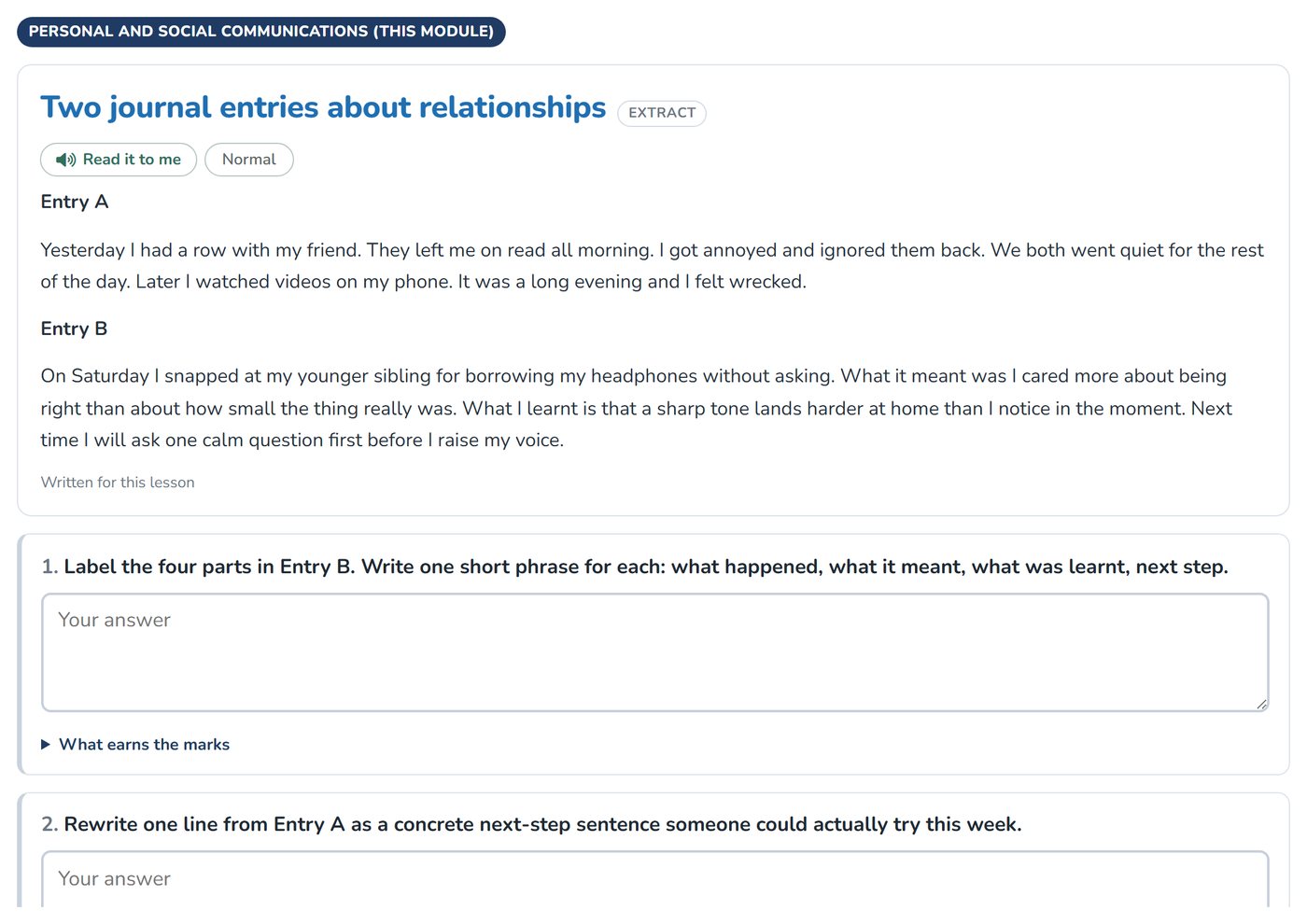
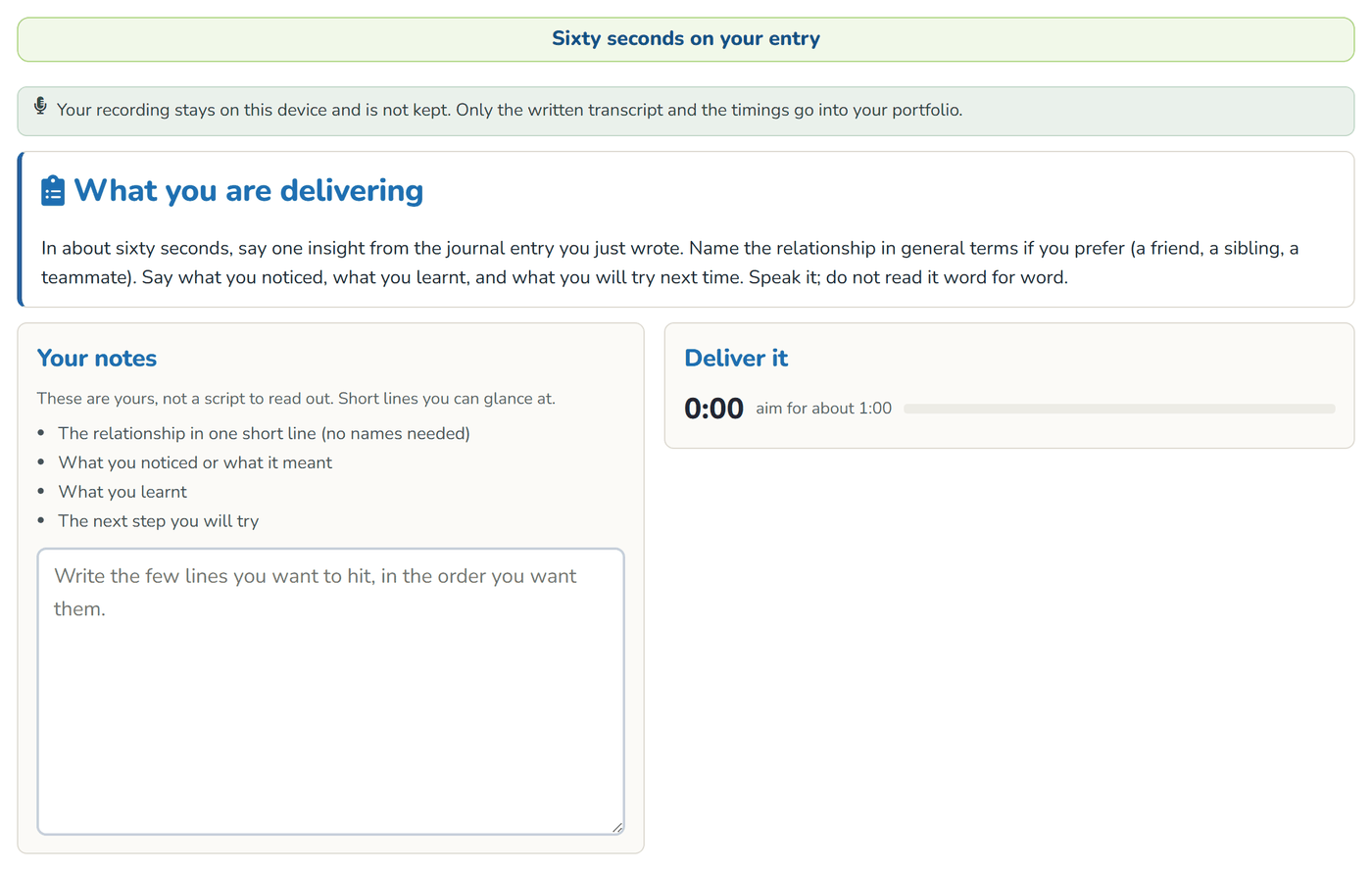
The whole first lesson, as your class sees it. No sign-in needed.

On the board, and on their devices
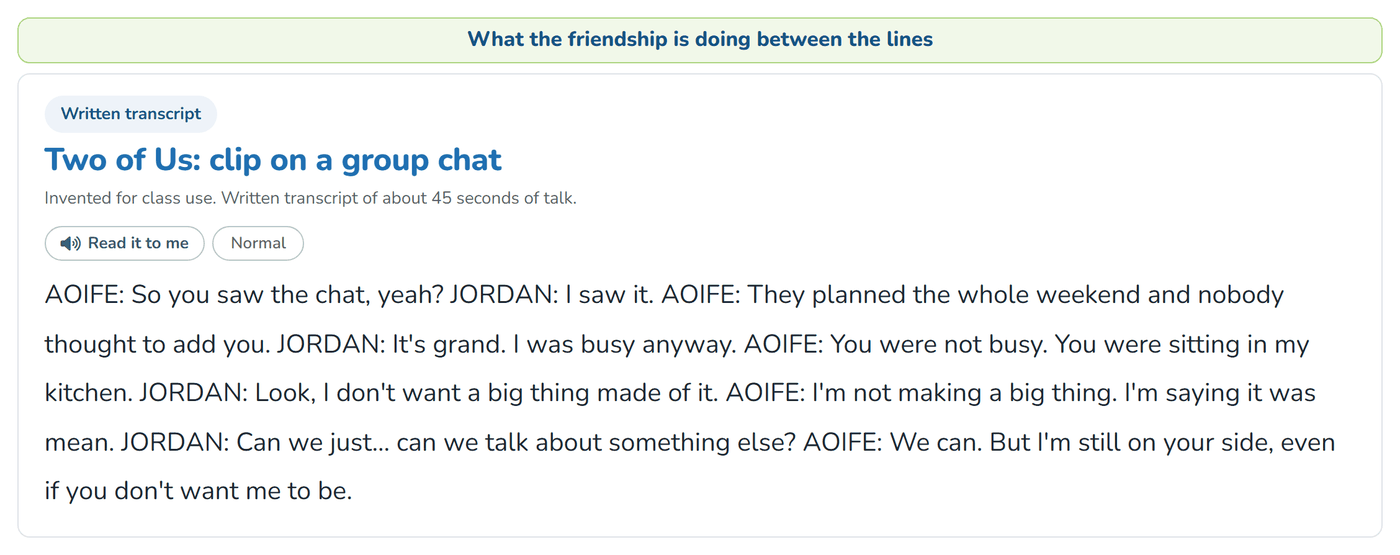
What the friendship is doing between the lines
Two journal entries
Sixty seconds on your entry

The same lesson opens on each student's own device, to follow in class and finish at home.

What your school gets

Everything a teacher needs to teach LCA English & Communications this year.

In class

On paper

  • Teacher Resource BookThe whole course laid out for the teacher, lesson by lesson, ready to print.
    The sample lesson's pages

The whole books come with the course, in each class's Resources.

The curriculum it covers

Every lesson is mapped to the specification. This course teaches 60 of the 60 outcomes for this class.

Module 1: Personal and Social Communication 18 of 18 outcomes
Module 2: Communication and the Digital World 11 of 11 outcomes
Module 3: Communication in Media 14 of 14 outcomes
Module 4: Express Yourself 17 of 17 outcomes
See every outcome
Curriculum Area
Outcomes
Module 1: Personal and Social Communication
Unit 1: Identity
M1.U1.1 M1.U1.2 M1.U1.3
Unit 2: Relationships
M1.U2.1 M1.U2.2 M1.U2.3
Unit 3: Journeys: Setting out
M1.U3.1 M1.U3.2 M1.U3.3
Unit 4: Journeys: Meeting new characters
M1.U4.1 M1.U4.2 M1.U4.3
Unit 5: Journeys: Finding our way
M1.U5.1 M1.U5.2 M1.U5.3 M1.U5.4
Unit 6: Destinations
M1.U6.1 M1.U6.2
Module 2: Communication and the Digital World
Unit 1: Digital Identity
M2.U1.1 M2.U1.2 M2.U1.3 M2.U1.4
Unit 2: Digital Safety
M2.U2.1 M2.U2.2 M2.U2.3 M2.U2.4
Unit 3: Digital Citizenship and Global Communication
M2.U3.1 M2.U3.2 M2.U3.3
Module 3: Communication in Media
Unit 1: Introduction to Media
M3.U1.1 M3.U1.2
Unit 2: Audio, Visual and Print Media
M3.U2.1 M3.U2.2 M3.U2.3 M3.U2.4
Unit 3: Media and Advertising
M3.U3.1 M3.U3.2 M3.U3.3
Unit 4: Film Studies
M3.U4.1 M3.U4.2 M3.U4.3 M3.U4.4 M3.U4.5
Module 4: Express Yourself
Unit 1: Song
M4.U1.1 M4.U1.2 M4.U1.3
Unit 2: Poetry
M4.U2.1 M4.U2.2 M4.U2.3 M4.U2.4 M4.U2.5
Unit 3: Drama
M4.U3.1 M4.U3.2 M4.U3.3 M4.U3.4 M4.U3.5
Unit 4: Reflection
M4.U4.1 M4.U4.2 M4.U4.3 M4.U4.4

Tap any outcome to read it. The coloured ones are taught in this course. The curriculum does not include official reference codes for individual learning outcomes, so we have assigned a code scheme to make it easier to identify and track coverage.

The course, module by module

120 lessons in 4 modules. The lesson marked Sample opens in full.

1 Personal and Social Communication 30 lessons · about 30 hours

Year 1 (September to January). Develops communication skills in personal and social situations through reading, writing and oral practice. Introduces the Reflective Journal and the Communication Portfolio that run across the whole course, and uses a single class-chosen anchor text (novel, short story collection or graphic novel) as a critical-literacy focal point. By the end of the module students have banked five Key Assignments and produced their first body of evidence in the portfolio.

  1. Identity
  2. 1 Welcome to English & Comms: Set Up Your Communication Portfolio & Pick the Anchor Text Sample lesson
  3. 2 Who Am I, Who Are We?: Identity Warm-Up & Reflective Journal Launch (KA1)
  4. 3 Comprehending Everyday Texts: Reading for Information
  5. 4 Writing for Audience and Purpose: One Message, Two Readers
  6. 5 Identity Out Loud: Spoken Self-Introduction
  7. Relationships
  8. 6 Comprehension Strategies for Communication
  9. 7 Reading Character: Identity and Relationship in Texts
  10. 8 The Reflective Journal as a Tool
  11. 9 Walking Debate or Written Stance: Identity and Relationship
  12. Journeys: Setting Out
  13. 10 Meet the Anchor Text: Cover Analysis
  14. 11 Front Cover Design Workshop, Part 1 (KA2 prep: Novel)
  15. 12 Front Cover Design Workshop, Part 2 (KA2: Short Story + Graphic Novel)
  16. 13 Examining Openings: How a Text Sets Off
  17. 14 Setting and Plot Structure
  18. Journeys: Meeting New Characters
  19. 15 Identifying Characters and Their Motivations
  20. 16 Differences Between Characters: Compare and Contrast
  21. 17 Writing Dialogue, Part 1 (KA3 prep)
  22. 18 Writing Dialogue, Part 2 + Role Play (KA3: pair/group)
  23. 19 Optional Drama Extension: From Page to Performance
  24. Journeys: Finding Our Way
  25. 20 Mechanics of Communication: Why It Matters
  26. 21 Mapping Plot and Resolution
  27. 22 Building Suspense: How Writers Hold the Reader
  28. 23 Drafting and Editing Workshop, Part 1 (KA4 prep)
  29. 24 Drafting and Editing Workshop, Part 2 (KA4: proof + edit)
  30. 25 Editing Tools: AI as Drafter, Critic, Explainer
  31. Destinations
  32. 26 Reflecting on the Reading Process
  33. 27 Forming and Defending an Opinion of the Text
  34. 28 Presenting an Opinion: Spoken and Written
  35. 29 Reflective Journal: Anchor Text Reflection (KA5)
  36. 30 Module 1 Recap & Bridge to Module 2
2 Communication and the Digital World 30 lessons · about 30 hours

Year 1 (February to May). Extends junior cycle digital communication skills into the senior cycle, with strong workplace and Work Experience ties. Students audit their own digital identity, build research and source-evaluation skills, contribute to a class digital safety charter, research a global communication platform, and update the Reflective Journal in light of Work Experience. Banks four Key Assignments.

  1. Digital Identity
  2. 31 Welcome to Module 2: Communication and the Digital World
  3. 32 Personal Digital Identity: What's Already Out There About You
  4. 33 Workplace Digital Identity: Employer and Employee Responsibilities
  5. 34 Spotting Bias in Digital Texts
  6. 35 AI-Generated Content and the Bias Question
  7. 36 Research Foundations: Picking a Subject and Framing a Question
  8. 37 The Website Analysis Template: Six Criteria
  9. 38 Online Research Workshop, Part 1 (KA1 prep)
  10. 39 Online Research Workshop, Part 2 (KA1: banking)
  11. 40 Unit 1 Recap: Becoming a Critical Reader of the Internet
  12. Digital Safety
  13. 41 Guarding Your Information Online
  14. 42 Managing Your Social Network Identity
  15. 43 Recognising Cyberbullying
  16. 44 Strategies to Address Cyberbullying
  17. 45 Digital Safety Charter Workshop, Part 1 (KA2 prep: brainstorm)
  18. 46 Digital Safety Charter Workshop, Part 2 (KA2: jigsaw + drafting)
  19. 47 Digital Safety Charter Workshop, Part 3 (KA2: finalising + contribution)
  20. 48 Digital Safety Charter Final Production (KA2: banking)
  21. 49 Consumer Awareness Online, Part 1: Spotting Legitimate vs Scam
  22. 50 Consumer Awareness Online, Part 2: Rights and Reporting
  23. Digital Citizenship and Global Communication
  24. 51 What Is Digital Citizenship?
  25. 52 Personal and Ethical Responsibilities of a Digital Citizen
  26. 53 Global Communication Platforms: An Overview
  27. 54 Picking Your Platform and Framing Your Inquiry (KA3 prep)
  28. 55 Research the Platform, Part 1 (KA3: history, structure, audience)
  29. 56 Research the Platform, Part 2 (KA3: impact, ethics, current debate)
  30. 57 Presentation Prep (KA3: designing the deliverable)
  31. 58 Present Your Findings (KA3: banking)
  32. 59 Multi-Modal Text Analysis
  33. 60 Module 2 Reflective Journal Update + Bridge to Module 3 (KA4: banking)
3 Communication in Media 30 lessons · about 30 hours

Year 2 (September to January). Develops communication and analytical skills around media texts: media forms and audiences, audio/visual/print media, advertising, and film studies. Unit 4 reconnects deliberately to the Module 1 anchor text via the film of (or thematically linked to) it. Banks four Key Assignments including a real-life-scenario advertisement and a film/text comparison.

  1. Introduction to Media
  2. 61 Welcome to Module 3: Communication in Media + Reading Journey Setup
  3. 62 Examining Different Types of Media Forms
  4. 63 Evaluating the Appropriate Audience for Each Form
  5. 64 Bias and Balance in Media Texts
  6. 65 M3 KA1: Reflective Journal Update, Reading Journey (banking)
  7. Audio, Visual and Print Media
  8. 66 Audio Media: Radio, Podcasts, and the Power of the Voice
  9. 67 Visual Media: Television, Film, Video Games, Streaming
  10. 68 Print Media: Newspapers, Magazines, Brochures, Posters, Billboards
  11. 69 The Comparison Rubric: Topic, Purpose, Audience
  12. 70 Impact of Design: Colour, Imagery, Sound Effects, Typography
  13. 71 Picking Your Event + Introduction to Coverage Analysis (KA2 prep)
  14. 72 Coverage Analysis Workshop, Part 1 (KA2: Channel 1)
  15. 73 Coverage Analysis Workshop, Part 2 (KA2: Channels 2 + 3)
  16. 74 KA2 Banking: Compare and Contrast Presentation
  17. Media and Advertising
  18. 75 Advertising Techniques: An Introduction
  19. 76 Critical Analysis: What Is the Ad Selling, Really?
  20. 77 Ethics in Advertising: When the Promise Crosses the Line
  21. 78 Identifying a Real-Life Scenario for Advertisement (KA3 prep)
  22. 79 Advertisement Design Workshop, Part 1 (KA3: planning)
  23. 80 Advertisement Design Workshop, Part 2 (KA3: drafting)
  24. 81 Advertisement Design Workshop, Part 3 (KA3: refining)
  25. 82 KA3 Banking: Final Advertisement + Real-World Placement
  26. Film Studies
  27. 83 Film Genres: An Overview
  28. 84 Linking to Module 1: Storytelling Across Page and Screen
  29. 85 Film Vocabulary: The Language of the Camera
  30. 86 How Techniques Are Used For Effect in Different Genres
  31. 87 Character Voice Creation: Writing as a Film Character
  32. 88 Film and Text Comparison Workshop, Part 1 (KA4 prep)
  33. 89 KA4 Banking: Comparison Display or Presentation
  34. 90 Module 3 Recap + Bridge to Module 4
4 Express Yourself 30 lessons · about 30 hours

Year 2 (February to May). The home stretch. Develops the student's own creative voice through critical engagement with song, poetry and drama, the composition of a personal-meaning piece, engagement with a real staged performance, and the two-year reflective journal update that anchors the oral examination and the Personal Reflection Task. Banks four Key Assignments. Every lesson doubles as oral-exam preparation.

  1. Song
  2. 91 Welcome to Module 4: Express Yourself
  3. 92 Song Techniques, Part 1: Rhythm, Beat, Repetition, Sound Effects
  4. 93 Song Techniques, Part 2: Alliteration, Assonance, Internal Rhyme, Imagery, Symbolism
  5. 94 Applying Critical Vocabulary: Themes and Emotions in Songs
  6. 95 Critiquing Songs: Beyond "I Like It"
  7. 96 Comparing Song and Poetry
  8. 97 KA1 Prep: Picking Your Theme and Your Three Pieces
  9. 98 KA1 Banking: Theme Comparison and Named Contribution
  10. Poetry
  11. 99 Poetic Terminology, Part 1: Theme, Mood, Atmosphere
  12. 100 Poetic Terminology, Part 2: Imagery, Symbolism, Figurative Language
  13. 101 A Structured Approach to Poetry Analysis
  14. 102 Personal Response to a Poem
  15. 103 Comparing and Contrasting Poems
  16. 104 From Spoken Word to the Page: Building Blocks of Composition
  17. 105 KA2 Prep: Picking Your Topic of Personal Meaning + Choosing Your Form
  18. 106 Composition Workshop, Part 1 (KA2: drafting)
  19. 107 Composition Workshop, Part 2 (KA2: revising and sharpening)
  20. 108 KA2 Banking: Polished Personal Composition
  21. Drama
  22. 109 Drama Vocabulary, Part 1: Theme, Plot, Characterisation, Setting, Dialogue
  23. 110 Drama Vocabulary, Part 2: Gestures, Costumes, Props, Scenery, Makeup, Special Effects
  24. 111 Studying Drama: Text and Extracts
  25. 112 Stage vs Film: Drama Across Media
  26. 113 Creating a Brief Performance
  27. 114 Engaging with a Staged Performance: KA3 Framework + Viewing
  28. 115 KA3 Banking: Performance Review or Report
  29. Reflection
  30. 116 Reflecting on Skills Learnt Over the LCA Course
  31. 117 Strengths and Areas for Development
  32. 118 How I Learn Now: A Metacognitive Review
  33. 119 KA4 Banking: Two-Year Reflective Journal Update
  34. 120 Oral Exam Practice + Course Farewell

What students learn

This LCA English and Communications course develops students’ personal voice, critical reading skills, and digital awareness through four modules aligned to the Curriculum 2026 specification. Students build a comprehensive Communication Portfolio by completing 17 Key Assignments, engaging with an anchor text, reflective journaling, media analysis, creative composition, and research into digital platforms and safety. Practical work in reading strategies, dialogue writing, advertising design, poetry, drama, and oral presentation prepares learners for both continuous assessment and the final oral examination.

By the end of the course, students can

  1. Apply reading strategies (skimming, scanning, close reading) to comprehend and analyse everyday, literary, and digital texts, demonstrating understanding through annotations and summaries.
  2. Adapt writing for diverse audiences and purposes, producing messages in varied registers, formats (e.g., letters, blogs, dialogues), and media, while applying editing techniques for clarity and impact.
  3. Deliver structured oral presentations and performances, including self-introductions, opinions, and reviews, lasting 60–90 seconds, with evidence of planning, delivery, and reflection.
  4. Critically evaluate digital and media content for bias, authenticity, and ethical implications, conducting research syntheses and comparisons using specified templates and rubrics.
  5. Maintain a reflective journal using a four-part structure to document personal growth in identity, communication skills, and learning processes across the course.

Ready to bring LCA English & Communications to your school?

Get in touch to discuss pricing and ordering for your school.

Back to Leaving Certificate Applied courses
Ready to get started?
Pricing & Ordering Contact Us
🍪 Our website uses cookies to make your browsing experience better. By using our website you agree to our use of cookies. Learn more