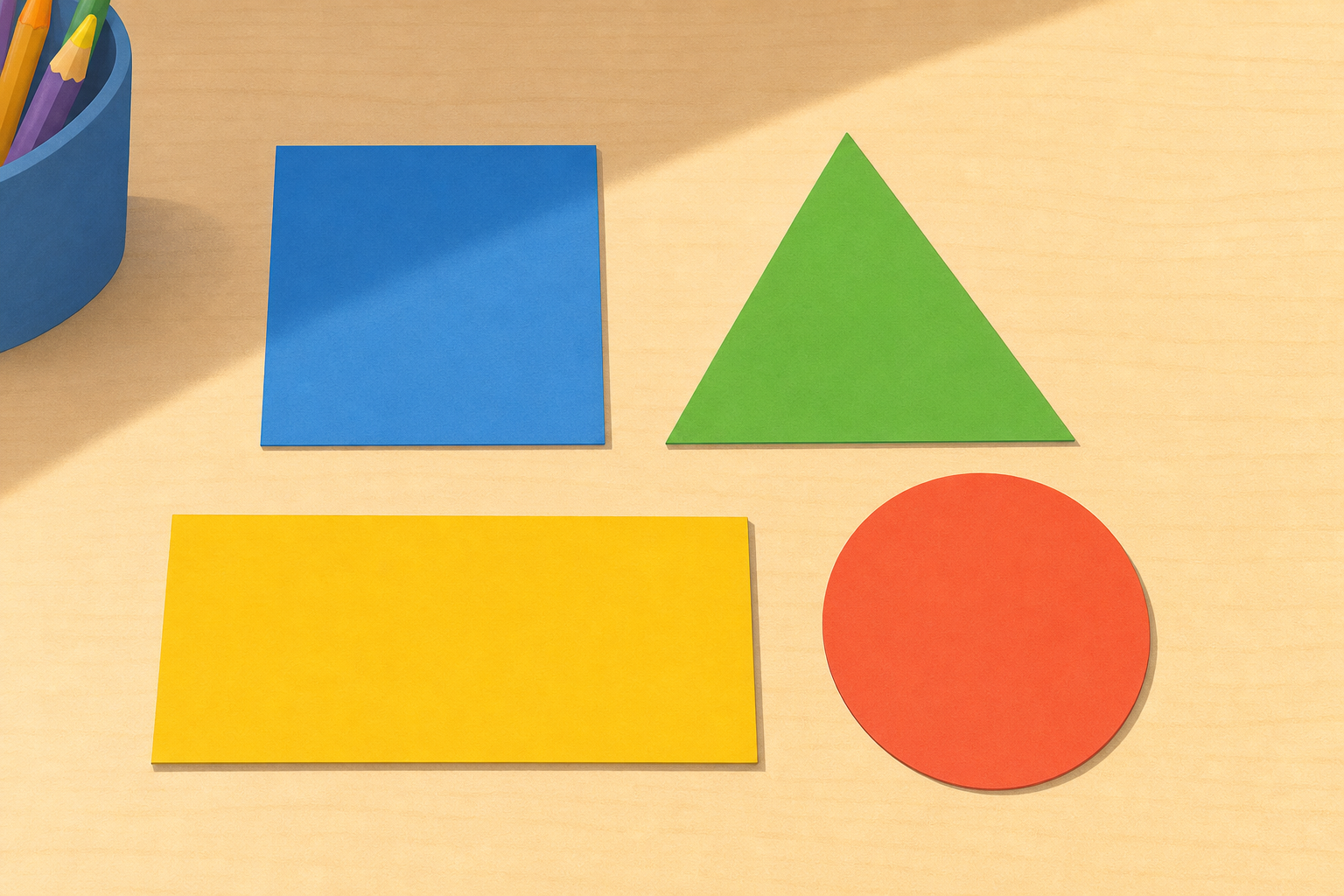
Look at these four shapes: a square, a triangle, a rectangle and a circle. One of them is different from all the others. Which one would you put on its own, and what is it about that shape that makes it the odd one out?
Display the four shapes and take three hands-up answers, not open call-outs. Most pupils will spot the circle (no straight sides, no corners); accept any reasoned answer and revoice it as 'so you are looking at the sides and corners to decide' — that sets up the whole lesson.
Watch as we go round each shape and count its sides and corners. Count along with me. What stays the same from one shape to the next, and what changes?
Triangle: tap the 3 sides, then the 3 corners; note the counts match.
Square: 4 sides all the same length, 4 corners.
Rectangle: also 4 sides and 4 corners; the difference is side length not number, two long and two short.
Circle: the key noticing is no straight sides and no corners, just one curved edge all the way round.
Pause after each and let the class say it back.
Let's try this together. I'll show a shape on the board, and one of you will come up to tap and count its sides and its corners, then tell us its name. The rest of us will check the count together.
This round is for talking it through together — a pupil taps at the board and the class agrees or corrects out loud.
Send a pupil to the board to tap each side (numbering them) and each corner on the shape shown, then name it. Have the class call the count back together, and revoice a strong answer so the room hears a classmate reason it out. Watch for pupils who count a corner as a side or skip the side they started on — prompt 'where did you begin? count that side once.' Between turns, hold up one of your paper shapes (triangle, square, a many-sided shape) for a couple more pupils so several get a turn, not just one.
In your maths copy, draw a triangle, a square and a rectangle. Beside each shape, write how many sides and how many corners it has, like this: triangle — 3 sides, 3 corners.
Walk the room glancing at the counts beside each shape. Catch any pupil writing different numbers for sides and corners on the same shape and ask them to check.
Now let's work through some questions together. The board will show one question at a time — read just the question you can see, and we'll check each answer before the next one appears.
These are the practice questions — a pupil answers at the board, the class confirms, then the board moves to the next question. Keep it brisk rather than over-explaining.
Run the four challenges in order. The third one is the thinking one: hold up a paper square and slowly turn it onto its corner while pupils watch, then ask 'did turning it change the number of sides?' The on-screen count confirms it is still four sides. The circle answer is zero straight sides — make sure pupils say zero, not 'one'.
How can counting the sides and corners help you name a shape you have never seen before?
Listen for pupils saying that the number of sides points to the shape family (3 sides → triangle, 4 sides → square or rectangle). Revoice a strong answer: 'so even a brand-new shape, you count its sides and that tells you which family it belongs to.' Head off the idea that a tilted shape changes its name — turning never changes the side count.
Next we will take the same shapes and sort them into groups by their properties — by how many sides they have, by whether they have corners, and by whether all their sides are the same length.
Recap the key noticing: name from parts, and turning a shape never changes its sides or corners. The Pupil Practice page reinforces counting sides and corners on a wider set of shapes.
You're previewing this lesson. Get full access to this lesson and hundreds more — each one ready to teach, with interactive activities, printable resources and pupil progress tracking built in.