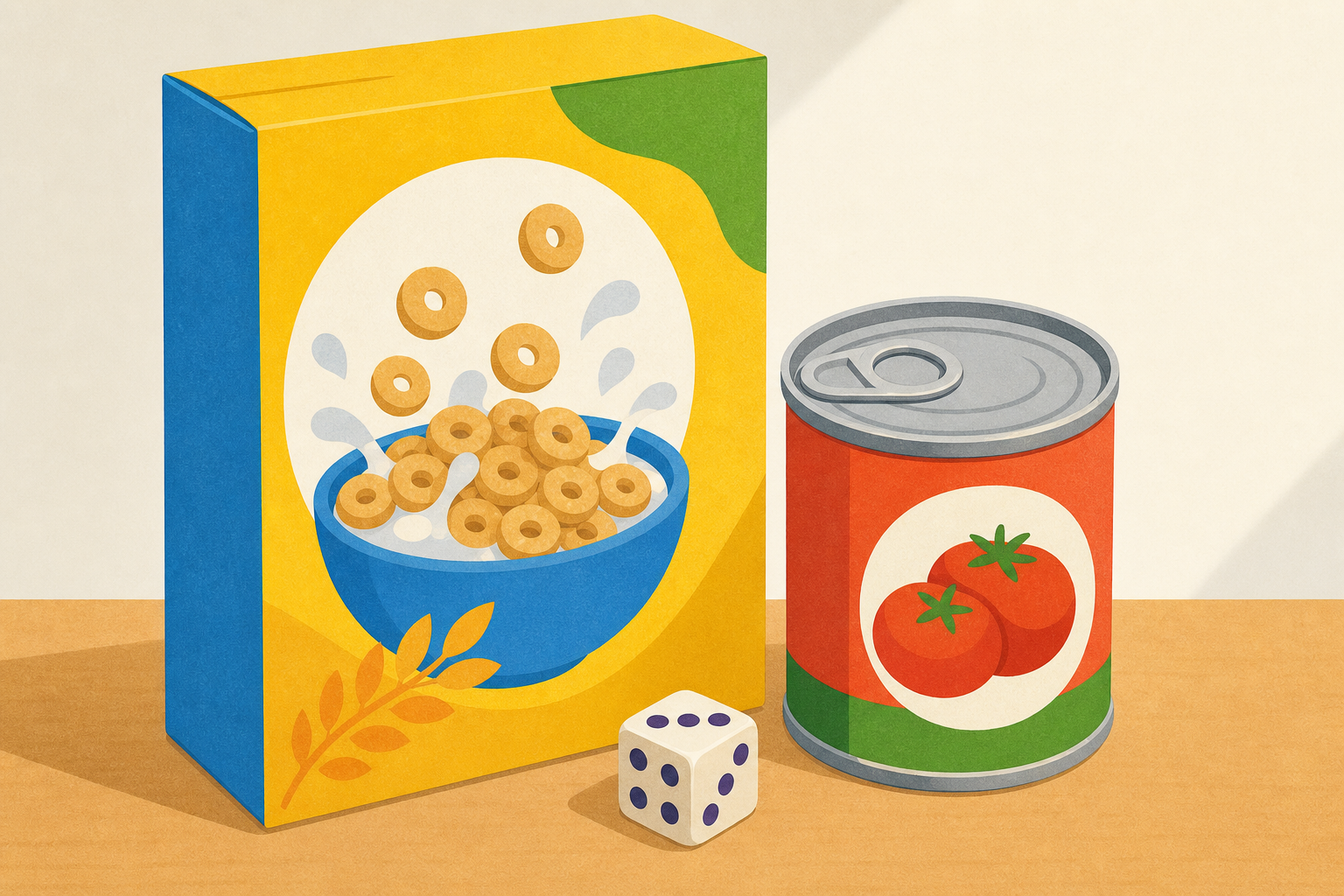
Look at these three everyday things: a cereal box, a tin of beans and a dice. Hands up: how many flat sides can you see on the box? Where do two flat sides meet to make a sharp line?
Take three hands-up answers, not open call-outs. Hold up a real box and run a finger along one edge, then touch one corner, to seed the words edge and corner before they are named on screen.
Watch four solids on the board. For each one, count its flat faces, count the straight edges where faces meet, and count the corners (vertices). Watch the last one carefully: the cylinder. Does it have any pointy corners?
Today we work through these solids together, tallying each one on the board: first the cube, then the cuboid, then the square-based pyramid, and finally the cylinder. For each shape we rotate it, tap each face to count them, then the edges, then the vertices, and say each total aloud before we check.
Talk this one through together — pupils take turns at the board and the class agrees or corrects out loud.
Rotate the shape before tallying so no face is hidden. Watch for pupils double-counting an edge or missing the back faces — slow the rotation and re-tap together. When the cylinder comes up, hold out for the class agreeing it has zero vertices.
In your maths copy, rule a small table with four columns: Shape, Faces, Edges, Vertices. Fill in one row for a cube and one row for a square-based pyramid, writing the number you counted in each column.
Walk the room glancing for tidy columns and the correct counts (cube 6/12/8, pyramid 5/8/5) — no marking, this is whole-class copybook practice, not assessment.
First we match a solid to a property description together. Property: exactly six faces. Check our counts for each solid and decide which ones match.
Then we answer property questions about the solids we counted, using the basket at the front and the shapes on screen. For each question, tap the number of chips to answer:
Worked match first (before chips): write exactly six faces on the board. Recheck counts aloud with the class: cube 6, cuboid 6, pyramid 5, cylinder 2. Circle cube and cuboid as the match; cross pyramid and cylinder. Slip to watch: pupils naming only the cube and forgetting the cuboid also has six.
Then the practice round, pupils take turns at the board, check each answer, class confirms. Keep board work brisk. Pass real solids from the basket while one pupil answers on screen; the rest hold and check. Cylinder-vertices is the make-or-break one; expect a wrong guess and revoice why a curved surface makes no corner.
Extension: fast finishers only, off the board: find two solids that share the same number of vertices but a different number of faces (e.g. a triangular prism and a pentagonal pyramid both have six vertices).
You're previewing this lesson. Get full access to this lesson and hundreds more — each one ready to teach, with interactive activities, printable resources and pupil progress tracking built in.