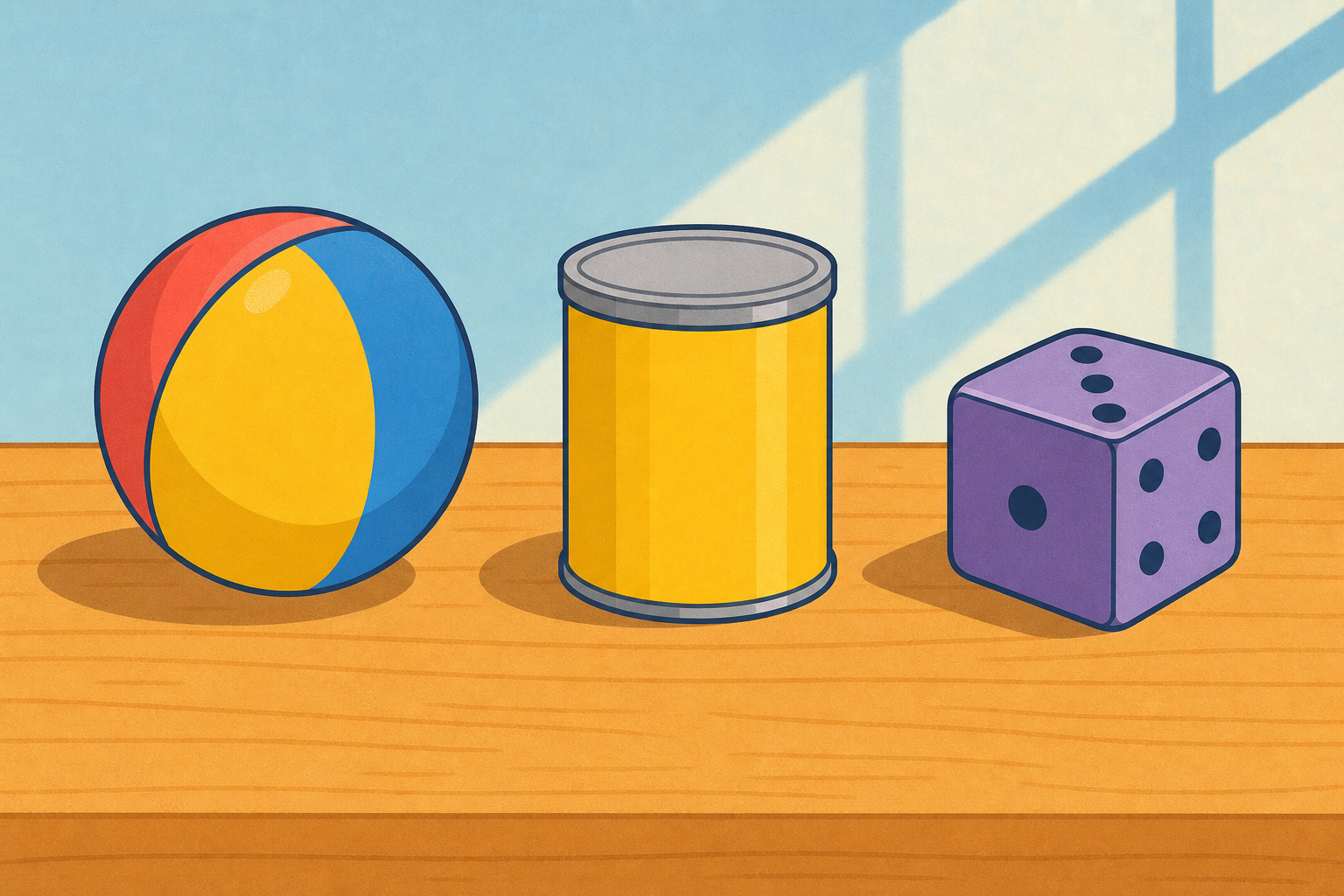
Here are three real objects: a ball, a tin and a dice.
If I gave each one a gentle push across the desk, which would roll away and which would just slide and stop? Have a good look before any hands go up.
Hold up (or show a photo of) a ball, a tin and a dice. Give five seconds of quiet think-time, then take three hands-up answers, not open call-outs.
Listen for the idea that the round parts do the rolling — you'll return to this at the end. Don't confirm or correct yet; let the wondering hang.
Watch five solids sorted into their names on the board. Look for the one thing that gives each solid away:
As each one lands in its name, think of something at home or in school that has the very same shape.
Point to each card as it settles and name one telling feature: a cube — every face is a flat square, like a dice; a cuboid — a box shape, like a cereal box; a sphere — fully round with no flat face at all, like a ball; a cylinder — a tin, flat round on top and bottom; a cone — an ice-cream cone that comes to a point.
Take one everyday example from the class per solid before moving on. Hold out for the sphere being the only fully round solid — that is the one that catches people out later.
In your maths copy, write the five shape names one under the other. Beside each name, write one everyday object that has that shape.
Walk the room glancing for correct spellings and sensible objects — this is whole-class copybook practice, not marking. If a pupil is stuck for a cone, nudge them toward an ice-cream cone or a party hat.
Today we sort these pictures together onto the board: a dice, a cereal box, a football, a tin of beans, an ice-cream cone, and then a kitchen-roll tube and a globe. We name each one, then decide which shape-name it belongs under.
Some are quick — a dice is clearly a cube. The tricky ones are near the end: is a kitchen-roll tube really a cylinder, and is a globe a sphere even though it has bumps drawn on it?
Talk this one through together — pupils take turns at the board and the class agrees or corrects out loud. For the quick items, use a turn-and-name: ask one pupil to name the solid and one telling feature before the drop, so more voices join in.
Work the pictures in the order they are named so the round-versus-flat idea builds. Ask which telling feature tells you its name? before each drop. When you reach the globe, hold out for the idea that a sphere is fully round even when it has a picture drawn on it.
Now sort real solids by what they DO, not just their name. On the board, sort the tray into two groups:
When we have the board sort right, we keep going with the real tray in our hands. Each rule is a little harder than the last: find only the solids with flat faces, then find the box shapes, and last of all find the one solid that is fully round with no flat face at all.
This is the practice round. Start on the board with the roll-or-slide sort the interactive supports: the class confirms each solid aloud before the next one drops. A curved-surface solid counts as rolls for this binary sort, so the cylinder and cone both go in Rolls.
Then move to the real tray in pupils' hands for the harder rules, which are called one at a time. Flat-faces-only pulls out the cube, cuboid, cylinder and cone. Box-shaped isolates the cuboid. The last rule leaves only the sphere. This is where the cylinder and cone earn a closer look: they roll, but they also have flat faces, so with the real tray they can sit in more than one group depending on the rule. Revoice: a cylinder rolls, and it also has flat ends, so it fits the flat-faces group too.
You're previewing this lesson. Get full access to this lesson and hundreds more — each one ready to teach, with interactive activities, printable resources and pupil progress tracking built in.