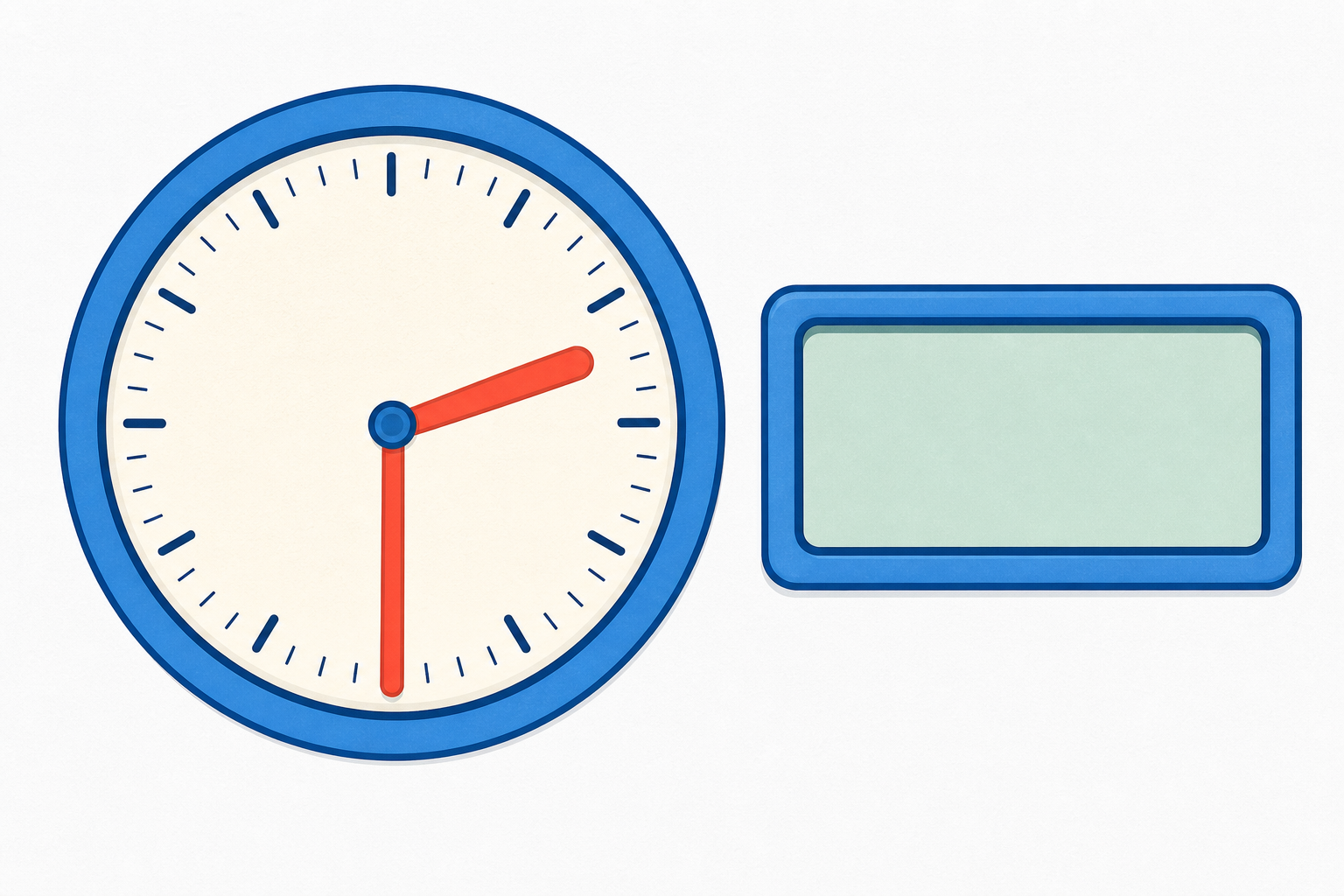
Look at the clock face showing half past 2 beside a blank digital screen. The hands tell us it is half past 2. So what numbers belong on the digital screen to say the very same time?
Display the analog clock at half past 2 beside an empty digital readout. Take two or three hands-up answers, not open call-outs. Don't confirm yet — let the Watch and Notice step reveal it.
Each clock shows the same time two ways: hands and a digital screen. Watch where the long hand sits and read what the digital screen says. Notice how the words we say link to the numbers.
Quarter past 3: long hand on the 3, a quarter round, screen 3:15.
Half past 6: long hand straight down, screen 6:30, thirty minutes up from 6.
For these two 'past' times the hour we say matches the hour on screen.
Ten to 8: hands say ten to 8 but screen reads 7:50 — the make-or-break idea. Have them predict the hour digit before you reveal it.
Say it: still inside the 7 o'clock hour, so a 'to' time keeps the earlier hour.
Twenty past 11: screen 11:20, twenty minutes up from 11.
Today we work through four times together. Each time I read out a digital time, one classmate comes up and sets the matching hands on the clock while the rest of us watch and check the two readings agree. We will do 3:15, then 6:30, then 7:50, then 11:20. Your job in your seat is to watch the hands and decide whether they match before we confirm.
This round is for talking it through together — one pupil sets the hands at the board and the class agrees or corrects out loud.
Read out the four digital times in order. A pupil drags the hands to match, the class checks the two readings agree, then reset the hands before the next time. Rotate four pupils, one per time. Watch for the 'to' times: when you read 7:50, listen for pupils saying it aloud as 'ten to 8' as they set the hands — that shows they have linked the two representations.
In your maths copy, make a two-column list. On the left write the analog time in words. On the right write the matching digital time. Write these four:
Read each pair aloud after you write it to check the two match.
Walk the room glancing at the 'to' times — the slip to catch is a pupil writing 8:50 or 8:10 for ten to 8 instead of 7:50. This is whole-class copybook practice, not marking.
The point of this round is the tricky 'to' times. We will set the hands to match 4:05, then 9:30, then the hard ones — 12:45 and 7:55. Say each one aloud before we check it, because the 'to' times catch people out.
These are the practice questions — rotate fresh pupils briskly, one per challenge, and the class confirms before moving on. 4:05 and 9:30 are quick warm-ups; spend the time on 12:45 and 7:55, which are the point of the round.
Use the 'why does a to time keep the earlier hour on the digital screen?' callout: 12:45 is still inside the 12 o'clock hour, and 7:55 is still inside the 7 o'clock hour. Use the ✓ to confirm each — 'yes, that's it.'
Why does 'quarter to 5' show as 4:45 and not 5:45 on a digital clock?
Listen for pupils explaining that the clock is still inside the 4 o'clock hour until it reaches 5:00 — the minutes are counting up toward 5, not from it. Revoice a strong answer: 'so the digital clock shows the hour we are still in, and the minutes count up to the next one.' Head off the common slip of reading the 'to' hour as the digital hour.
Next we will look at the calendar — days, weeks and months — and find any date we are looking for.
Close on the 'to' time idea, since it is the part that lasts. A quick thumbs-up check: read '4:50' and ask whether that is a 'to' time and what we would say (ten to 5).
You're previewing this lesson. Get full access to this lesson and hundreds more — each one ready to teach, with interactive activities, printable resources and pupil progress tracking built in.