Which birds visit our school grounds or local gardens, and what would help them feed well?
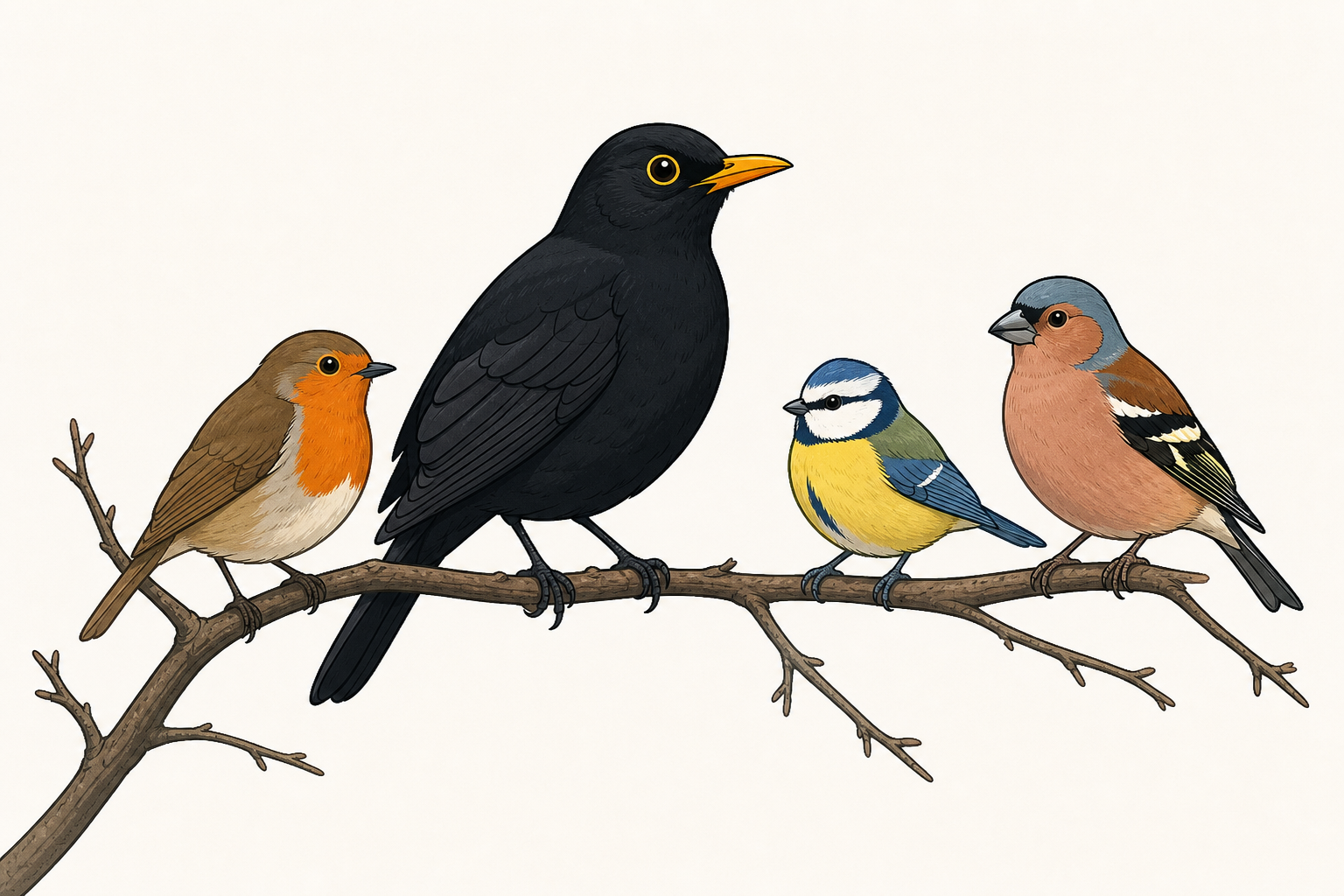
Meet four Irish garden birds: robin, blackbird, blue tit and chaffinch. What does each one need from a feeder?
Light hook only. Show the four bird names and short traits on the IWB (the board list matches the pupil description). You may also hold up the printed fact cards for richer detail. Do not hand out materials or start sketching yet.
Traits below are framed as common garden observations for class discussion (see BirdWatch Ireland garden-bird guidance for wider Irish context). Soften any “must” language if pupils treat the cards as hard rules.
Card A — Robin: A small orange-breasted bird common in Irish gardens and hedgerows. Eats insects, worms and some seed; often feeds low or on the ground. May use a low, steady perch on a platform-style feeder more readily than a high hanging bottle.
Card B — Blackbird: A larger garden bird; males are black with a yellow beak. Often feeds on the ground but will use a sturdy platform feeder. Needs space and a strong perch that will not tip. If a group chooses the blackbird as its main user, steer toward platform designs rather than thin hanging bottles.
Card C — Blue tit: A tiny blue-and-yellow bird often seen hanging and flitting on feeders. Frequently uses hanging feeders and thin perches. Dry seed is easier for small birds to take than wet, clumped seed.
Card D — Chaffinch: A common Irish finch with a short, strong beak suited to cracking seeds. Often seen on hanging or tray feeders. Benefits from a clear perch and seed that has not been soaked by rain.
Key questions: Which of these might visit our grounds? What would go wrong if the seed got wet? Why might a tiny blue tit need a different perch from a blackbird?
Nature of STEM: Real engineers start with the user, not the materials. Today the users are Irish garden birds.
Engineers start with the user need: what the user (here, the birds) really needs the feeder to do.
What three things must our feeder do for small Irish garden birds?
We will pin those three needs on the board and keep them up while we imagine and plan.
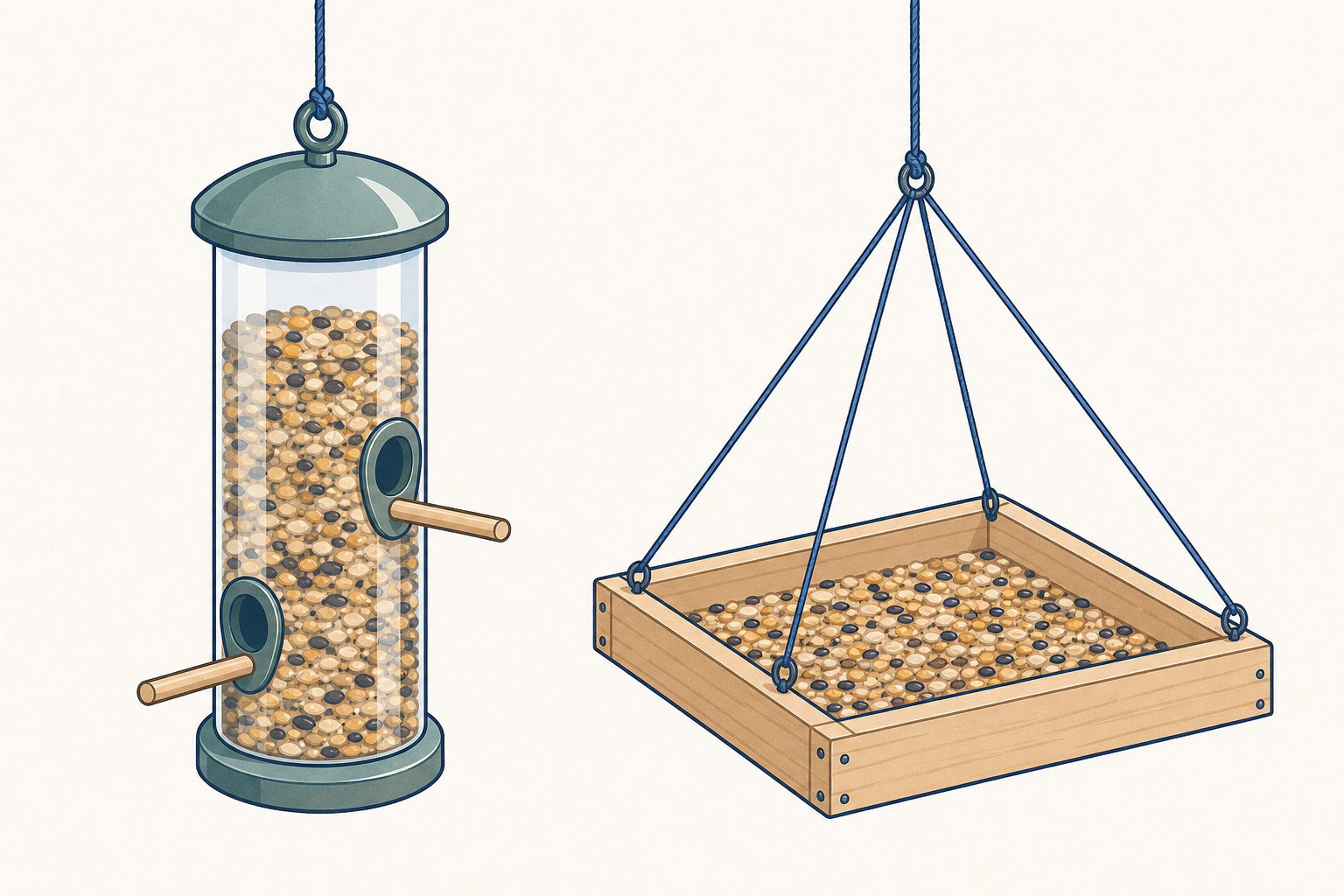
Do not dump a glossary. Open with user need only, then ask the board question. Draw out the class answer: the feeder must hold seed, keep seed dry, and give small birds a stable perch. Write those three user needs on the IWB and leave them up for the rest of the lesson.
Hold back the labels design brief and success criteria until pupils need them: the challenge wording appears with the Design Brief and Plan page in the Plan step; the fair checks are locked together in the Agree how we will test step. Mention brainstorm only as the next step’s job: lots of ideas first, no judging yet (a doing word, not a term to define).
| Concept | Why it matters | Example |
|---|---|---|
| User need — what the user (here, the birds) really needs the feeder to do | If we skip the user, we build something clever that does not help the birds | Blue tits need dry seed and a thin, steady perch they can grip |
| Design plan — a labelled sketch of the idea, parts and materials before building starts | A clear plan saves wasted materials and arguments mid-build next lesson | A bottle feeder sketch with string, perch stick and seed hole labelled |
| Success criteria — the clear checks we will use later to judge whether the design works | Without agreed checks, every group will argue about what “good” means in the test | Holds seed; seed stays dry under a light shower; perch does not tip |
Teacher only (do not project yet): everyday talk for the page header is “the challenge” (who it is for, what it must do, any limits). You will name success criteria when the class turns the three needs into fair checks later.
Modelled thinking (say aloud, do not project as a finished answer): “I wonder what a blue tit needs. I think the biggest problem is wet seed. So any design I pick must keep rain off the seed and still let a tiny bird perch. That is my user need before I draw anything.”
Misconception to head off: pupils may jump straight to “a fancy shape” or “as big as possible”. Bring them back to the three user needs on the board. Pretty is not the test; useful for the birds is.
First we share feeder ideas as a whole class. Call out ideas for the board. No idea is silly yet. Think about hanging designs, tray designs, or anything that could hold seed, stay dry, and give a small bird a stable perch.
Next, in your groups, shortlist the ideas you like best.
Then each group names the one idea it will take to the Design Brief and Plan page.
Whole-class brainstorm first (about 4 minutes), then 3 minutes in groups to shortlist, then 3 minutes for each group to name the one idea they will take to the Design Brief and Plan page.
Capture ideas on the IWB as a simple list. Welcome variety: hanging plastic bottle, milk-carton hopper, tray on a post, upside-down pot with a perch stick, recycled tub with a roof flap.
Prompts if the room goes quiet:
Choice that makes this child-led: the class shares many ideas; each group chooses its own design to take forward. Do not assign designs. Two groups may pick the same type; that is fine and will make later testing interesting.
Look-fors: ideas linked back to hold seed / keep dry / stable perch; groups able to name one idea in a sentence; no building yet.
Differentiation: if a group is stuck, offer two starter stems on a sticky note: “A hanging bottle with…” or “A tray with a roof that…”. Confident groups can add one extra feature (squirrel baffle, drainage hole) once they have a core idea.
Here is your Design Brief and Plan page. The brief is the challenge at the top; under it you sketch and label your group’s feeder.
Your group has one feeder idea. Sketch it large enough to label.
Label the parts, list the materials you will need next lesson, and show how seed stays dry and where a small bird can perch.
One page per pupil (or one shared page per group if you prefer a single group plan; either works). Pupils record on paper only. Tell the class clearly: “The brief at the top is our challenge; the plan is your labelled sketch underneath.” Point at the three user needs still on the board: that is the challenge in short. Do not lock success criteria yet — that is the next whole-class step.
On the IWB or a large sheet, think aloud a simple hanging-bottle design. Do not give them a finished perfect plan to copy; show the habits:
Then send groups to their own chosen design. Circulate. Ask: “Point to where the seed stays dry. Point to the perch. What will you build first next lesson?”
Clean plastic bottles, string or garden twine, lollipop or garden sticks, card or bottle lids for roofs/trays, scissors (adult help for hard cuts), bird seed for testing later. Groups only plan today; they do not cut or build.
What good looks like: a clear sketch; at least four labels; a short materials list; the three user needs visible somewhere on the plan (seed store, rain protection, stable perch).
If a group finishes early: add a drainage idea, a way to refill seed, or a second small view from the side. Not an on-device task.
Common pitfall: beautiful shading with no labels. Stop the class once and say: “Engineers label. If a stranger cannot build from your page, the plan is not finished.”
IWB note: if the design-challenge interactive is open, show only the challenge, constraints, materials and sketch prompts. Keep any success-criteria list off the board until after the class agrees the checks in the next step.
We already know the three user needs. Now we turn them into fair test checks that every group will use later.
Look at the board side by side:
For example: “keep seed dry” becomes “after a light watering-can shower, the seed is not soaked.” “Stable perch” becomes “a gentle finger press on the perch does not tip the feeder wildly.”
Agree the three checks as a class, then copy that locked wording onto your Design Brief and Plan page so you know what “good” means before you build.
Return to whole class. The three checks must not already be on the pupil screen from the Plan step. Let pupils propose, then lock three clear, testable checks that match the user needs already on the board. Stress the shift on the IWB: user needs say what the birds need; success criteria say how we will fairly check every feeder later (same wording, same test).
Before pupils copy: circulate for about 30 seconds. “Point to each check on your sketch. If a check is missing from the plan, add it now — still no building.” Then pupils write the three locked checks onto their Design Brief and Plan page in their own words. That locks the test for later parts of this project.
Science-talk prompts: Why must every group use the same checks? What would make a test of “keeps seed dry” unfair? (different amounts of water, different pouring heights).
Misconception: “Prettiest feeder wins.” Revoice: engineers judge against the user need and the agreed checks, not decoration. Keep “safe feeding” (cats, height) for a separate chat if it comes up; it is not one of our three checks.
Display-only: no typing into the platform; writing is on the paper Design Brief and Plan page only.
You're previewing this lesson. Get full access to this lesson and hundreds more — each one ready to teach, with interactive activities, printable resources and pupil progress tracking built in.