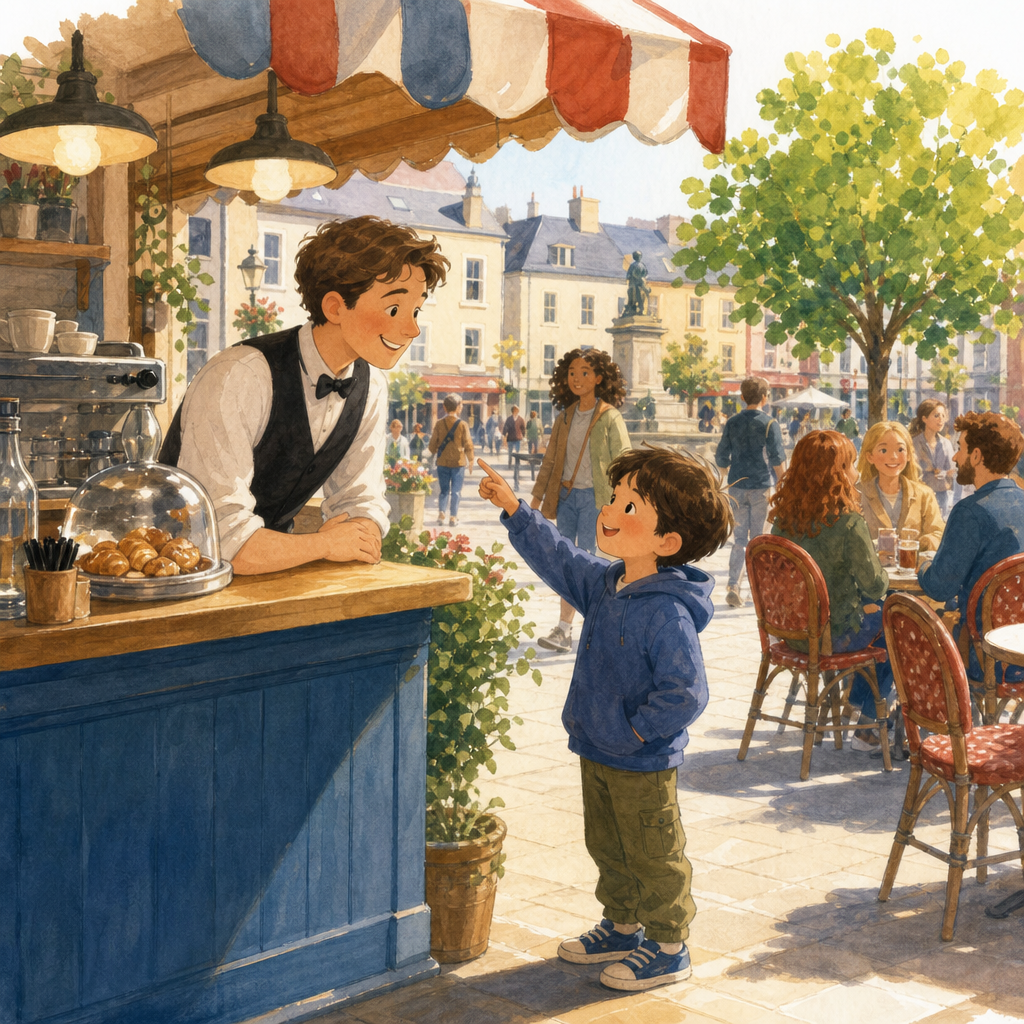
 Two years of French, and today you walk into a café and handle it yourselves.
Picture a sunny terrace café in a French town square. On the counter sits a small chalkboard menu of drinks with prices in euros, glasses stacked ready, and a waiter waiting to take your order.
Today's board menu (carte des boissons):
- L'eau (carafe): free if you ask
- Le jus d'orange: 3 €
- Le jus de pomme: 3 €
- Le lait: 2 €
- Le café: 2 €
- Le thé: 2 €
- Le chocolat chaud: 3 €
- La limonade: 3 €
You can already greet someone, ask for something, say thank you, and say goodbye. Today you put all four moves together in one short café exchange, and you learn eight drinks from that menu. By the end you will stand up and run the full chat with a partner.
By the end of this lesson, you will be able to:
- Open and close a café chat in French
- Order a drink politely from the menu
- Thank the waiter and take your leave
- Say honestly what you could manage if you landed in France tomorrow
We are at the café counter, reading today's chalkboard menu.
Watch and listen first, because the whole point is that you hear each drink before you try to say it, so there is no guessing here.
For every card you will see the English word and the picture, then hear the French drink with its article, then repeat it together as a class, and only then flip the card to confirm how the French is spelled.
We meet the drinks in two groups of four.
After the first group, you and the class will lock in this order line together, listening to it first and then saying it:
Je voudrais…, s'il vous plaît. (zhuh voo-DREH…, seel voo PLEH)
Full model on the board:
Je voudrais un chocolat chaud, s'il vous plaît.
Then you meet the second group, and after each new drink a volunteer slots it into the same order line using the café form on the board (un / une / de l').
Whole class on the board. Volunteers click each French drink, then its English meaning. When a pair is found, say the French together, then one volunteer slots that drink into a full café order:
Je voudrais un / une / de l'…, s'il vous plaît.
Examples: Je voudrais une limonade, s'il vous plaît. · Je voudrais de l'eau, s'il vous plaît.
You have just performed the café exchange out loud. Now open your copy and write it down.
Copy this café exchange and swap in any drink from today's menu on the order line. Mind every accent.
Model on the board (copy the frame):
Bonjour !
Je voudrais un jus d'orange, s'il vous plaît.
Merci.
Au revoir.
Keep the greeting, thanks and goodbye exactly as shown. Only the drink in the order line is yours to choose (use the correct un / une / de l' form, e.g. de l'eau, une limonade, un café).
- l'eau — Water
- le jus d'orange — Orange juice
- le lait — Milk
- le café — Coffee
- le thé — Tea
- le chocolat chaud — Hot chocolate
- la limonade — Lemonade
- le jus de pomme — Apple juice
You will each get a printed bingo card for your desk. If there is no card for you, copy six of the eight drinks from the board menu into your copy and tick them as you hear each one.
Listen for each French drink called out, and if it is on your card or your list, mark it. The first person with every drink ticked stands up and orders that last drink aloud: Je voudrais…, s'il vous plaît. (use un, une or de l'eau as needed).
We play one quick round only (two only if time is left).
Unlock the full learning experience
You're previewing this lesson. Get full access to this lesson and hundreds more — each one ready to teach, with interactive activities, printable resources and pupil progress tracking built in.
This lesson is copyright of Coding Ireland 2017 - 2026. Unauthorised use, copying or distribution is not allowed.